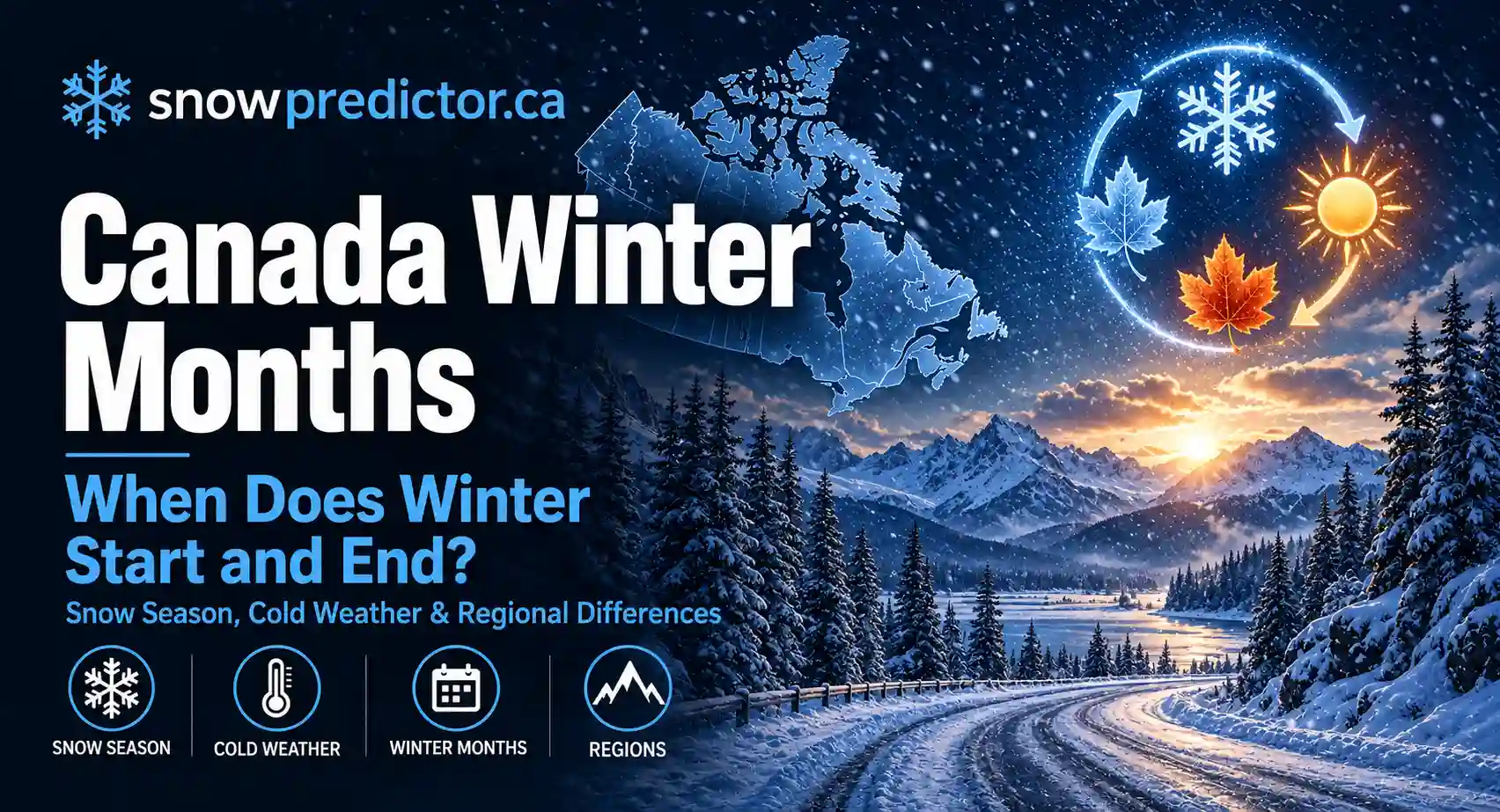
Canada Winter Months: When Does Winter Start and End?
The Canada winter months depend on what you mean by “winter.”
Astronomically, winter in Canada begins at the December solstice, usually around December 21, and ends at the March equinox, usually around March 20. For weather and everyday life, however, winter conditions often begin earlier and last longer.
Across much of populated Canada, cold, snow and ice can affect daily life from November through March or April. Northern Canada and mountain regions can experience winter-like conditions for much longer, while Vancouver and Victoria have much milder winters where rain is often more common than snow. The Government of Canada notes that snow generally covers the ground from around December through March or April across most places, with southwest British Columbia being a major exception.
So the simplest answer is:
| Meaning of Winter | Typical Period in Canada |
|---|---|
| Meteorological winter | December 1 to February 28 or 29 |
| Astronomical winter | Around December 21 to March 20 |
| Practical winter weather | Often November to March or April |
| Northern and mountain winter | Can begin in October or earlier and continue well into spring |
| Vancouver-area winter | December to February is coolest, but rain is often more common than lasting snow |
What Are the Winter Months in Canada?
The three core Canadian winter months are December, January and February.
These are the months most closely associated with persistent cold, snow cover, freezing conditions and winter storms across much of the country.
But Canadian weather does not follow the calendar perfectly.
November can already feel fully winter-like in Alberta, Manitoba, Saskatchewan, northern Ontario, Quebec and northern Canada. March can still produce major snowstorms, extreme cold and school transportation disruptions. April snow is also normal in many areas.
This is why some Canadian guides describe the practical winter season as November through March or early April rather than limiting winter to December, January and February. UNHCR Canada, for example, describes Canadian winter as generally lasting from November to March, while Western University notes that snow can arrive as early as October and continue until April.
When Does Winter Start in Canada?
There are two useful answers.
Official Astronomical Start of Winter
Canada’s astronomical winter begins at the winter solstice, when the Sun reaches its southernmost position in the sky for the Northern Hemisphere.
The National Research Council Canada defines the start of winter by the December solstice.
When Winter Weather Actually Starts
Weather-wise, winter can arrive weeks earlier.
November commonly brings freezing temperatures and snow to large parts of the Prairies, Ontario, Quebec and northern Canada. Some colder regions begin experiencing winter conditions during October.
That means a Canadian family may already be clearing snow, wearing winter boots and dealing with icy roads long before the official December solstice.
The practical answer to when does winter start in Canada is therefore usually November for much of the country, although timing varies greatly by location.
When Does Winter End in Canada?
Astronomical winter ends at the March equinox.
For the 2026–27 Canadian winter, spring officially begins on March 20, 2027.
Weather does not necessarily switch to spring on that date.
Snow and freezing temperatures can continue through March and April across Ontario, Quebec, Atlantic Canada, the Prairies and Alberta. Mountain and northern regions can remain wintry much later.
The Government of Canada describes snow cover as generally lasting until March or April in most locations.
So if someone asks when does winter end in Canada, there are again two answers:
Officially: around March 20.
Practically: often sometime in March or April, and later in colder regions.
Canada Winter Months 2026–27
For people searching Canada winter months 2026, the key dates are straightforward.
| Winter 2026–27 Milestone | Date |
|---|---|
| Meteorological winter begins | December 1, 2026 |
| Astronomical winter begins | December 21, 2026 |
| January | Core winter month |
| February | Core winter month |
| Meteorological winter ends | February 28, 2027 |
| Astronomical winter ends | March 20, 2027 |
| Late winter weather | Can continue through March or April depending on location |
The December 21 and March 20 astronomical dates come from the solstice and equinox calculations published by the National Research Council Canada.
These dates define the season, not the exact arrival or disappearance of snow.
Canada Winter Months Month by Month
November: Winter Begins Early in Many Regions
November is technically a fall month, but it often behaves like winter.
Snow and freezing temperatures become increasingly common across inland and northern Canada. Winter tires, icy roads, freezing rain and early-season storms can already become part of daily life.
On the Pacific coast, November is generally milder and wetter.
December: Winter Becomes Established
December marks the beginning of meteorological winter, while astronomical winter begins around December 21.
By this point, winter conditions are established across much of Canada.
Snow cover becomes more common, days are short and temperatures are frequently below freezing across inland regions.
January: The Heart of Canadian Winter
January is generally one of Canada’s coldest months.
Environment and Climate Change Canada’s 1991–2020 normals illustrate just how different January can be across the country. Vancouver International averages about 4.1°C, Toronto City about -3.5°C, Calgary Airport -7.6°C, Montréal Trudeau -9.2°C, Winnipeg Airport -16.3°C, and Yellowknife Airport -25.5°C.
January is therefore a very different experience depending on whether someone is spending winter in Vancouver, Toronto, Winnipeg or northern Canada.
February: Still Full Winter
February remains a core Canadian winter month.
Snow cover, ice and prolonged below-freezing temperatures remain common across much of inland Canada. Days begin getting noticeably longer, but that does not mean severe winter weather is finished.
Western University identifies January and February as the coldest part of winter in London, Ontario, with cold conditions made more severe by wind chill.
March: Winter Meets Spring
Astronomical winter ends around March 20, but March can still feel very wintry.
Ontario, Quebec, the Prairies and Atlantic Canada can receive significant snowfall during the month. Warm spells may alternate with freezing temperatures.
March is therefore better viewed as a transition month than as a guaranteed end to winter.
April: Spring on the Calendar, Winter in the Forecast
April is a spring month, but snow remains possible across much of Canada.
Western University notes that snow in southern Ontario can continue through April.
Alberta, mountain regions and northern Canada can experience significant snow even later.
How Cold Is Canada in Winter?
There is no meaningful single “Canada winter temperature.”
The country spans thousands of kilometres and includes Pacific coast, Prairie, Great Lakes, Atlantic, mountain and Arctic climates.
The January averages below show the range using Environment and Climate Change Canada’s 1991–2020 Climate Normals:
| Location | January Average °C | Approx. °F |
|---|---|---|
| Vancouver | 4.1°C | 39.4°F |
| Toronto | -3.5°C | 25.7°F |
| Halifax | -5.7°C | 21.7°F |
| Calgary | -7.6°C | 18.3°F |
| Montréal | -9.2°C | 15.4°F |
| Winnipeg | -16.3°C | 2.7°F |
| Yellowknife | -25.5°C | -13.9°F |
These are monthly averages rather than the coldest temperatures a location can experience.
This also answers the common question how cold is Canada in winter in Fahrenheit: depending on location, normal winter averages can range from above 32°F on the Pacific coast to well below 0°F in northern Canada.
Why Canada’s Winter Is So Different From One Region to Another
Canada’s size is the main reason one definition cannot describe winter everywhere.
The west coast receives strong Pacific Ocean influence. Vancouver’s January daily average is above freezing, at about 4.1°C, while rain is more common than snow during much of the winter.
The Prairies have a continental climate with colder winters and larger temperature swings.
Ontario and Quebec experience cold continental winters but also receive major influence from the Great Lakes and changing storm tracks.
Atlantic Canada is moderated somewhat by the ocean but can experience snow, freezing rain, strong winds and powerful coastal storms.
Northern Canada experiences much longer and colder winters. Yellowknife’s January average of -25.5°C demonstrates how different northern winter is from southern British Columbia or Ontario.
Ontario Canada Winter Months
For most of Ontario, practical winter conditions run from roughly November through March or April.
Southern Ontario normally experiences its coldest conditions from December through February. March is a transition month, while April can still bring late snow or freezing temperatures.
Northern Ontario usually enters winter sooner and leaves it later.
This means Ontario Canada winter months cannot be defined only by Toronto. A storm may bring mild rain to southwestern Ontario while northern or snowbelt communities remain firmly in winter.
For current Ontario school-weather conditions, the Ontario Snow Day Predictor provides location-specific context rather than treating the whole province as one weather zone. Snow Predictor
How Long Is Winter in Ontario?
Official astronomical winter lasts about three months, from around December 21 to March 20.
In practical weather terms, Ontario winter often feels closer to four or five months, because cold, ice or snow can begin during November and continue into March or April.
Northern Ontario can have an even longer winter season.
The distinction matters because “how long is winter in Ontario” and “what are the official winter months?” are not quite the same question.
Winter in Canada: Toronto
Toronto has a milder winter than many Prairie, northern Ontario and Quebec locations, but it still experiences regular snow, freezing temperatures, ice and winter storms.
Environment and Climate Change Canada’s Toronto City normals show average daily temperatures of about:
- December: -0.1°C
- January: -3.5°C
- February: -2.7°C
- March: 1.7°C
This shows why March can switch rapidly between winter and spring conditions.
Families concerned with a specific storm rather than the seasonal calendar can use the Toronto Snow Day Predictor for local school-disruption context. Snow Predictor
Is Canada Cold All Winter?
No.
Even cold Canadian cities experience warm spells, thaws and large temperature changes.
Calgary is well known for rapid winter temperature changes, while southern Ontario can move above freezing during winter storms. Vancouver frequently remains above freezing even during January.
A Canadian winter should therefore not be imagined as several uninterrupted months of extreme cold.
Conditions can shift between snow, rain, freezing rain, ice, mild weather and severe cold.
Is Winter the Same as Snow Season in Canada?
No. This is an important distinction for SEO and for readers.
Winter is a season.
Snow season describes the part of the year when snow can reasonably occur.
Snow can fall before astronomical winter begins and after it ends. Western University, for example, states that although winter officially begins in December, snow around London, Ontario can arrive as early as October and continue until April.
That means an October snowfall does not make October an official winter month.
Likewise, an April snowstorm does not make April part of astronomical winter.
What Are the Fall and Summer Months in Canada?
Using the common meteorological grouping:
| Season | Months |
|---|---|
| Spring | March, April, May |
| Summer | June, July, August |
| Fall | September, October, November |
| Winter | December, January, February |
Astronomical seasons start around the equinoxes and solstices instead, so their exact start dates fall later within March, June, September and December. Canada’s National Research Council defines these seasons using Earth’s position relative to the Sun.
This explains why November is officially fall under the calendar system even though it may already look and feel like winter in many Canadian communities.
What Winter Means for Canadian Families
The practical winter season matters more than a calendar date when families are deciding how to travel, dress or prepare for school.
Snow, ice, freezing rain, wind chill and poor visibility can begin before December and persist after March.
When winter weather is approaching, seasonal averages cannot tell a family whether school transportation will operate tomorrow. The Canada Snow Day Predictor is designed for that shorter-term question, while the winter calendar explains the broader seasonal pattern. Snow Predictor
What Are the Winter Months in Canada?
The core Canadian winter months are December, January and February. Practical winter conditions commonly extend from November through March or April, depending on location.
When Does Winter Start in Canada?
When Does Winter End in Canada?
Astronomical winter ends around March 20 at the spring equinox. Snow and freezing weather can continue through March or April, and even later in northern or mountain areas.
When Does Winter Start in Canada in 2026?
Astronomical winter begins on December 21, 2026.
When Does Winter End in Canada in 2027?
How Long Is Winter in Canada?
Official winter lasts about three months. In practical weather terms, many Canadian communities experience winter-like conditions for four to five months, while northern and mountain regions can remain wintry considerably longer.