Storm Day Predictor Atlantic Canada: School Closure Guide
Atlantic Canadian families rarely face a simple snowfall question. A winter system can bring heavy snow to one community, freezing rain to another, damaging winds near the coast, and rain followed by a flash freeze inland. The same storm may close selected schools, delay buses, cancel classes, or shut down an entire system.
That is why a storm day predictor Atlantic Canada tool must consider more than centimetres of snow. It should help families assess overall disruption risk while making clear that only the responsible school authority confirms the outcome. This guide explains what “storm day” means, how Nova Scotia, New Brunswick, Prince Edward Island, and Newfoundland and Labrador handle weather decisions, and which morning notices parents must check.
Quick Answer: What Is an Atlantic Canada Storm Day?
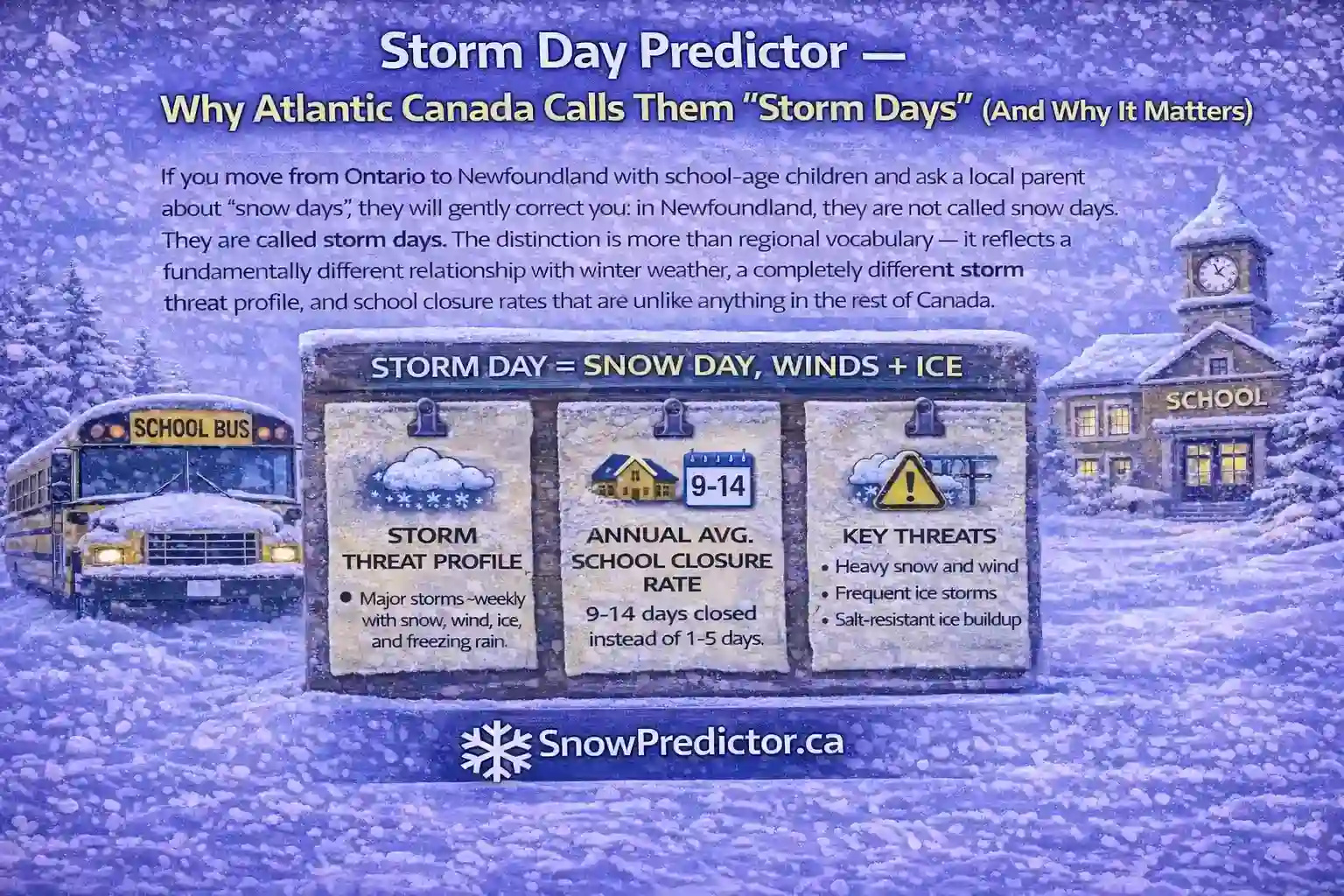
“Storm day” is a regional term for a school day disrupted by severe weather. The cause may be snow, freezing rain, wind, poor visibility, coastal conditions, flooding, unsafe roads, or a combination of hazards. It is not one legally standardized category across all four Atlantic provinces.
| Province | Official Operational Examples | Typical Announcement Source |
|---|---|---|
| Nova Scotia | Two-hour delay, buses cancelled with schools open, selected closures, or all schools closed | Regional centre or CSAP website and direct alerts |
| New Brunswick | Schools open, one-hour bus delay, zone closure, full district closure, or early dismissal | Anglophone or Francophone school district |
| Prince Edward Island | Classes cancelled, individual or family-of-schools closure, or system-wide shutdown | Public Schools Branch or CSLF |
| Newfoundland and Labrador | Closed, delayed opening, early dismissal, or another school-specific status | NLSchools Status Central and school communications |
Related searches include storm day prediction Canada, school bus cancellations Atlantic Canada, weather-related school closures, and snow day predictor Atlantic Canada. Official notices decide operations.
Storm Day vs Snow Day: Is There a Difference?
A snow day implies that snow is the main hazard. Atlantic Canada winter storms frequently involve mixed precipitation, rapid temperature changes, strong wind, coastal exposure, and power disruption. “Storm day” therefore describes the full event more accurately in everyday conversation.
However, terminology varies by community and authority. Official pages may use:
- school cancellation
- storm closure
- inclement weather
- weather-related closure
- delayed opening
- classes cancelled
- system-wide shutdown
- school status report
Do not assume that every use of “storm day” means all buildings are closed. The operational wording in the official announcement matters more than the regional nickname.
Why Atlantic Storms Are Difficult to Predict
Atlantic storms can change track, intensity, precipitation type, and timing before reaching the region. A shift of only a limited distance can move a community from heavy snow into ice pellets, freezing rain, or rain. Coastal and inland conditions may also differ sharply.
A useful storm day forecast considers:
- snowfall before and during the morning commute
- freezing rain and ice accumulation
- wind gusts and blowing snow
- visibility on exposed roads
- temperature changes and flash-freeze risk
- coastal flooding and infrastructure impacts
- road conditions across transportation zones
- whether conditions will worsen before dismissal
This is why a city-level snowfall total cannot determine Atlantic Canada school closures on its own.
Nova Scotia Storm-Day Procedures
Nova Scotia does not use one province-wide school decision. Regional centres for education and the Conseil scolaire acadien provincial communicate their own operational status.
Halifax Regional Centre for Education
Halifax Regional Centre for Education describes a structured early-morning review. By about 5:30 a.m., staff make recommendations to the Regional Executive Director of Education. A decision is then communicated at approximately 6:00 a.m.
Possible outcomes include:
- all schools open normally
- a two-hour delayed school opening and delayed bus pickup
- schools open while some or all buses do not operate
- selected schools or families of schools closed
- all schools closed
This range matters. A Nova Scotia storm day can be a delay or transportation disruption rather than a complete closure.
Why Local Geography Matters
HRCE covers urban, suburban, rural, inland, and coastal communities. Weather can differ across that territory, making family-of-schools decisions more practical than one automatic result. Cape Breton, the Annapolis Valley, the South Shore, and northern Nova Scotia also face their own terrain and storm exposure.
For storm day predictor Atlantic Canada planning in Nova Scotia, identify the regional centre and family of schools before interpreting the probability.
New Brunswick School Closure Procedures
New Brunswick uses Anglophone and Francophone school districts, and weather outcomes can be organized by zone. A storm does not have to close every school in a district.
Anglophone School District West lists several possible responses:
- schools open as usual
- all schools closed
- one or more weather zones closed
- all school buses delayed by one hour
- early school closure if conditions deteriorate
During a one-hour bus delay, schools can open at the usual time for walkers and students dropped off by families. Students arriving on delayed transportation are not disadvantaged under the published procedure.
What Parents Should Verify
- district name
- school weather zone
- transportation delay or cancellation
- building status
- early-dismissal arrangements
- current emergency contacts
New Brunswick school closures can differ between neighbouring zones, so a forecast for Fredericton or Saint John cannot confirm every rural route nearby.
Prince Edward Island Storm Closures
Prince Edward Island’s Public Schools Branch states that every effort is made to announce weather-related cancellations by 6:30 a.m. through its website and local radio.
The wording distinguishes important outcomes:
- “All classes in the Public Schools Branch are cancelled” means students do not attend classes.
- “System-wide shutdown” means schools and offices are closed.
- An individual school or family of schools may close without a province-wide result.
Those differences affect staff, buildings, services, and family plans. PEI storm closures should therefore be read from the full notice, not summarized as “Island snow day.”
Schools can also close partway through the day. Families should maintain current contact information and arrange care for children who may arrive home earlier than expected.
Newfoundland and Labrador Storm-Day Procedures
NLSchools provides a central School Status Report showing schools that are closed, delayed, dismissed early, or operating under another status. This is more useful than assuming one decision covers the entire province.
The published weather protocol states that closure or delay decisions are generally announced between 6:30 and 7:00 a.m. Information is shared through Status Central, local media, school communication systems, and social channels.
Possible School-Level Outcomes
- closed for the full day
- delayed opening
- closed for the morning with a later update
- early dismissal
- open with another operational notice
A Newfoundland storm day may apply to St. John’s Metro while schools elsewhere operate normally. Labrador communities can face different conditions and timing from the island. The correct status comes from the individual school listing.
For a storm day predictor Atlantic Canada result in Newfoundland and Labrador, the location must be precise enough to distinguish local school conditions.
Comparison of Official Morning Procedures
| Authority | Published Decision Timing | Geographic Flexibility | Key Distinction |
|---|---|---|---|
| HRCE, Nova Scotia | Announcement at about 6:00 a.m. | Selected schools or families | Delay, bus cancellation, and closure are different |
| ASD-W, New Brunswick | Before the school day | Weather zones | One-hour bus delay can leave schools open |
| PEI Public Schools Branch | Every effort by 6:30 a.m. | Individual schools or families | Classes cancelled differs from system shutdown |
| NLSchools | Generally 6:30 to 7:00 a.m. | Individual school status | Delay, morning closure, and full-day closure may differ |
These procedures can change. Confirm the current policy each winter rather than relying on an old screenshot or saved social post.
Which Weather Factors Matter Most?
Heavy Snow and Snowfall Rate
Total accumulation matters, but timing matters more. Snow falling rapidly during bus preparation and pickup can be more disruptive than a larger amount that ends early enough for clearing.
Freezing Rain
Freezing rain school closures can occur with little snow. Ice affects roads, sidewalks, power lines, school access, and vehicle control. A forecast that considers only snowfall will underestimate risk.
Wind and Blowing Snow
Strong winds reduce visibility and create drifting across exposed roads. Nor’easter school closures often result from the combination of snow and wind, not either factor alone.
Changing Precipitation Type
Atlantic systems commonly move through snow, ice pellets, freezing rain, and rain before temperatures fall again. This sequence can create a flash freeze and make the afternoon journey more dangerous than the morning.
Power and Building Access
A school can close because it lacks power, heat, water, safe access, or other essential services. That outcome may not be predictable from city-level snowfall.
How to Use a Storm Day Predictor Atlantic Canada Tool
SnowPredictor provides an early probability estimate for weather-related school disruption. Use it before the official announcement to prepare childcare, work flexibility, and transportation alternatives.
A responsible storm day predictor Atlantic Canada routine is:
- Select the correct community and province.
- Check the forecast the evening before.
- Review snow, ice, wind, temperature, and timing.
- Recheck early in the morning as the forecast develops.
- Open the official district, regional-centre, branch, or NLSchools status page.
- Confirm buses, classes, buildings, and childcare separately.
SnowPredictor.ca should not claim unpublished Atlantic accuracy rates or hidden board-specific algorithm weights. Until a reproducible accuracy archive exists, the probability should be presented as an estimate rather than validated performance.
Read when Canadian schools announce closures to prepare for each authority’s morning decision window.
What the Current Page Gets Wrong
The existing article uses precise annual closure-rate ranges without citing attendance or closure records. It also calls Newfoundland’s authority NLESD and PEI’s authority ELSB, names that no longer match the current official structures used for parent notices.
Other unsupported claims include:
- St. John’s averaging 10 to 15 closures every year
- multiple seasons with more than 20 NLESD closures
- specific algorithm multipliers for Atlantic weather
- 75% to 83% Atlantic Canada accuracy
- direct comparisons with Ontario accuracy
These numbers should not be repeated without a public dataset and methodology. Removing them makes the page more credible, not less authoritative.
Parent Checklist for an Atlantic Storm Morning
Before acting on a storm day predictor Atlantic Canada estimate, confirm:
- exact school authority and school name
- weather zone or family of schools
- delayed opening versus full closure
- bus delay versus transportation cancellation
- classes cancelled versus system shutdown
- morning-only closure and scheduled update time
- childcare and after-school program status
- early-dismissal and emergency-contact arrangements
The official message controls the decision. A forecast helps you prepare for it.
Frequently Asked Questions
What Is a Storm Day in Atlantic Canada?
It is an informal term for a school day disrupted by severe weather such as snow, freezing rain, wind, poor visibility, flooding, or unsafe roads. The official outcome may be a delay, bus cancellation, selected closure, class cancellation, or system shutdown.
What Time Are Atlantic Canada School Closures Announced?
Timing varies. HRCE communicates at about 6:00 a.m., PEI’s Public Schools Branch aims for 6:30 a.m., and NLSchools generally announces delays or closures between 6:30 and 7:00 a.m. Check the current local procedure.
Does a Bus Delay Mean Schools Are Closed?
No. In New Brunswick, a one-hour bus delay can occur while schools open normally for walkers and students dropped off by families. Nova Scotia authorities may also keep schools open while some or all buses do not operate.
Where Do I Check Newfoundland Storm Day School Status?
Use the NLSchools School Status Report or Status Central, then review direct school messages and local media. Check the individual school because decisions can vary across the province.
Can Freezing Rain Cause a Storm Day Without Heavy Snow?
Yes. Ice can make roads, sidewalks, bus routes, and school access unsafe while affecting power infrastructure. A reliable school closure predictor Atlantic Canada tool must consider precipitation type, not only snowfall totals.