Chance of a Snow Day in Canada: How to Estimate Tomorrow’s Closure Risk
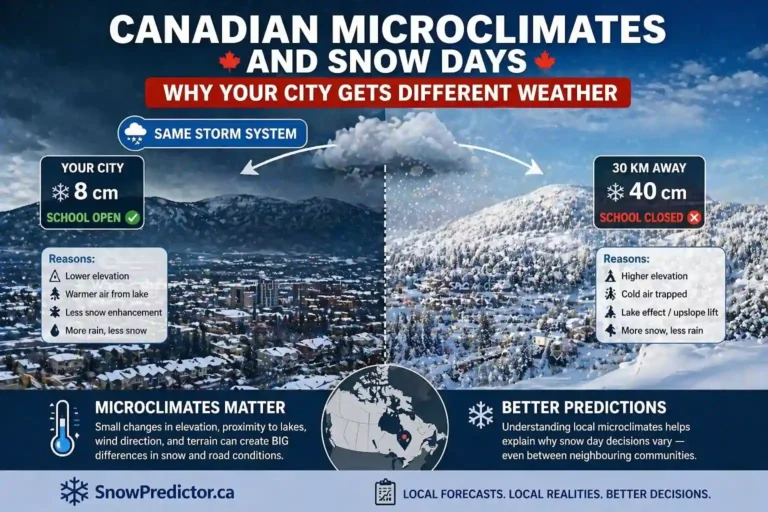
A heavy snow icon does not automatically mean school will close. Ten centimetres falling slowly after the morning commute may cause less disruption than three centimetres combined with freezing rain, strong wind and untreated rural roads before sunrise. The same forecast can also produce different decisions in neighbouring school districts.
Estimating the chance of a snow day requires more than reading an accumulation total. Parents need to examine when the storm arrives, what type of precipitation falls, how roads respond and whether the forecast affects morning and afternoon transportation. Local policies and route geography matter too. This guide explains the strongest prediction signals, the meaning and limits of a percentage, regional Canadian differences and the official sources families must check before assuming buses or schools are cancelled.
Snow Day Risk Factors at a Glance
| Signal | Lower Disruption Potential | Higher Disruption Potential |
|---|---|---|
| Storm timing | Snow after morning buses finish | Heavy snow or ice before and during service |
| Precipitation | Light, dry snow | Freezing rain, heavy snow or mixed precipitation |
| Road conditions | Treated and improving | Ice-covered, drifting, closed or deteriorating |
| Visibility | Clear or briefly reduced | Snow squalls, blowing snow or whiteouts |
| Wind | Light wind | Strong gusts moving loose snow across routes |
| Temperature | Stable winter temperature | Flash freeze or locally published extreme-cold trigger |
| Route type | Short, urban and well maintained | Long, rural, hilly or exposed |
| Afternoon outlook | Improving steadily | Storm strengthening before dismissal |
This table supports comparison, not a universal scoring formula. A single serious hazard can outweigh several favourable signals.
What Does “Chance of a Snow Day” Mean?
A chance of a snow day is an estimated probability that a school authority will change normal operations because of winter weather. Depending on the location, the outcome may be a bus cancellation, route cancellation, delayed opening, full building closure or remote-learning day.
The percentage is not the same as the probability of precipitation shown in a weather app. A 40% chance of snow means measurable precipitation may occur within the forecast area under the weather service’s definition. It does not mean there is a 40% school closure probability.
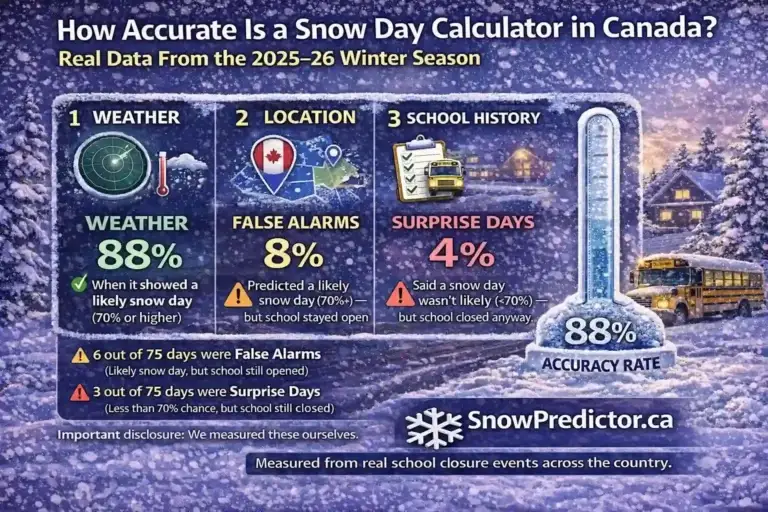
A snow day probability attempts to connect expected weather with transportation and school operations. Its value depends on the quality of the forecast inputs, local knowledge and evidence supporting the prediction method. A tool that does not publish its methodology or performance should not describe its result as guaranteed or “near certain.”
Seven Snow Day Weather Factors That Shape Your Chance of a Snow Day
1. Storm Timing
Timing can matter more than the final snowfall total. Overnight accumulation may leave roads uncleared when buses depart. Snow beginning after students arrive creates a different problem: whether conditions will remain safe for the return trip.
Forecast timing can shift by several hours. Check the hourly forecast again before bed and early in the morning rather than relying on an afternoon screenshot.
2. Precipitation Type
Snow is only one closure trigger. Freezing rain can coat roads with glaze, a flash freeze can turn wet surfaces icy and ice pellets can create slippery travel. Mixed precipitation may also change from rain to ice or snow across a small area.
The guide to freezing rain versus snow bus cancellations explains why a small ice amount may sometimes create more route risk than a larger snowfall.
3. Snowfall Amount and Rate
Total accumulation matters, but rate shows how quickly roads may deteriorate. Plows can make progress during light snow, while intense snowfall can cover a route again soon after clearing.
There is no Canada-wide centimetre threshold for Canadian school closures. Boards, divisions and transportation providers operate different fleets across different roads and climates. Generic claims that a fixed total always closes schools are not reliable.
4. Road Conditions
Forecasts describe expected weather. Road reports show whether that weather is affecting travel. Officials may inspect highways, municipal roads, hills, bridges, bus turnarounds and school approaches. They may also consult road crews, police, bus operators and provincial 511 services.
A cleared street outside a home does not represent an entire bus route. The most hazardous rural or elevated section may determine whether transportation can operate.
5. Wind and Visibility
Wind can move loose snow back over cleared roads and create drifts. Falling and blowing snow may also hide lane markings, intersections and other vehicles. A modest snowfall with poor visibility can be more disruptive than deeper snow under calm conditions.
6. Temperature and Wind Chill
Extreme cold policies vary. Some authorities publish temperature or wind-chill triggers for transportation, while others use broader risk assessments. Never apply one district’s threshold to another.
Temperature also affects road treatment. A sharp decline after rain or snowmelt can produce a flash freeze. The flash freeze school closure guide explains that risk.
7. Local Transportation Policy
An urban board with limited bus reliance may react differently from a rural division with long routes. Some systems use weather zones. Others cancel all transportation across the service area. Building closures may require a separate decision.
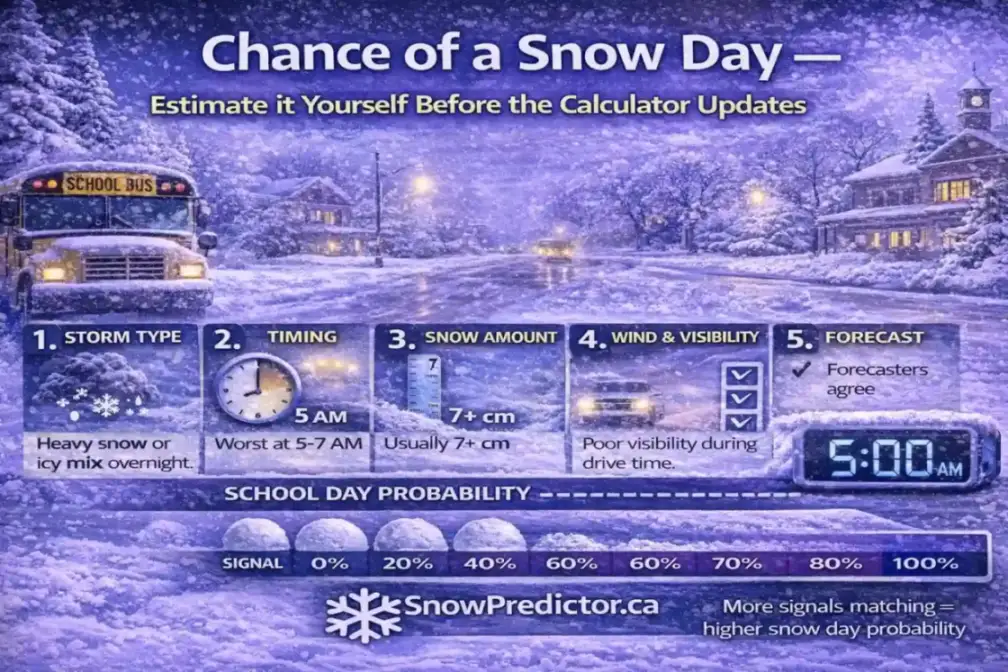
How to Estimate the Chances of a Snow Day Tomorrow
Use this five-step assessment instead of guessing from one weather symbol.
Step 1: Identify the Decision Window
Find the hours when buses begin their morning routes and when students return home. Weather outside those hours still matters, but hazardous conditions during transportation windows deserve more attention.
Step 2: Find the Dominant Hazard
Determine whether the main concern is snow accumulation, freezing rain, flash freezing, wind, visibility or extreme cold. If several occur together, the combined impact may be greater than any single forecast number suggests.
Step 3: Compare Forecast and Observed Conditions
Before the storm, forecasts provide the best available guidance. Once precipitation starts, radar, surface observations and road reports show what is actually happening. Confirm whether temperatures and precipitation types match the earlier forecast.
Step 4: Apply Local Context
Consider route length, hills, rural roads, lake-effect exposure and the authority’s published inclement-weather process. Use documented policies rather than rumours about how a board “usually” behaves.
Step 5: Verify the Official Result
A school closure forecast is never the final notice. Check the transportation consortium, school board or division through its website, app, email, text message or other official channel.
How to Interpret a Snow Day Percentage
The snow day percentage meaning is frequently misunderstood. A displayed probability is a planning estimate, not a promise that a specific outcome will happen.
| Estimated Range | Sensible Interpretation | Appropriate Response |
|---|---|---|
| 0% to 30% | Closure appears less likely based on current inputs | Continue normal planning and monitor changes |
| 31% to 60% | Meaningful uncertainty remains | Prepare a backup plan and recheck later |
| 61% to 80% | Several disruption signals may be aligned | Expect a possible change but wait for confirmation |
| 81% to 100% | The model sees substantial closure risk | Prepare seriously, but do not treat it as official |
These are reader-friendly interpretation bands, not observed national closure rates. A 70% estimate does not mean every Canadian board closes under the same conditions. It means the prediction method currently assigns seven chances out of ten to its defined outcome.
Also check what the tool predicts. Some estimate full school closure, while others estimate school bus cancellation probability. Mixing those outcomes makes the number misleading because buses can be cancelled while buildings remain open.
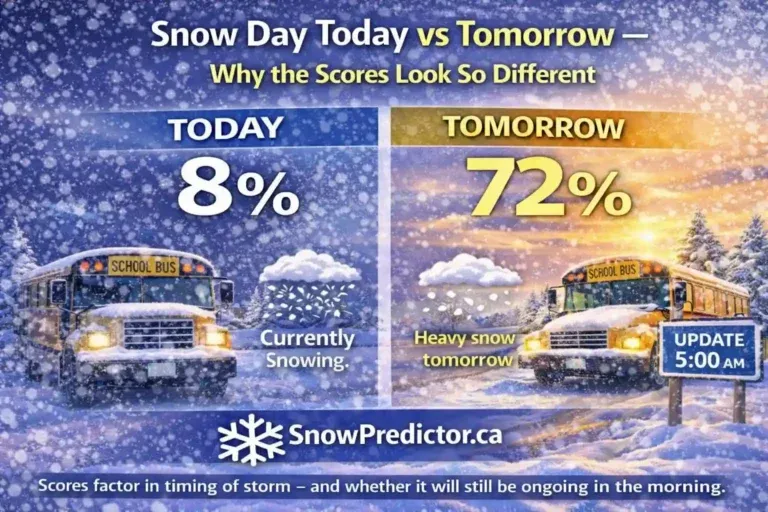
Why Your Chance of a Snow Day Changes Overnight
The question “will school be closed tomorrow?” may receive a different answer at 5 a.m. than at 9 p.m. That does not automatically prove the earlier prediction was defective.
Forecast updates can change:
- Storm track and arrival time
- Snowfall intensity and accumulation
- Rain, freezing rain and snow boundaries
- Wind direction and gusts
- Temperature and flash-freeze timing
- Warning areas and impact levels
Road crews also work overnight, while real-world reports reveal whether routes are improving. Strong snow day prediction accuracy requires both updated weather information and local operational evidence. A model based only on snowfall totals will miss critical changes.
Regional Differences Across Canada
Ontario
Ontario transportation consortia may cancel buses by route, zone or service area. Some boards keep schools open after transportation is cancelled. Snowbelts around Georgian Bay and Lake Huron can experience conditions that differ sharply across short distances.
Quebec and Atlantic Canada
Quebec boards and Atlantic districts may face major snowfall, freezing rain and mixed precipitation. Atlantic authorities may use “storm day” language, while delayed openings can be more common in some areas than in Ontario.
The Prairies
Alberta, Saskatchewan and Manitoba may experience blowing snow, drifting and extreme cold alongside snowfall. A low new-snow total can still produce dangerous rural visibility when strong wind moves existing snow.
British Columbia
Elevation, hills and coastal temperature changes create local variation. Lower Mainland rain may turn to wet snow or ice at higher elevations, while Interior routes face different winter conditions.
These differences are why one national snowfall threshold cannot predict winter school closures reliably.
Bus Cancelled and School Closed Are Different Outcomes
If transportation is cancelled, the school may remain open for students who can arrive safely. Families who drive a child to an open school may also be responsible for the return trip because many morning bus cancellations remain in effect all day.
Read the full announcement and confirm:
- The date and affected weather zone
- The route, school or board involved
- Whether morning and afternoon buses are cancelled
- Whether the building is open
- Whether childcare, activities or remote learning are affected
The guide to bus cancelled versus school closed explains the difference in detail.
Using SnowPredictor Responsibly
Unlike a generic snow day calculator Canada tool, SnowPredictor Canada helps families estimate the chance of a snow day by organizing weather and local-risk signals into a planning percentage. Use it to decide whether backup childcare, remote-work arrangements or an adjusted morning routine may be needed.
Do not use a prediction percentage as permission to travel or stay home. Road safety decisions require current local information, and attendance decisions should follow school instructions. The responsible authority remains the only source that can officially cancel transportation or close a school.
For a broader snow day prediction Canada comparison, review the best snow day prediction apps and check whether each tool explains its inputs, predicted outcome and limitations.
Frequently Asked Questions
How Can I Predict a Snow Day in Canada?
Compare storm timing, precipitation type, accumulation rate, wind, visibility, temperature, road reports and local transportation policies. A prediction tool can organize these factors, but the school authority confirms the result.
Does a 70% Chance of a Snow Day Mean School Will Close?
No. It means the model estimates a relatively elevated likelihood under its own method. It is not an official threshold, guarantee or national closure rate. Forecast and road conditions may still change.
What Is the Best Time to Check a Snow Day Forecast Canada Tool?
Check during the evening for planning, then check again early in the morning after forecasts and road observations update. The latest prediction may be better informed, but it still does not replace the official notice.
Can There Be a Snow Day Without Snow?
Yes. Freezing rain, flash freezing, blowing snow, extreme cold or another dangerous condition can disrupt transportation. “Snow day” is commonly used as a broad label for a weather-related school change.
How to Know If School Is Closed?
Check the official website, app, email or notification service operated by the school board, division or transportation provider. Read whether the notice cancels buses, closes buildings or affects only selected routes or zones.