Snow Day Percentage Explained: What Do 30%, 60% and 90% Mean?
You check a predictor before bed and see 47%. Is school more likely to open or close? Should you arrange childcare, or is the number too low to matter? The confusion usually comes from treating a probability as either a promise or a meaningless guess.
A snow day percentage estimates uncertainty from the information available at that moment. It cannot close a school or guarantee a bus cancellation. To use it correctly, know the predicted outcome, input age and remaining uncertainty. This guide explains probability bands, overnight changes and practical planning actions.
Snow Day Percentage Meaning at a Glance
| Displayed Range | Plain-Language Interpretation | Sensible Planning Response |
|---|---|---|
| 0% to 20% | Current inputs show little closure support | Continue normal plans and monitor major changes |
| 21% to 40% | Closure is possible but not the leading outcome | Note the risk and keep essentials ready |
| 41% to 60% | The outcome is genuinely uncertain | Prepare a realistic backup plan |
| 61% to 80% | The model sees elevated disruption risk | Arrange contingencies and recheck updates |
| 81% to 99% | Conditions strongly support the predicted event | Prepare seriously but wait for official confirmation |
| 100% | The model expresses complete confidence | Still verify the responsible authority’s notice |
This snow day probability meaning table provides interpretation bands, not Canadian closure rates or official thresholds. Tools may calculate percentages differently.
What Does a Snow Day Percentage Mean?
A 60% estimate assigns a six-in-ten chance to the defined event under current inputs and leaves a four-in-ten chance it will not happen. It does not mean 60% of local schools will close.
The definition of the event is critical. A predictor might estimate:
- Full school-building closure
- All school transportation cancelled
- At least one bus route cancelled
- A delayed opening
- Any weather-related operating change
Those outcomes differ. A “70%” result is incomplete without an event definition. A bus cancellation probability may exceed the probability of school closure where buildings remain open after transportation stops.
Snow Day Percentage vs Chance of Snow
A weather app’s precipitation percentage and a school-closure percentage answer different questions.
A 40% chance of snow describes measurable precipitation likelihood for an area and period. It does not mean a 40% chance of a snow day.
A school closure probability connects weather with an operational response, potentially considering snowfall, timing, ice, wind, visibility, roads and local practices.
This difference matters because a low precipitation probability can still involve a serious ice risk, while a high chance of light snow may have little effect on transportation. Never copy the weather app’s precipitation percentage and treat it as a snow day forecast percentage.
How to Read Common Snow Day Percentages
What Does a 0% to 20% Prediction Mean?
The model sees limited closure support. Weather may be light or timed away from transportation hours, but low probability does not mean impossible.
Continue normal preparation. Recheck only if a new warning appears, precipitation changes type or conditions begin deteriorating faster than expected.
What Does a 30 Percent Chance of Snow Day Mean?
A 30 percent chance of snow day disruption means closure is possible but not the leading outcome. Snow may be light or begin after the morning commute.
Parents do not need to assume a closure. They should identify backup childcare, confirm notification channels and check again closer to the decision window.
What Does a 50 Percent Chance of Snow Day Mean?
A 50 percent chance of snow day disruption means available evidence does not strongly separate closure from normal operation. It is not a prediction failure.
Borderline forecasts often involve uncertain storm timing, temperatures near freezing, localized snowbands or road conditions that could improve with treatment. This is the point where a practical backup plan has the greatest value.
What Does a 60 Percent Chance of Snow Day Mean?
A 60 percent chance of snow day disruption leans toward the event, but substantial uncertainty remains. A calibrated model would still expect four in ten comparable cases to go the other way.
Prepare for a possible cancellation without telling children or employers that school is definitely closed. Check the issue time and whether the forecast has updated since the percentage was produced.
What Does a 70 Percent Chance of Snow Day Mean?
A 70 percent chance of snow day disruption indicates elevated risk, not certainty. Road treatment, a storm-track shift or a local decision can change the result.
This range justifies stronger planning. Charge devices, arrange care and review work options. The remaining 30% is not a technicality; it is part of the forecast.
What Does a 90 Percent Chance of Snow Day Mean?
A 90 percent chance of snow day disruption strongly favours the defined event but leaves a one-in-ten chance of another outcome. Precipitation or road conditions can still change.
Prepare as though disruption is highly plausible, but do not treat the estimate as an official closure notice.
Why a Percentage Is Not a Guarantee
Probability describes uncertainty across repeated comparable situations. If a well-calibrated predictor issued 70% forecasts many times, the event should occur approximately 70% of the time in that group, not every time.
This concept is called calibration. A model that closes only half the time after issuing many 80% forecasts is overconfident. A model whose 30% forecasts close much more frequently than three times in ten is underestimating risk.
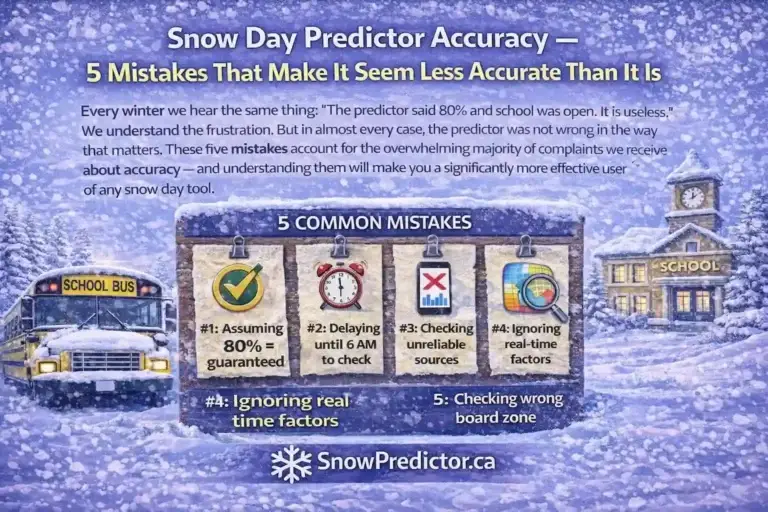
One prediction cannot prove snow day prediction accuracy. A 20% event can occur without making the estimate wrong, and a 90% event can fail. Performance must be evaluated over a large set of dated forecasts using the exact outcome predicted.
Users should be sceptical of tools claiming exceptional accuracy without publishing:
- The period and locations tested
- The number of forecasts evaluated
- The event definition used
- How revised forecasts were handled
- Calibration or error results
- Whether failed and successful predictions were both counted
Why Your Snow Day Percentage Changes Overnight
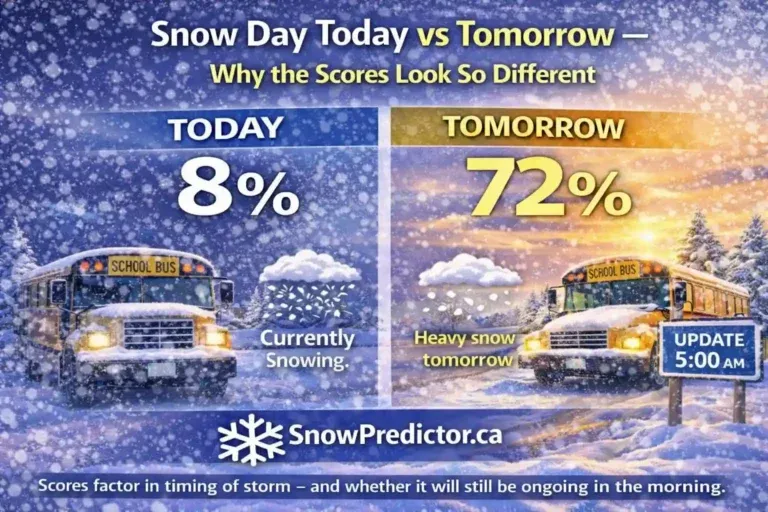
A change from 35% at night to 72% before sunrise can be reasonable when new evidence arrives. Forecast models and observations continuously update.
Inputs that may change include:
- Storm arrival and departure time
- Snowfall amount and intensity
- Rain, freezing rain, ice-pellet and snow boundaries
- Wind direction, gusts and visibility
- Temperature and flash-freeze timing
- Weather alerts and impact levels
- Road treatment, closures and collisions
The percentage should move when material inputs change. A tool that never responds to new evidence is not necessarily more reliable because its number looks stable.
What Creates a High School Closure Probability?
No single factor guarantees Canadian school disruption. Risk generally increases when multiple hazards overlap with transportation hours.
Examples include:
- Heavy overnight snow continuing into bus time
- Freezing rain coating untreated roads and hills
- Blowing snow reducing rural visibility
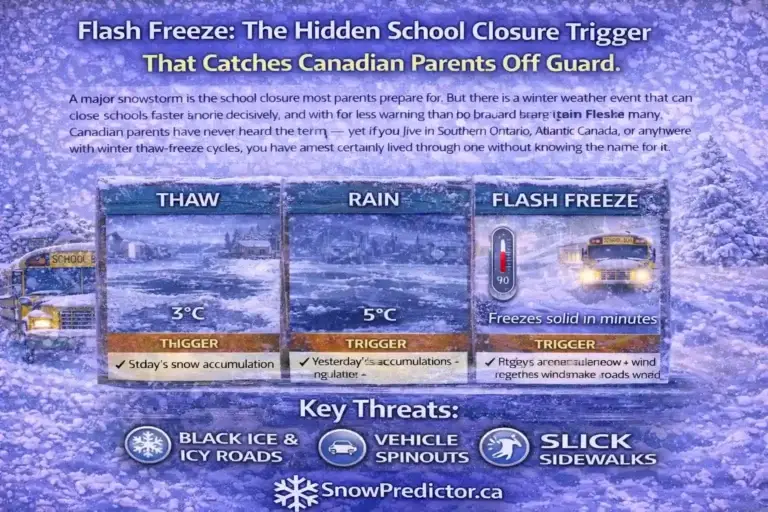
- A flash freeze after rain or snowmelt
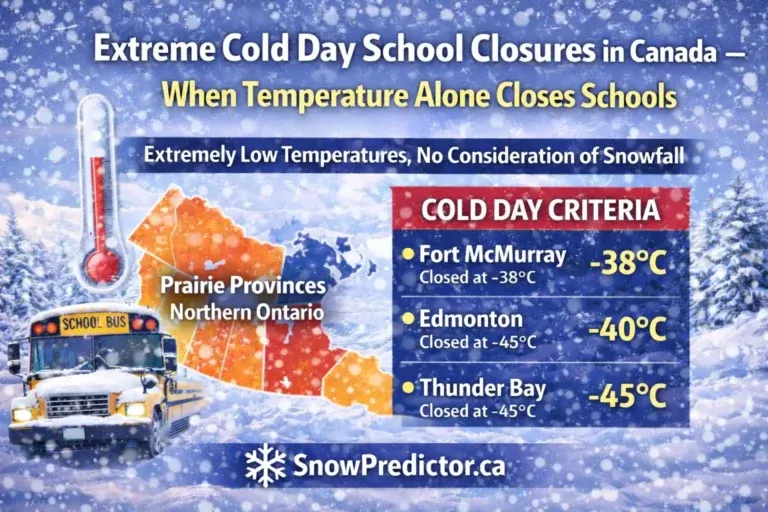
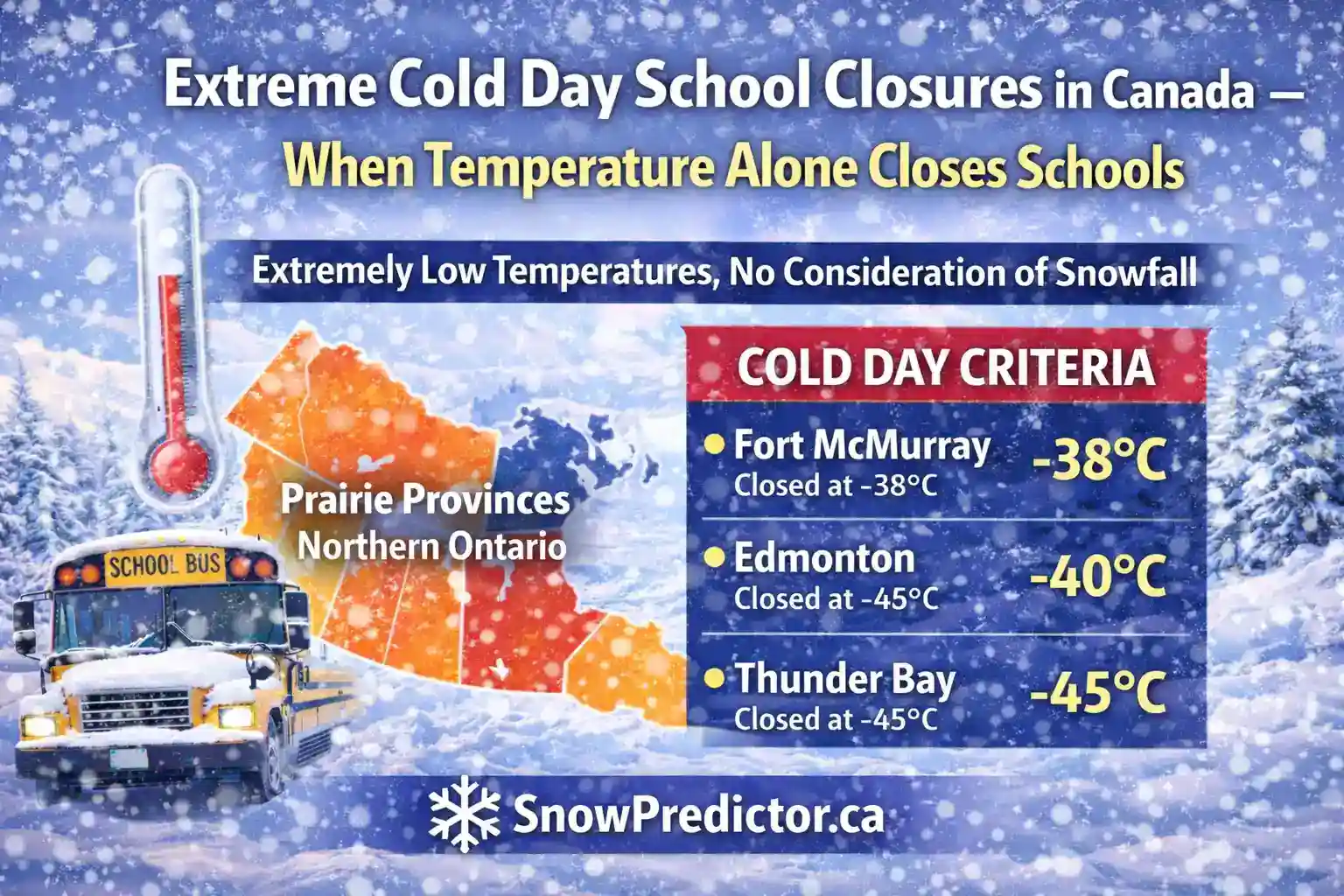
- Extreme cold meeting a locally published policy
- Road closures or plows unable to keep routes open
- A storm expected to worsen before afternoon dismissal
Local context changes the response. Urban streets, remote rural routes, hills, lake-effect snowbelts and coastal transitions create different operating challenges. The article on estimating your chance of a snow day covers these weather and route factors without duplicating this page’s probability focus.
How Parents Should Act at Each Percentage Level
The percentage should change the amount of preparation, not replace official instructions.
Below 40%: Stay Aware
Continue the normal routine. Confirm that alerts are enabled and watch for a significant forecast change. There is usually no reason to reorganize the entire day based only on a low estimate.
From 40% to 60%: Build a Backup
Identify who could provide childcare, whether remote work is possible and what transportation alternatives exist. Avoid making irreversible plans because the outcome remains genuinely uncertain.
From 61% to 80%: Prepare Actively
Set out devices, schoolwork and home essentials. Inform anyone affected that disruption is plausible. Check the predictor again after updated forecasts and road reports become available.
Above 80%: Expect Serious Risk
Put the backup plan in place, but wait for the official announcement before treating school as closed. A high estimate is useful because it creates planning time, not because it grants authority.
Check What Outcome SnowPredictor Is Showing
Before acting on a snow day calculator percentage, confirm the location, date and result label. A prediction for tomorrow should not be confused with today’s operating status. A city-level estimate may also differ from a route-specific notice.
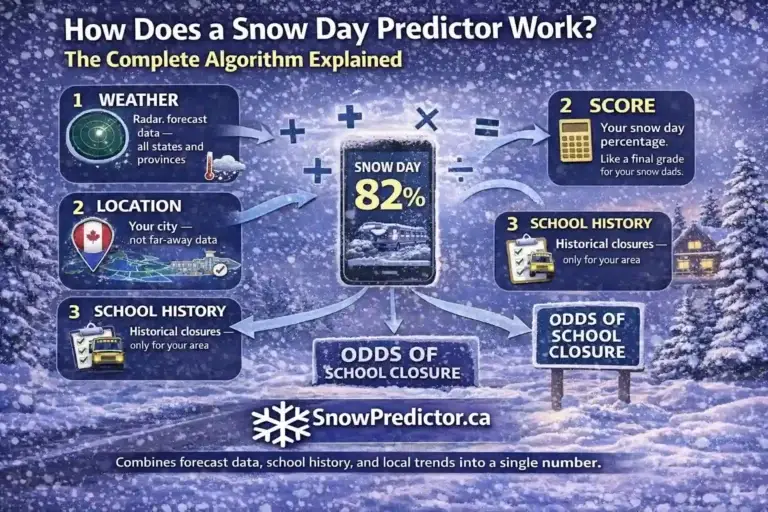
SnowPredictor Canada provides an early probability to support family planning. Its number should be read alongside the latest forecast and local conditions. It does not replace a school board, division or transportation provider.
For snow day prediction Canada use, follow this sequence:
- Confirm the location and forecast date.
- Read which closure outcome the percentage represents.
- Check when the prediction was last updated.
- Review the main weather hazards behind it.
- Use the probability to scale preparation.
- Verify the official operating notice.
Bus Cancellation Is Not the Same as School Closure
A transportation consortium may cancel buses while school buildings remain open. Some notices apply only to one zone or selected routes. Others cancel morning and afternoon transportation across an entire service area.
This distinction can make a prediction appear wrong when the tool and user are measuring different outcomes. A model predicting buses may be correct even though the building opens. A full-closure prediction should not claim success from a route-only cancellation.
The guide to bus cancelled versus school closed explains how to read each announcement. Families should always follow the terminology used by their local authority.
When and Where to Confirm the Official Result
Check the school board or division and its transportation provider. Official channels may include the website, mobile app, email, text alert, automated call or verified social account. The article on when Canadian schools announce closures explains typical notification windows.
Do not rely on an old screenshot, media headline or group post that omits the date, zone or type of cancellation. The final authority is the organization responsible for operating the buses or schools.
Frequently Asked Questions
What Does Snow Day Percentage Explained Mean?
It means translating a prediction number into a clear statement of uncertainty and an appropriate planning action. The percentage estimates a defined event under current inputs; it is not an official cancellation or guarantee.
Does a 70% Snow Day Probability Guarantee a Closure?
No. A 70% estimate leaves a 30% chance that the predicted event will not occur. It indicates elevated risk and supports preparation, but the local school or transportation authority confirms the outcome.
Is a 50% Prediction Basically a Guess?
Not necessarily. It can be an honest expression that closure and normal operation are similarly plausible under the available evidence. Storm timing, precipitation type or local road response may still be uncertain.
Why Did the Percentage Rise Even Though the Snow Total Fell?
Another hazard may have become more serious. Freezing rain, stronger wind, reduced visibility, worse timing or deteriorating roads can increase operational risk even when the predicted snow accumulation decreases.
Can a Low Percentage Still Result in a Snow Day?
Yes. Low probability does not mean impossible. A storm can develop differently than forecast, road conditions can deteriorate unexpectedly or the local authority may make a cautious decision based on information unavailable to the model.