Snow Day Today vs Tomorrow: Which Prediction Should You Check?
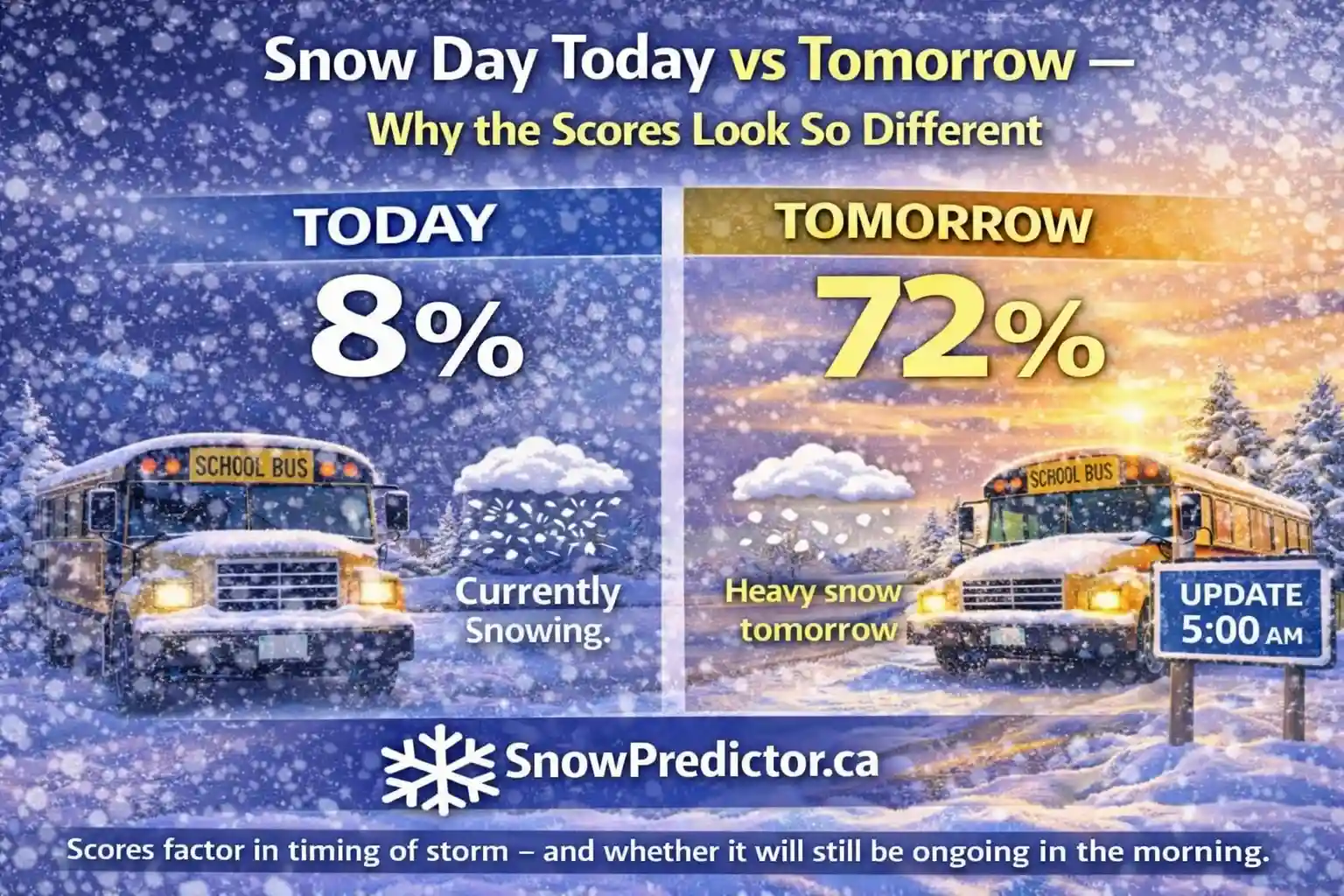
It is 9 p.m. and snow has started falling. The predictor shows 12% for today and 68% for tomorrow. The lower number can look wrong because the storm is already outside, but it may be measuring the school day that has almost finished. The higher number is tied to the next morning’s transportation risk.
Understanding snow day today vs tomorrow scores begins with one rule: use the prediction labelled with the school date you are planning for. Relative labels become confusing around midnight. This guide explains date selection, overnight storms and official confirmation.
Today vs Tomorrow Score: Quick Answer
| When You Check | School Day You Are Planning | Score to Use | What Else to Confirm |
|---|---|---|---|
| Before school in the morning | The current calendar date | Today’s dated score | Official board and transportation status |
| During the school day | Afternoon travel on the current date | Today’s information, if afternoon risk is covered | Early dismissal or transportation notice |
| Evening before school | The next calendar date | Tomorrow’s dated score | Latest overnight forecast |
| Between midnight and morning | The new current date | Today’s score after verifying the written date | Timezone and last update |
| Friday evening | Usually the next scheduled school day, not Saturday | Check the labelled school date and tool coverage | Weekend handling |
| Holiday or school break | No regular school day may be scheduled | Do not assume the percentage applies | School calendar |
The date is more reliable than a relative label. “Tomorrow” changes at midnight, while the target school day does not.
What Does Snow Day Today vs Tomorrow Mean?
A snow day today result should refer to weather-related disruption for the current calendar date in the location’s timezone. Depending on the tool, it may estimate school closure, bus cancellation or another operational change.
During the morning, the authority may already have announced its decision. The prediction then becomes secondary. Families asking will school be closed today should check official school and transportation channels.
Later, a snow day prediction today has limited value after morning transportation. A new storm can still affect afternoon buses or early dismissal, but the tool must state whether it covers those outcomes.
How Snow Day Today vs Tomorrow Dates Work
A snow day tomorrow result estimates disruption for the next date using conditions expected around that school day.
For evening planning, the snow day prediction tomorrow is usually the relevant result. It may consider overnight accumulation, freezing rain, a flash freeze, strong wind, reduced visibility, extreme cold and conditions expected during morning transportation.
Tomorrow school closure probability remains an estimate. A school closure tomorrow depends on updated weather, road response and local decisions. Use the number for planning, not to declare a closure.
Why Snow Day Today vs Tomorrow Scores Differ
The two scores cover different dates and weather windows. They should not be expected to match.
Different Transportation Windows
School decisions focus heavily on times when students and buses must travel. Snow falling at 10 p.m. has no effect on the morning commute that already happened, but it can affect roads for the next school day.
That is why an overnight snow school closure threat may produce a low score for the ending day and a high score for the next one.
Different Forecast Conditions
Weather can improve or deteriorate across consecutive days. One day may involve heavy snow and freezing rain, while the following day has cleared roads and lighter wind. The scores should reflect those differences.
Different Forecast Lead Times
Today’s weather may already be observed, while tomorrow’s conditions remain forecast. More uncertainty exists when storm track, timing or precipitation type is unresolved.
Different Operational Questions
Today school closure status is an official real-world condition. Tomorrow’s score is a forecast. Comparing them as if they are two versions of the same answer mixes an observed outcome with an estimate.
Snow Day Today vs Tomorrow at Midnight
The most common error occurs across midnight.
At 11:50 p.m. on Tuesday:
- “Today” means Tuesday.
- “Tomorrow” means Wednesday.
- Wednesday is the school day being assessed.
At 12:10 a.m. on Wednesday:
- “Today” now means Wednesday.
- “Tomorrow” means Thursday.
- The same Wednesday school risk should now appear under today.
If labels change without the forecast date moving correctly, users may see the wrong result. A reliable interface shows the weekday and full date.
When comparing a snow day calculator today result with a snow day calculator tomorrow result, confirm:
- The written weekday and date
- Your location and timezone
- The predicted school outcome
- The forecast period included
- The last-updated timestamp
Snow Day Today vs Tomorrow During Overnight Storms
Use the school date affected by transportation risk, not the date of the first snowflake.
Example 1: Snow Begins Tuesday Evening
Snow starts at 8 p.m. Tuesday and continues until 7 a.m. Wednesday. Tuesday’s school day is finished. Wednesday’s dated prediction is relevant because the accumulation overlaps Wednesday morning bus service.
Example 2: Snow Begins Wednesday Afternoon
The morning commute is clear, but heavy snow begins before dismissal. Wednesday’s current-day information matters because afternoon transportation could be affected. A predictor designed only for full-day morning closures may not estimate early dismissal.
Example 3: Snow Ends Before Midnight
Snow ends Tuesday at 10 p.m., but roads remain covered for Wednesday morning. Wednesday’s score still matters. Precipitation does not need to be falling during bus service for untreated roads to create risk.
Example 4: Freezing Rain Arrives After Sunrise
If freezing rain begins after buses depart but before dismissal, officials may assess afternoon travel. The relevant date remains that current school day, though the predicted event may differ from a full morning closure.
Why the Tomorrow Score Can Change by Morning
The evening forecast is not frozen. Updated weather guidance and observations may alter:
- Snowfall totals and rates
- Storm arrival and departure
- Rain, snow and freezing-rain boundaries
- Wind and blowing-snow risk
- Temperature and flash-freeze timing
- Visibility and road conditions
- Weather alerts and impact levels
A score can rise or fall as these inputs change. The guide to why snow day scores change explains update behaviour in detail.
Changing probability does not automatically mean the earlier result was dishonest. Forecasts are revised as new evidence arrives. Unexplained movement caused by the wrong date, location or stale data is different and should be treated as a technical issue.
Today’s Prediction vs Today’s Official Status
Once an authority announces its decision, official status takes priority over the predictor.
Possible official outcomes include:
| Official Notice | Meaning |
|---|---|
| All schools open and transportation operating | Normal operations apply |
| Selected routes cancelled | Only listed routes are affected |
| Weather zone cancelled | Transportation stops in the named zone |
| All buses cancelled, schools open | Buildings operate, but transportation does not |
| Delayed opening | School or service begins later |
| Schools closed | Buildings are not open for regular attendance |
School bus cancellations today may not mean school buildings are closed. Read the complete notice, including the date, zone and whether afternoon service is cancelled.
The guide to bus cancelled versus school closed explains these different outcomes.
How to Check the Correct Score Step by Step
Step 1: Name the School Date
Say the weekday and date you are planning for, such as “Wednesday, January 14.” This removes ambiguity immediately.
Step 2: Confirm the Location
Verify the city, board or school region. Similar place names and broad postal-code areas can return the wrong forecast context.
Step 3: Read the Outcome Label
Determine whether the tool predicts full school closure, bus cancellation or general disruption. Do not assume every percentage measures the same event.
Step 4: Check the Update Time
An evening score may use older guidance than an early-morning result. Compare timestamps before concluding that two numbers conflict.
Step 5: Review the Main Hazards
Look at snow timing, ice, wind, visibility, temperature and roads. The number makes more sense when you know what is driving it.
Step 6: Verify the Official Decision
Check the responsible school authority and transportation provider. A predictor supports preparation but cannot issue an official cancellation.
Weekend, Holiday and Timezone Complications
Relative labels work poorly when the next calendar day is not a school day. A Friday-evening “tomorrow” prediction may point to Saturday even though the family wants Monday’s school risk. Tools should state whether they skip weekends and holidays or simply forecast consecutive dates.
School calendars also differ. Professional activity days, local holidays and staggered breaks can mean no regular student attendance is scheduled. A weather probability has little practical meaning when school was already closed for the calendar.
Timezone errors can cause early or late date rollover. Families near provincial boundaries or travelling outside their home region should confirm that the tool uses the school location’s local time rather than the device’s current timezone.
How to Use Snow Day Today vs Tomorrow Results
Open SnowPredictor Canada and confirm the location and written school date.
Use the tomorrow result during the evening to prepare for the next school day. After midnight, use the today result only after confirming that it carries the same target date. If the date or last-update label appears wrong, do not rely on the number.
For school bus cancellations tomorrow, monitor official channels and the latest snow day forecast Canada information. A high prediction supports planning but never overrides school instructions.
Families who want help interpreting the number itself can read the snow day percentage explained guide. That page covers probability bands, while this page resolves date selection.
A Parent’s Evening and Morning Checklist
The Evening Before
- Check the next school day’s written date.
- Review the tomorrow score and its update time.
- Note whether snow, ice, cold or visibility drives the risk.
- Prepare childcare, work and transportation alternatives.
- Confirm where the board publishes announcements.
After Midnight or Early Morning
- Confirm that today now displays the intended school date.
- Review the latest score and changed weather inputs.
- Check provincial road and local transportation information.
- Look separately for bus and building notices.
- Follow the official announcement when it appears.
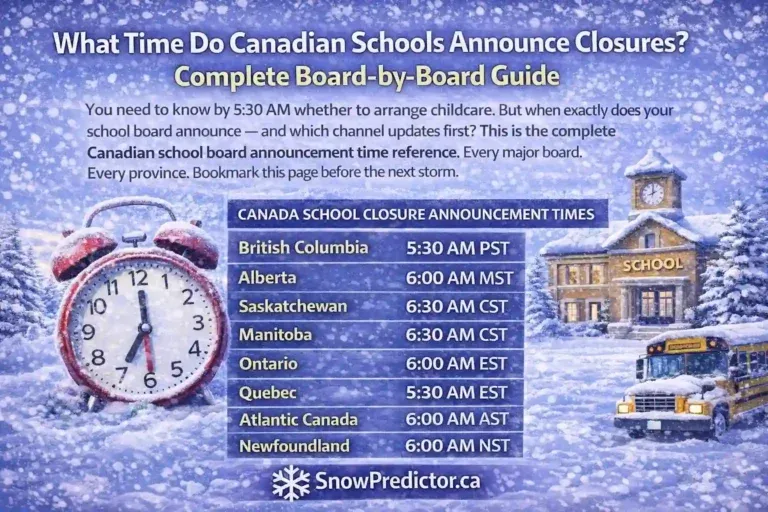
The guide to when Canadian schools announce closures explains common notification windows without claiming every authority reports at the same time.
Frequently Asked Questions
Should I Check Snow Day Today or Snow Day Tomorrow?
Check the score labelled with the date of the school day you are planning for. Before midnight, that is usually tomorrow. After midnight, the same school date becomes today. Always verify the weekday and full date.
Why Is Today’s Score Low When It Is Snowing Outside?
Today’s school transportation may already be finished, while the snow is creating risk for the next morning. The current snowfall does not prove the ending school day should have had a high closure probability.
Will School Be Closed Tomorrow If the Score Is High?
Not necessarily. A high estimate indicates substantial risk but remains a probability. Forecasts and roads may change, and the responsible authority publishes the final decision.
Can Today’s Score Confirm That My School Is Closed?
No. A prediction is not an operating notice. Check the school board, division and transportation provider for the official status, including whether buses, buildings or selected routes are affected.
Why Did Tomorrow’s Score Become Today’s Score After Midnight?
The calendar date changed. Tuesday’s “tomorrow” becomes Wednesday’s “today” at midnight. The written weekday and date should remain the same even though the relative label changes.
Where Should Families Check for a School Closure Today?
Use the official website, app, email, text alert or verified account of the responsible school authority and transportation provider. Forecast tools and road reports support planning, but only the local authority confirms whether buses operate and schools open.