Flash Freeze School Closures in Canada: What Parents Need to Know
The roads can look merely wet at bedtime and become dangerously icy before the first school bus starts. This rapid change catches families off guard because the forecast may show little snow and the evening drive may have been easy. The real hazard is water already covering roads, sidewalks and parking areas when colder air arrives.
Flash freeze school closures happen when a quick temperature fall freezes rainwater, snowmelt or slush before routes can be made safe. The resulting ice can affect intersections, hills, bridges, rural roads and school entrances at the same time. However, a weather warning does not automatically cancel buses or close a building. This guide explains the science, the areas commonly affected, the signals transportation officials evaluate and the official sources parents should check before making a school-day decision.
Flash Freeze Closure Risk at a Glance
| Forecast or Road Signal | Why It Matters | What Parents Should Do |
|---|---|---|
| Rain or melting snow before a cold front | Leaves untreated water on travel surfaces | Watch the hourly temperature trend |
| Temperature falling through 0°C | Water may begin freezing across the area | Check alerts and road reports |
| Sharp overnight temperature decline | Gives road crews less response time | Prepare for an early transportation update |
| Ice reported on bridges and untreated roads | Confirms the forecast is affecting travel | Use provincial 511 and local reports |
| Flash freeze or ice alert | Signals potentially hazardous surfaces | Read its location, timing and impact colour |
| Bus cancellation notice | Transportation will not operate as stated | Confirm whether the school remains open |
| Full school closure notice | The building is closed | Follow the board’s closure instructions |
No single row defines flash freeze school closure risk. Outcomes depend on surface water, temperature, treatment, route design and the afternoon trip.
What Is a Flash Freeze?
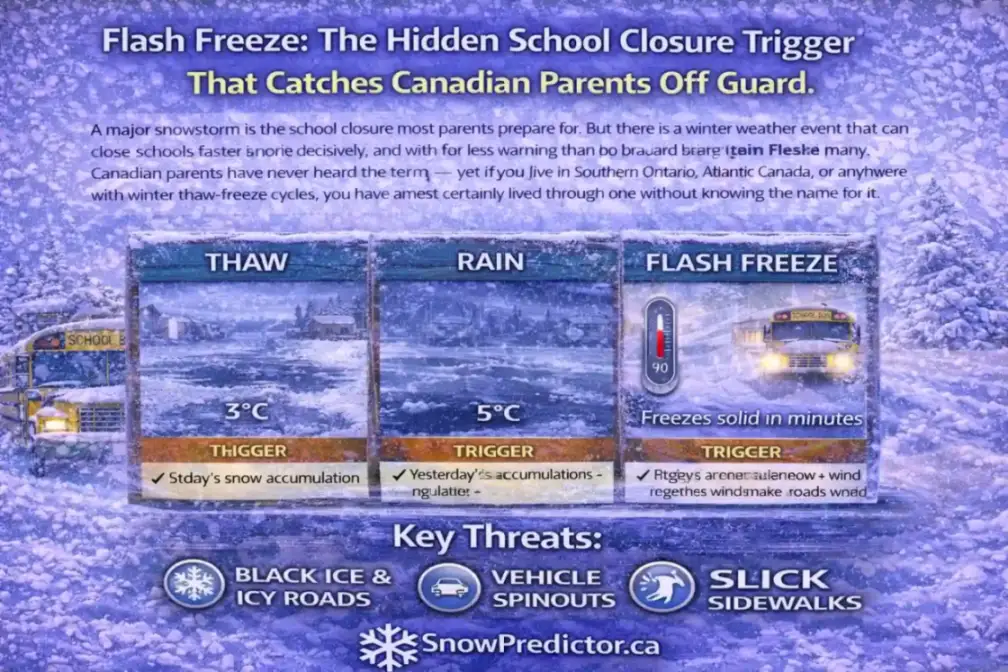
Environment and Climate Change Canada describes a flash freeze as a rapid temperature drop that causes water from rain or melted snow on streets and sidewalks to freeze quickly. The essential ingredients are wet surfaces followed by fast cooling below the freezing point.
A typical sequence looks like this:
- Mild air brings rain or melts existing snow.
- Roads, sidewalks, parking lots and bus stops become wet or slushy.
- A cold front passes and causes a sudden temperature drop.
- Surface water freezes, sometimes before crews can treat every route.
- Travel conditions deteriorate even though precipitation may have ended.
The event is not defined by one universal temperature change within a fixed number of hours. A claim that every drop of 8°C in four hours triggers the same outcome oversimplifies the hazard. Starting temperature, pavement temperature, water coverage, wind and treatment all influence how quickly ice forms.
Why Flash Freeze School Closures Can Happen Without Snow
Snow depth is not the issue. Ice can form from rainfall, drainage, puddles, wet slush or melted snowbanks. If the surface temperature falls below freezing, that moisture may become a thin, difficult-to-see layer.
This explains school closures due to flash freeze on mornings when the snowfall forecast is zero. A bus still needs adequate traction to stop, turn, climb hills and approach railway crossings. Students and staff also need safe access across sidewalks, stairs and parking areas.
Icy road school closures are more likely when the hazard is widespread, treatment is incomplete or routes include steep and untreated sections. Local officials must assess the full transportation network, not just a major highway or the pavement outside one home.
Flash Freeze, Freezing Rain and Black Ice Compared
These hazards can produce similar travel problems, but they form differently.
| Hazard | How It Forms | Primary School-Day Concern |
|---|---|---|
| Flash freeze | Existing surface water freezes after rapid cooling | Fast, widespread loss of traction |
| Freezing rain | Supercooled liquid rain freezes when it contacts a cold surface | Ice accumulation on roads, trees and infrastructure |
| Freezing drizzle | Fine droplets gradually form glaze on exposed surfaces | Subtle but persistent icing |
| Black ice | A thin, transparent-looking ice layer forms on pavement | Drivers may not recognize it in time |
The freezing rain vs flash freeze distinction matters when reading a forecast. Freezing rain is a precipitation type. A flash freeze is a surface response to rapid cooling. One event can follow the other, but they are not interchangeable.
Black ice school closures is a common search phrase, although black ice is a road description rather than a specific school policy. Boards and transportation operators focus on traction and route safety regardless of what the ice is called.
Where Flash Freeze School Closures Affect Canada
Temperature swings can occur across Canada, but the risk is especially relevant where winter thaws, rain and rapid cold-front passages are common.
Southern and Eastern Ontario
Southern Ontario can move from mild rain to below-freezing temperatures when a winter cold front passes. The Greater Toronto Area, London, Kitchener-Waterloo, Ottawa Valley and eastern Ontario may face different timing during the same system.
A flash freeze warning Ontario families receive may cover only selected forecast regions. Check whether the warning includes the school and the complete bus route. School bus cancellations Ontario transportation providers announce may also be limited to a weather zone, municipality or group of routes.
Atlantic Canada
Atlantic storms can bring rain, mixed precipitation and falling temperatures. Coastal and inland areas may transition at different times, while hills and rural routes add local variation. A region that remains above freezing may have wet roads as another area develops ice.
Families should monitor their provincial road service, school authority and transportation provider. Atlantic districts may use terms such as storm day, delayed opening or early dismissal instead of relying only on “snow day.” The Atlantic Canada storm day predictor guide explains that regional language.
Quebec and the Prairies
Quebec can experience rain-to-freeze transitions during winter temperature swings. Prairie flash freezes can follow mild conditions, snowmelt or rain, although blowing snow and extreme cold may also affect the same routes.
This overlap matters because a closure decision may reflect several hazards at once. A flash freeze forecast cannot isolate every road risk when wind, drifting, fresh snow or freezing rain are happening together.
How Weather Alerts Describe Flash-Freeze Risk
A flash freeze warning Canada alert tells the public that rapid cooling is expected to freeze water on exposed surfaces. It identifies a serious travel hazard, not a direct order to close schools.
Since November 2025, Environment and Climate Change Canada has used colour-coded weather alerts. Yellow represents moderate, localized or shorter-term impacts. Orange signals major or widespread impacts, while red is reserved for extreme, dangerous and potentially life-threatening conditions.
For ice hazards, including freezing rain, freezing drizzle and flash freeze, the federal impact guide lists possible effects such as travel delays, icy routes and vehicle collisions. Higher-impact events can bring widespread dangerous travel, multiple collisions, infrastructure problems and power outages.
Read the full alert rather than its headline. Check:
- The communities and highways included
- The expected start and end time
- Whether temperatures are still above freezing
- The alert colour and described impacts
- Other hazards, such as freezing rain or strong wind
- Updates issued as the front approaches
What School Transportation Officials Assess
Flash freeze school closures are local operational decisions. Canada does not have one national temperature-drop or ice-coverage threshold that automatically closes every school.
Authorities may consider:
- Reports from drivers who inspect roads before service
- Pavement conditions on highways, rural roads and city streets
- Ice on bridges, hills, intersections and school approaches
- Current and forecast temperature trends
- Rainfall, snowmelt and water remaining on surfaces
- Salt, sanding and plowing progress
- Road closures, collision reports and travel advisories
- Whether conditions may improve or worsen before dismissal
- Safe access for students, staff and emergency services
School transportation safety depends on the weakest part of a route. A treated main road does not prove that a concession road, bus turnaround or school entrance is safe.
Bus Cancelled Does Not Always Mean School Closed
A transportation provider may cancel buses while the school board keeps buildings open. This distinction applies to many winter school closures Canada families search for, including flash freeze school cancellations.
When transportation is cancelled, read whether the notice covers:
- One route or all routes
- A named weather zone
- Morning and afternoon transportation
- Taxis and special transportation
- Schools, board offices and childcare programs
- Before-school and after-school activities
If a parent drives a child to an open school after buses are cancelled, the parent may also need to arrange the return trip. The guide to bus cancelled versus school closed in Ontario explains the difference between transportation and building announcements.
How to Estimate Flash Freeze School Closures
A forecast can support planning, but it cannot replace early road inspections. Use several signals together:
- Confirm that surfaces are wet. A temperature decline matters more when rain or melting has left water on roads.
- Read the hourly forecast. Identify when temperatures cross below 0°C and how that timing overlaps with bus service.
- Watch the cold front. Forecast timing may change as the system approaches.
- Check official alerts. Note the geographic area, impact colour and other hazards.
- Review road conditions. Provincial 511 services and municipal notices can confirm icing or closures.
- Wait for the responsible authority. Only the board or transportation provider confirms the operating decision.
SnowPredictor Canada can combine forecast signals into an early planning probability. A responsible snow day prediction Canada estimate should treat rain, surface moisture, timing, temperature direction and local road reports as connected evidence. It should not add an arbitrary percentage simply because temperatures are falling.
A Practical Flash-Freeze Morning Checklist
Bookmark the correct board, transportation and road pages before winter weather arrives. If the forecast shows wet roads freezing overnight:
- Check the latest Environment Canada alert.
- Look at the current temperature, not only the daily low.
- Confirm whether rain or meltwater remains on surfaces.
- Review route-level or zone-level transportation notices.
- Check separately for an Ontario school closures announcement or the equivalent provincial notice.
- Confirm afternoon transportation before driving a child to school.
- Report the absence according to school instructions if the route feels unsafe.
Families can review when Canadian schools announce closures to understand typical decision windows. Official local messages remain the final authority because road conditions may change after any prediction is published.
Frequently Asked Questions
Can a Flash Freeze Close Schools Without Snowfall?
Yes. Rainwater, slush or melted snow can freeze after temperatures fall rapidly. The resulting ice may make bus routes, school entrances and sidewalks unsafe even when no new snow appears in the forecast.
Do Flash Freeze School Closures Automatically Follow a Warning?
No. The warning identifies a weather hazard. Transportation providers and school boards inspect local conditions and publish separate operating decisions. Families must confirm whether the notice affects buses, buildings or both.
How Fast Does a Flash Freeze Happen?
There is no fixed national timeframe. Surfaces can become icy quickly when wet pavement encounters rapidly falling air and surface temperatures. The speed depends on starting temperature, pavement temperature, water coverage, wind and road treatment.
What Is the Difference Between a Flash Freeze and Freezing Rain?
Freezing rain freezes when liquid precipitation touches a cold surface. A flash freeze occurs when water already on roads, sidewalks or other surfaces freezes after a rapid temperature decline. Both can create serious travel hazards.
Why Can Buses Be Cancelled While Schools Stay Open?
Bus operators assess the complete transportation network, including rural roads, hills and turnarounds. The school building may remain accessible to walkers and local staff even when some bus routes are unsafe. Always read the board’s attendance and transportation instructions.