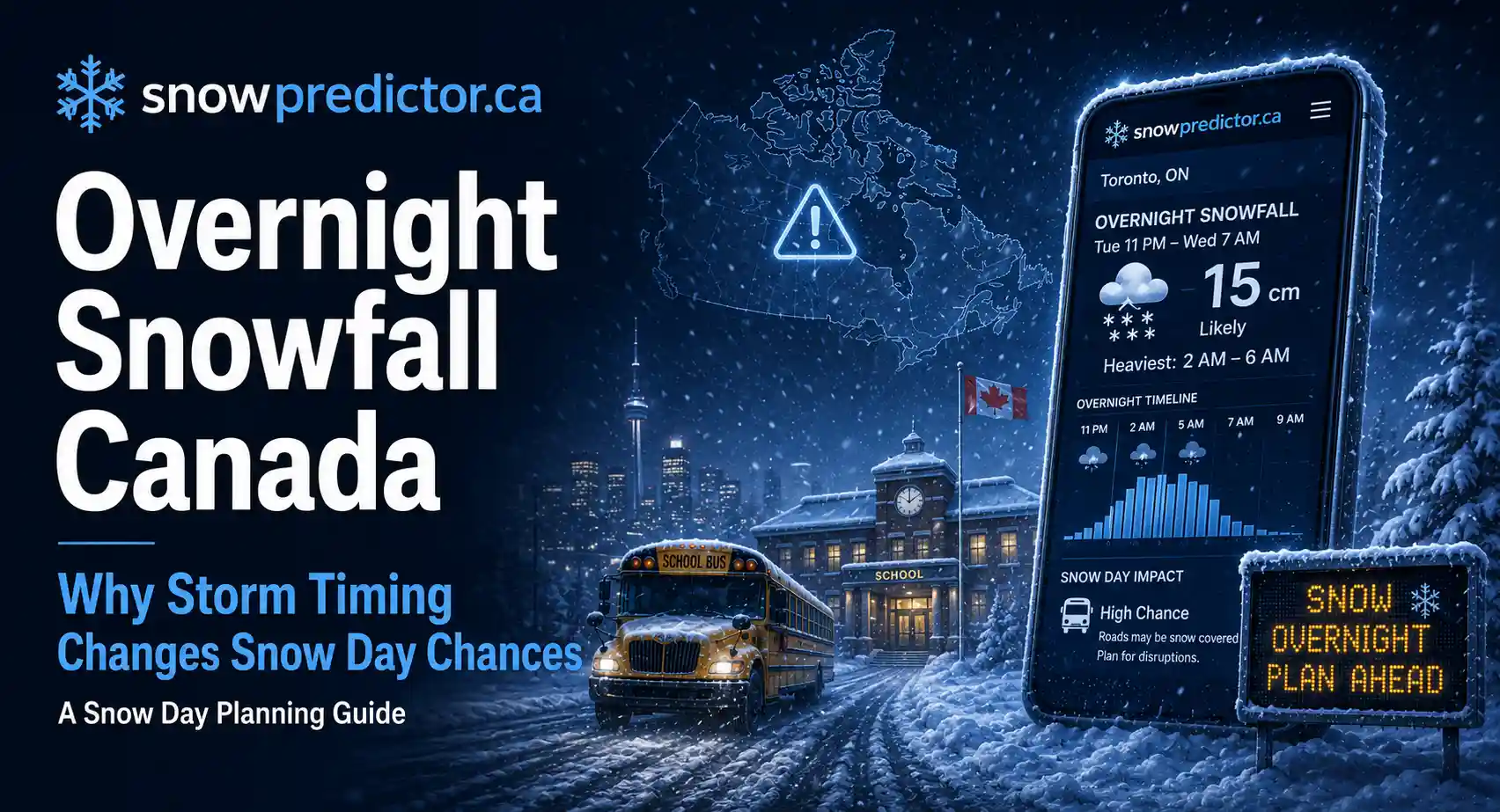
Overnight Snowfall Canada: Why Storm Timing Changes Snow Day Chances
Canadian parents often ask how much snow fell overnight, but snowfall totals alone do not decide whether schools close or buses run. Timing can matter just as much as accumulation. Snow that ends near midnight gives crews several hours to clear and treat roads, while the same amount falling between 4 a.m. and 7 a.m. can cover routes during inspections and the morning commute. This overnight snowfall Canada guide explains how timing, road clearing and changing conditions affect transportation decisions. The Canada Snow Day Predictor can support early planning, while official weather, road, bus and school-board notices remain final.
Why the Timing of Overnight Snow Matters
Overnight snowfall Canada conditions can raise the chance of transportation disruption when snow continues into early morning, falls faster than crews can clear it or combines with ice, wind and poor visibility. Snow ending earlier may create fewer problems because plows have more time to reopen priority roads before buses leave.
There is no national snowfall amount that automatically creates a snow day. Local teams assess roads, visibility, current and forecast weather, accumulation, freezing rain, plow activity and expected afternoon conditions.
| Storm Timing | Possible Operational Effect |
|---|---|
| Snow ends by midnight | Crews may have several hours to clear major routes |
| Snow continues from midnight to 6 a.m. | Roads may become covered again after plowing |
| Heaviest snow begins near 5 a.m. | Route checks may occur while conditions worsen |
| Snow begins after morning buses leave | Afternoon transportation may face greater disruption |
The final total can be identical in each example, but the clearing window is different.
What Counts as Overnight Snowfall?
“Overnight snowfall” is a common public phrase rather than a formal weather-alert title. It usually means snow falling between evening and the following morning.
A weather page may report snow since midnight, snowfall overnight, a 12-hour amount or a 24-hour amount. Check the measurement period before comparing figures. Overnight snowfall totals from different sources may not cover the same hours or use the same observation site.
Why Early-Morning Snow Creates More Disruption
Transportation teams often make decisions before most families leave home. If overnight snowfall Canada conditions intensify near that decision window, roads may change faster than officials can assess them.
Early-morning snow can:
- Cover pavement after an earlier plow pass
- Hide ice beneath fresh accumulation
- Reduce visibility and hide lane edges
- Slow traffic and snow-removal vehicles together
- Delay route inspections
- Affect rural roads later than urban streets
- Continue after buses would normally start
A road that looked manageable at 4:30 a.m. may be unsafe by 6 a.m. Officials therefore use both current observations and the expected trend.
Snowfall Rate Can Matter More Than the Total
Snowfall rate means how quickly snow is accumulating. A moderate event spread across 12 hours may be easier to manage than the same amount falling in three hours.
Fast accumulation can cover treated pavement, reduce visibility and outpace plows. A narrow heavy band can also create sharply different conditions between nearby communities.
Parents should check the hourly snow forecast and weather forecast rather than relying only on a daily icon. Look for wording such as “heavy at times,” “rapidly accumulating,” “reduced visibility,” “difficult travel” or “rates increasing during the commute.”
A high snowfall rate close to departure can matter more than a larger overnight snow accumulation that ended several hours earlier.
Overnight Snowfall and Formal Weather Alerts
Overnight snowfall Canada does not automatically mean a Snowfall Warning is active. Snow may appear in a regular forecast, Special Weather Statement, Winter Storm Warning, Snow Squall Warning or another weather message.
Canada’s winter-alert system separates hazards by expected impact. Snowfall alerts focus on significant accumulation. Snow Squall alerts cover narrow, intense bands with sudden visibility loss. Winter Storm alerts may combine snow, freezing rain, wind and cold.
Warnings, Advisories and Watches can also carry yellow, orange or red colours. Families should read the hazard, alert type, colour, location, timing and impact section together.
The Canadian weather alerts guide explains how these messages differ.
Does Overnight Snow Automatically Create a Snow Day?
No. A snow day is an operational decision, not a direct weather product. Overnight snowfall Canada may increase snow day chances, but the outcome depends on roads, transportation and building conditions.
Possible outcomes include:
- Normal school and bus operations
- Selected route or weather-zone cancellations
- All buses cancelled while schools remain open
- Delayed opening
- Individual school closures
- Board-wide closure
- Normal morning service followed by afternoon changes
A board may keep buildings open even when transportation stops. Parents should check bus and school notices separately.
Why Snowplow Timing Changes the Outcome
Snowplow timing affects how much of the network can be cleared before route inspections and bus departures. Major highways and priority streets are often treated before residential, rural or secondary roads.
Continued snow can cover a route again after a plow passes. Transportation providers need the entire route to be manageable, including hills, bridges, turning areas, bus stops and school entrances.
This explains why a parent may see a clear main street while buses remain cancelled. The actual route may include drifting, untreated or repeatedly covered sections that are not visible from home.
The winter road conditions and school closures guide explains how maintenance and route exposure influence decisions.
Rural and Urban Routes May Get Different Decisions
Overnight snowfall Canada can affect rural and urban transportation differently.
Rural routes may include open roads with drifting, lower traffic, longer distances, hills and surfaces treated later than major city streets. Urban routes may receive more frequent plowing but face parked vehicles, congestion, narrow roads and busy intersections.
Weather-zone decisions allow a provider to cancel service where conditions are unsafe without stopping the whole system. One community may have normal transportation while another nearby zone has school bus cancellations.
Can Schools Stay Open When Buses Are Cancelled?
Yes. School transportation and building operations are separate decisions.
A transportation provider may cancel buses because roads are unsafe while a school remains accessible to staff and nearby families. Possible outcomes include one cancelled route, several zones without service or all buses cancelled while buildings stay open.
Families who drive a child to an open school may also be responsible for safe pickup if buses remain cancelled in the afternoon.
The bus cancelled but school open guide explains how to interpret those separate announcements.
What Parents Should Check Before School
Check When Snow Started and Will End
A total without snowfall timing is incomplete. Determine whether snow ended hours earlier, is falling now or will intensify during the commute.
Review the Hourly Forecast
Check snowfall rate, temperature, wind, visibility and any change to freezing rain or blowing snow. Morning snowfall may create a different risk from snow that ended before midnight.
Read Active Alerts
Confirm whether a Snowfall, Snow Squall or Winter Storm alert covers the home, school or full route.
Review Road Information
Use the relevant provincial or territorial service for winter road conditions. Cameras and reports may show whether priority roads remain snow-covered or visibility is poor.
Check Transportation
Look for the child’s route, school or weather zone. Do not infer a cancellation from overnight snowfall totals alone.
Check the School Board
Confirm whether the building is open, delayed or closed and whether childcare, activities or dismissal procedures have changed.
The weather app versus school-board notice guide explains which source answers each question.
How to Read Overnight Snowfall Totals Correctly
An overnight snowfall Canada report is useful only when the measurement period and observation point are clear. One source may count snow since midnight, another may use the previous 12 hours, and a third may report the full storm total. Airport, downtown and suburban stations can record different amounts because snow bands, elevation, wind and local temperatures vary.
Parents should compare:
- The start and end time of the measurement
- The location of the observing station
- Settled depth versus newly measured snow
- Additional snow expected before buses leave
- Whether wind has created drifting
- Whether rain or ice occurred beneath the snow
A reported total also cannot show whether plows have reached the child’s route. Fresh snow may be shallow but cover untreated ice, while deeper snow on a priority road may already be cleared. Use measured accumulation as context, then review current road reports, cameras, transportation notices and the hourly forecast. This approach prevents a single number from being mistaken for a reliable school closure prediction.
A Five-Minute Morning Checklist
Before children leave, confirm:
- The current snowfall rate
- Overnight and expected additional accumulation
- Whether roads were plowed and are becoming covered again
- Visibility and wind
- Ice beneath fresh snow
- Bus or zone cancellation status
- School operating status
- The afternoon forecast
- Backup childcare or pickup arrangements
The best question is not simply, “How much snow fell?” It is, “What condition are the routes in when buses must travel?”
Should Parents Drive When Buses Are Cancelled?
A family vehicle is not automatically safer than a school bus. First determine why service stopped.
The concern may involve rural or exposed roads outside the family’s route, but heavy snow, poor visibility and unplowed streets can also affect a short trip.
Drivers should check road reports, reduce speed, increase following distance and delay travel when conditions are poor. Winter tires improve control but do not make an unplowed or low-visibility route safe.
The winter weather safety checklist provides practical travel guidance.
What If Snow Begins After School Starts?
Storm timing can shift disruption from morning to dismissal. A school may open normally and later cancel activities, delay dismissal or change transportation if snow intensifies.
Keep school and bus notifications enabled. Confirm who can collect the child if afternoon service changes. Do not assume a normal morning guarantees a normal return trip.
Planning the Night Before
When overnight snowfall Canada is forecast, check the hourly timeline instead of relying on one snow icon. Note the expected start, heaviest period and end time.
Charge phones, prepare winter clothing and confirm the child’s transportation zone. Arrange backup childcare and decide who can collect the child if conditions worsen.
The Canada school-closure probability tool can support school closure prediction with a location-based estimate. Compare the estimate with official alerts, road reports, transportation notices and board announcements.
The prediction tool does not confirm a closure or declare a route safe.
Frequently Asked Questions
Does overnight snowfall automatically mean schools will close?
No, overnight snowfall does not automatically mean schools will close. Officials also consider snowfall timing, road conditions, visibility, freezing rain, wind, plowing progress and the forecast for afternoon travel. Buses may be cancelled while school buildings remain open, so families should check transportation and school-board announcements separately.
How much overnight snow is needed for a snow day in Canada?
There is no Canada-wide snowfall amount that guarantees a snow day. A smaller amount falling rapidly during the morning commute may cause more disruption than heavier snow that ended before midnight. Local transportation authorities and school boards evaluate road safety, route conditions and expected weather before making decisions.
Why does early-morning snowfall increase snow day chances?
Early-morning snowfall can cover roads after plows have passed and create worsening conditions during route inspections. Snow falling between approximately 4 a.m. and 7 a.m. may leave crews less time to clear roads before buses depart. Snowfall rate, visibility and ice beneath fresh snow can make the timing especially important.
Can school buses be cancelled even if overnight snowfall is light?
Yes, school buses can be cancelled after light snowfall when roads are icy, visibility is poor or strong wind causes drifting. Freezing rain and flash freezing can make a small accumulation more dangerous than a deeper layer of manageable snow. Officials assess complete routes rather than relying only on the reported snowfall total.
What should parents check after overnight snowfall?
Parents should check the hourly forecast, active weather alerts, provincial or territorial road reports, local transportation notices and the school board’s official announcement. Confirm both morning and afternoon conditions because a school may open normally before worsening weather changes dismissal, activities or return transportation later in the day.