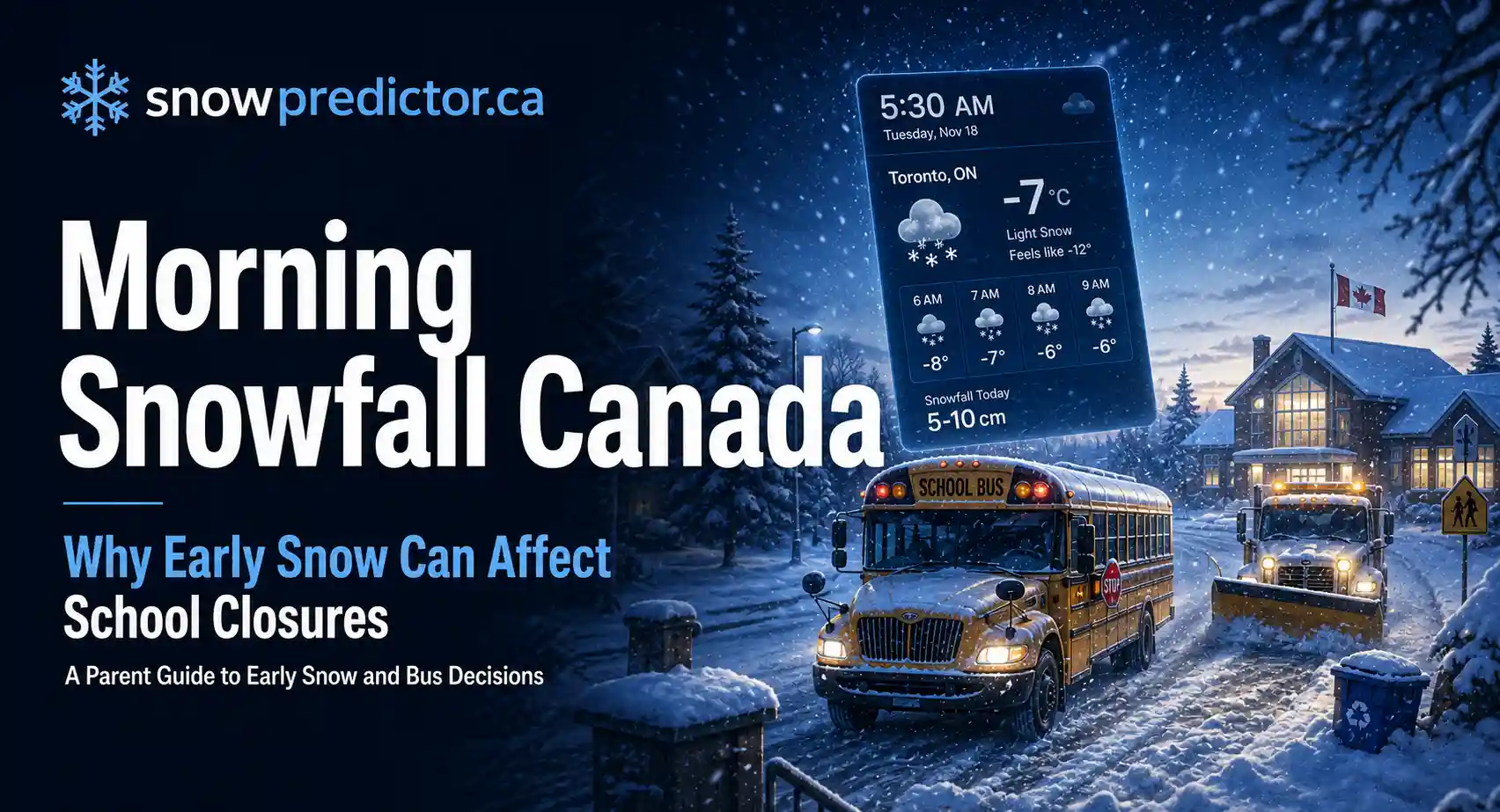
Morning Snowfall Canada: Why Early Snow Can Affect School Closures
Canadian parents may wake to only a few centimetres of fresh snow and still find that buses are cancelled or schools are changing operations. Snow beginning near the morning commute can cover roads after plows have passed, reduce visibility during route inspections and leave transportation teams little time to assess conditions before buses depart. This guide explains how morning snowfall school closures can happen, why route conditions matter more than one snowfall total and what families should check before children leave home. The Canada Snow Day Predictor can support early planning, while official weather, road, transportation and school-board notices remain the final sources.
Why Early Snow Can Disrupt the School Morning
Morning snowfall school closures become more likely when snow begins or intensifies during the early decision window. Transportation teams may be assessing roads while snow is accumulating, traffic is increasing and plows are trying to keep priority routes clear.
There is no national snowfall amount that automatically closes Canadian schools. Boards and transportation providers consider current and forecast weather, road conditions, visibility, ice, plow activity and expected conditions when students would return home.
| Snow Timing | Possible Effect Before School |
|---|---|
| Ends before midnight | More time for plowing, salting and route checks |
| Continues through the night | Roads may become covered again after each plow pass |
| Starts around 4 to 6 a.m. | Conditions may worsen while transportation decisions are being made |
| Begins after buses depart | Morning travel may operate normally, but dismissal could be affected |
The same snowfall total can produce different outcomes because the available clearing time changes.
Why Morning Snowfall School Closures Differ From Overnight Storms
Early morning snowfall starting around 4 or 5 a.m. may still be intensifying when school boards and transportation providers must decide whether buses can operate.
Confidence also changes. During active morning snowfall Canada conditions, a road that looks acceptable at 4:30 a.m. may be snow-covered by 6 a.m.
The overnight snowfall Canada guide explains why an earlier ending storm may create more recovery time than snow arriving close to departure.
Why a Small Morning Accumulation Can Be Disruptive
A modest amount of snow can cause serious travel problems when it falls quickly, lands on untreated pavement or covers existing ice. Fresh snow may hide lane markings, road edges, potholes and slippery surfaces beneath it.
Three centimetres falling slowly after roads have been treated may be manageable. Impacts can differ.
Morning snowfall school closures are therefore not based on one universal centimetre threshold. Morning snow school closures depend on route safety. School closures due to snow remain local decisions. The important question is whether the complete school route can be travelled safely at the time buses, pedestrians and family vehicles need to use it.
Snowfall Rate Matters During the Commute
Snowfall rate describes how quickly snow is accumulating. Five centimetres spread across ten hours may be easier to manage than five centimetres falling in two hours.
A high snowfall rate can:
- Cover treated roads again
- Hide ice and road markings
- Reduce visibility during route inspections
- Slow plows, buses and regular traffic together
- Create sharp differences between neighbouring communities
- Make arrival times difficult to predict
- Cause drifting when combined with wind
Parents should read the hourly forecast and full alert rather than relying only on a daily snow icon. Phrases such as “heavy at times,” “rapidly accumulating,” “poor visibility” and “difficult travel” may be more useful than the final total.
Morning Snowfall School Closures and Official Weather Alerts
Morning snow does not always trigger a formal Snowfall Warning. It may appear in a regular forecast, Special Weather Statement, Winter Storm Warning, Snow Squall Warning or another weather message.
Snowfall alerts focus on significant accumulation. Snow Squall alerts cover narrow bands of intense snow and sudden visibility loss. Winter Storm alerts may involve several serious hazards, including snow, freezing rain, wind and cold.
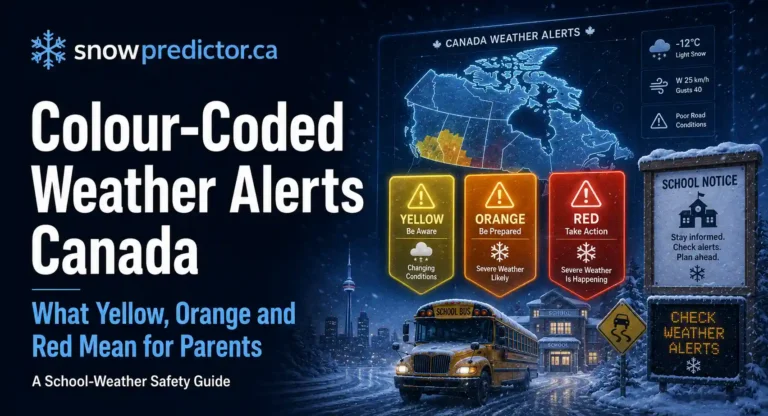
Canada also uses yellow, orange and red impact colours with formal Warnings, Advisories and Watches. The colour helps describe expected disruption, but it does not decide whether a school closes.
The Canadian weather alerts guide explains how parents can read the hazard, alert type, colour, timing and impact statement together.
Why Transportation Decisions Can Change Quickly
School transportation decisions are often made before the morning commute is fully underway. When snow begins close to the deadline, officials may have less completed information than they would after a storm that ended overnight.
Transportation teams may review:
- Road-patrol and bus-operator reports
- Current and forecast snowfall
- Visibility and wind
- Snowplow timing and road-treatment progress
- Bridges, hills and exposed rural roads
- Ice beneath fresh accumulation
- Conditions expected before afternoon dismissal
- Whether buses can complete the full route safely
The afternoon forecast matters because a route that appears manageable at 7 a.m. may still be cancelled if heavier snow is expected before buses return.
Why Rural Routes May Be Cancelled First
Morning snowfall school closures and transportation changes do not affect every area equally. Rural buses may cross open roads where drifting and reduced visibility develop quickly. They may also use secondary roads that are treated later than highways and major streets.
Urban routes may receive more frequent plowing but face congestion, parked vehicles, narrow roads and crowded intersections. Transportation providers may therefore cancel one service area while another continues operating.
This difference explains why conditions outside one home cannot confirm whether the child’s entire route is safe.
Can Buses Be Cancelled While Schools Stay Open?
Yes. Transportation and school-building decisions are separate. A provider may cancel buses because roads are unsafe while the school remains accessible to staff and nearby families.
Possible outcomes include:
- Normal school and bus operations
- Selected route or service-area cancellations
- All buses cancelled while schools remain open
- Delayed opening
- Individual school closures
- Board-wide closure
- Normal morning service followed by dismissal changes
School bus cancellations do not automatically mean classes are cancelled. Families must check both the transportation provider and school board. The bus cancelled but school open guide explains what parents should consider when transportation stops but the building remains open.
What Parents Should Check Before School
Check When the Snow Started
Determine whether snow began overnight, has just started or is expected to intensify during the commute. The start time can be as important as the final total.
Read the Hourly Forecast
Review snowfall rate, visibility, wind, temperature and any expected transition to freezing rain or blowing snow. Morning commute snowfall can become more dangerous when wind or ice develops at the same time.
Read Active Weather Alerts
Check whether the home, school and complete route are covered by a Warning, Advisory, Watch or weather statement. Open the latest message rather than relying on an old screenshot.
Review Winter Road Conditions
Use the relevant provincial or territorial road service for reported winter road conditions, closures and cameras. A major road may look clear while rural or secondary roads remain snow-covered.
Check Transportation
Look for the child’s route, school, zone or service area. Do not infer school transportation cancellations from one neighbourhood photograph or a snowfall total.
Check the School Board
Confirm whether the school is open, delayed or closed and whether childcare, activities or dismissal procedures have changed. The weather app versus school-board notice guide explains which source answers each question.
A Five-Minute Morning Snow Checklist
Before a child leaves home, confirm:
- The current snowfall rate
- Expected additional accumulation
- Visibility and wind
- Road and sidewalk condition
- Whether snow is covering treated roads again
- Bus, route or service-area status
- School operating status
- Conditions expected near dismissal
- Backup childcare or pickup arrangements
The useful question is not simply, “How much snow is falling?” It is, “What will the full route be like when buses need to travel?”
How Snowplow Timing Changes the Outcome
Snowplow timing determines how much of the road network can be cleared before inspections and departures. Priority highways and main streets may receive attention before residential, rural and secondary roads.
Continued snow can cover a route again soon after a plow passes. Transportation providers need the entire route to be manageable, including bridges, hills, turning areas, stops and school entrances.
This is why a parent may see a clear main street while morning snowfall school closures or bus cancellations are still being considered. The route may include untreated, drifting or repeatedly covered sections that are not visible from home.
The winter road conditions and school closures guide explains how maintenance and route exposure affect decisions.
Should Parents Drive When Buses Are Cancelled?
A family vehicle is not automatically safer than a school bus. First determine why transportation was cancelled.
The concern may involve rural roads, bridges or hills outside the family’s direct route. However, fast snowfall, poor visibility and unplowed streets can also affect a short urban trip.
Drivers should check current road reports, clear every window, reduce speed, increase following distance and avoid sudden braking or steering. Winter tires improve traction but do not make a low-visibility or unplowed road safe.
Parents should delay travel when they cannot confidently assess the route. The winter weather safety checklist provides practical travel guidance.
Walking and Bus-Stop Safety
Fresh snow can hide ice, uneven pavement, curb edges and roadside hazards. Children should wear visible, weather-appropriate clothing and footwear with good traction.
At the bus stop, families should:
- Keep children well back from the road
- Avoid climbing snowbanks
- Allow vehicles extra stopping distance
- Supervise younger children
- Keep hands free for balance
- Return indoors if the bus is delayed and visibility worsens
Schools may also shorten recess or move it indoors when playgrounds and walking surfaces are unsafe.
What If Snow Starts After the Initial Decision?
Morning snowfall school closures are not always decided before dawn. Conditions can change after a board announces normal operations. Snow may intensify, a squall may move into the area or temperatures may create ice beneath the accumulation.
Keep transportation and school notifications enabled throughout the day. A school may cancel activities, delay dismissal or change afternoon buses even after a normal morning.
Parents should confirm who can collect the child if service changes and should not assume that the return trip will match the journey to school.
How Families Can Plan the Night Before
Even when snow is forecast to begin near dawn, families can prepare early. Charge phones, check notification settings, prepare winter clothing and confirm the child’s route, zone or service area.
The Canada school-closure probability tool can support school closure prediction with a location-based estimate of possible disruption. Families should compare that estimate with official alerts, road reports, transportation notices and board announcements.
The estimate may help families think about snow day chances and backup childcare, but it does not confirm a closure or declare a route safe. Official decisions always take priority when morning snowfall school closures are possible.
Frequently Asked Questions
Will Schools Be Cancelled Tomorrow in Ontario?
That depends on the date, local school calendar, weather, transportation decisions and official board notices. During the regular school year, families should check their transportation provider and school board before departure. Summer-school, private-school and year-round programmes may follow different schedules.
What Age Can You Legally Quit School in Ontario?
Students in Ontario are generally required to attend school until they turn 18 or graduate, whichever happens first. Some students aged 14 or older may qualify for approved alternative-learning arrangements, but they cannot simply stop attending without meeting the applicable legal or programme requirements.
At What Temperature Do School Buses Not Run?
There is no single temperature used by every Canadian or Ontario transportation authority. Local policies may consider temperature, wind chill, road conditions, visibility, vehicle reliability and forecast timing. Families should check the specific provider’s extreme-cold and inclement-weather policy.
Is School Cancelled Today in Nova Scotia?
That depends on the current date, regional school calendar and official weather notice. During scheduled holidays or summer break, regular classes may not operate, but that is different from a weather cancellation. During the school year, check the regional centre for education and transportation updates.