Lake-Effect Snow School Closures in Ontario: What Families Need to Know
A clear forecast can turn confusing overnight when one Ontario community wakes up under deep snow while a nearby town sees bare pavement. This sharp difference is common during lake-effect snow. Narrow, shifting snowbands can cover a bus route faster than crews can clear it, reduce visibility within minutes and leave neighbouring school zones with completely different conditions.
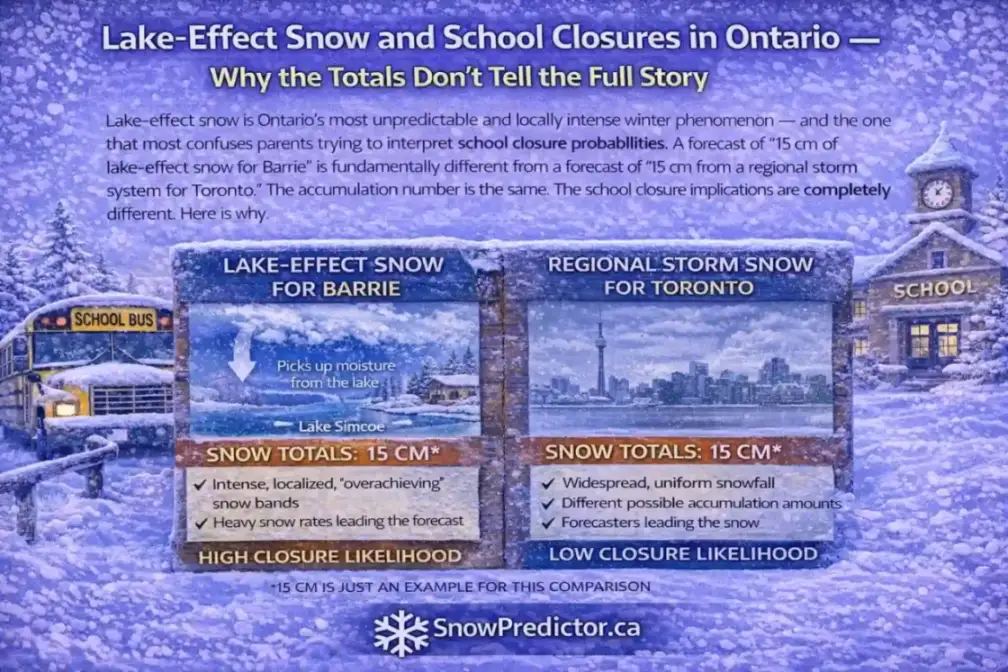
That is why lake-effect snow school closures cannot be predicted from a regional snowfall total alone. Officials must consider where a band is located, how roads are responding and whether buses can complete both trips safely. This guide explains the weather, identifies Ontario’s exposed snowbelts and shows parents how to interpret forecasts, prediction percentages and official notices.
Lake-Effect Snow Closure Risk at a Glance
| Ontario Region | Main Water Source | Common Wind Setup | Main School-Day Concern | Where Families Should Verify |
|---|---|---|---|---|
| Barrie and Simcoe County | Georgian Bay | West to northwest | Fast accumulation, rural roads and changing visibility | SCSTC and the applicable board |
| Collingwood and Wasaga Beach | Georgian Bay | Northwest to north | Persistent bands, drifting and zone-specific impacts | SCSTC West Zone updates |
| Owen Sound and Grey-Bruce | Lake Huron and Georgian Bay | West to northwest | Whiteouts, exposed roads and heavy local totals | Grey Bruce transportation and board notices |
| Goderich, Huron and Perth | Lake Huron | West to northwest | Rural route conditions and drifting | Local transportation consortium |
| London area | Lake Huron, sometimes Lake Erie enhancement | Northwest or west | Uneven conditions across a large service area | Southwestern Ontario transportation updates |
| Sault Ste. Marie and areas east of Lake Superior | Lake Superior | West to northwest | Intense squalls, cold and long routes | Local board and transportation provider |
| Kingston and eastern Lake Ontario corridor | Lake Ontario | West to southwest, depending on location | Local bands and abrupt visibility loss | Local board and transportation consortium |
This table shows exposure, not guaranteed closures. Outcomes also depend on temperature, moisture, band movement and road conditions.
What Causes Lake-Effect Snow School Closures?
Lake-effect snow develops when cold air travels over comparatively warmer, open lake water. Heat and moisture enter the lower atmosphere, making the air unstable. As that air moves downwind and reaches land, it can form organized snow showers or intense squalls.
The distance air travels across open water is called fetch. A longer fetch can collect more heat and moisture, but wind, temperature differences, terrain and ice coverage also influence the result.
A broad winter storm often affects many communities at once. Lake effect snow Ontario events can be much more localized. One town may receive heavy snow while another a short drive away gets flurries. The band may also shift when the wind changes, transferring the greatest risk from one transportation zone to another.
This behaviour makes a lake effect snow forecast difficult to translate into a yes-or-no prediction. Route-level effects often become clearer only when radar, surface reports and road observations show where the band has settled.
Why Lake-Effect Snow School Closures Happen
Snow depth matters, but it is rarely the only issue. The most serious transportation risk may be the rate at which conditions change.
Visibility Can Fall Before Roads Look Deep
Heavy snow and wind can produce dangerous blowing snow and visibility. A driver may enter a whiteout along one part of a route. Open rural roads are exposed because drifting can return after a plow passes.
Environment and Climate Change Canada describes a snow squall warning as an alert for localized, intense snowfall that significantly reduces visibility and may include strong, gusty winds. A snow squall warning Ontario families receive should therefore be treated as a serious travel signal, even when the forecast total for their town looks modest.
Morning Conditions Are Only Half the Decision
A route might be manageable before school but unsafe later. Officials consider whether the band could strengthen or move before dismissal, along with freezing rain, flash freezing, wind and road-crew response.
Large Boards Include Different Road Networks
A board can include city streets, county roads, hills and rural routes. Localized snowfall totals can create safe travel in one area and unacceptable conditions elsewhere, so some systems use weather zones.
The Ontario Snowbelts Most Exposed to Disruption
Georgian Bay: Barrie, Collingwood and Simcoe County
Georgian Bay lake effect snow frequently affects communities southeast and east of the bay when cold air and favourable winds align. Barrie, Innisfil, Orillia, Midland, Collingwood, Stayner and surrounding rural areas do not always experience the same band at the same time.
The Simcoe County Student Transportation Consortium divides the county into North, West, South and Central zones. Its guidance says officials assess forecasts, roads, visibility, precipitation and plowing. Decisions can affect one zone, several zones or the county.
This process matters when interpreting Simcoe County snow days. A Central Zone cancellation does not cover the West or North Zone, and a bus notice does not mean every building is closed. Use the SCDSB snow day tracker for context, then confirm with SCSTC and the board.
Lake Huron: Grey-Bruce, Huron-Perth and Southwestern Ontario
The Lake Huron snowbelt includes weather-sensitive rural corridors. The Bruce Peninsula, Owen Sound, Goderich and inland areas can receive persistent bands, while open roads add drifting.
Grey Bruce school bus cancellations may be issued because one or more routes have unsafe conditions, even when snowfall in a nearby community appears lighter. Parents should use the Student Transportation Service Consortium of Grey Bruce for transportation status and the relevant board for building information.
London and neighbouring counties can also be affected. Southwestern Ontario Student Transportation Services says bus companies review early conditions and post cancellations by 6:30 a.m. A cancellation may affect only part of a county, making blanket claims about snowbelt school closures unreliable.
Lake Superior and Northern Ontario
Cold air crossing Lake Superior can produce Great Lakes snow squalls around Sault Ste. Marie and downwind locations. Northern routes may combine heavy snow, low temperatures and long travel distances.
Northern location does not guarantee a closure. The question is whether buses, staff and families can travel safely that day.
Lake Ontario and Lake Erie Corridors
Parts of eastern Ontario can receive lake-effect bands from Lake Ontario, while communities near Lake Erie may experience localized squalls under favourable winds. The affected corridor depends heavily on wind direction. Hamilton, Niagara, Kingston and Belleville should not be treated as one uniform snowbelt.
These areas can also receive lake-enhanced snow within a larger storm. Parents should follow local alerts and boundaries instead of assuming every lakeside community faces equal risk.
What Actually Determines a School-Day Decision?
There is no single Ontario snowfall number that automatically closes schools. Public guidance from transportation consortia and boards commonly points to several practical factors:
- Current road and surface conditions
- Visibility along actual bus routes
- Forecast snow, wind, freezing rain or flash freezing
- Whether snow is accumulating or drifting faster than crews can clear it
- Confirmation that plows and road crews are operating
- The location and expected movement of the snowband
- Conditions expected for the afternoon return trip
- Access to schools for students, staff and emergency services
This explains why lake-effect snow school closures Ontario searches produce different answers for adjacent boards. Each authority evaluates its own routes and conditions.
Bus Cancelled Does Not Always Mean School Closed
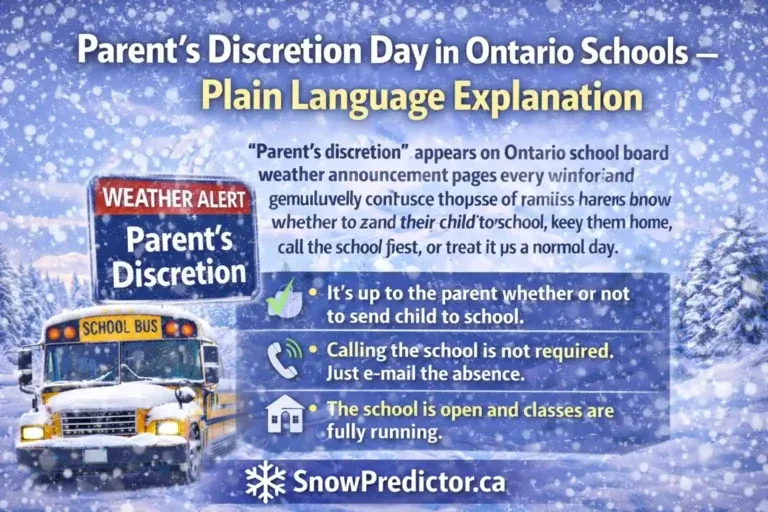
This is the key distinction for parents. School bus cancellations Ontario authorities issue may occur while buildings remain open. Follow attendance and transportation instructions, and never assume an afternoon ride will be available after a morning cancellation.
A full closure means the building is closed. A zone cancellation affects specified routes; a delay is different again. Read the date, zone, school and whether the notice covers both trips. The guide to bus cancelled versus school closed in Ontario explains each message.
How to Judge Tomorrow’s Risk Without Guessing
A prediction tool supports preparation, not official confirmation. To assess lake-effect snow school closures and improve snow day prediction Ontario planning, combine these signals:
- Read the alert wording. A watch means conditions are favourable; a warning means hazardous conditions are occurring or expected. Check the valid location and time.
- Study radar movement. A narrow band approaching your area may matter more than a broad regional total. Radar is an observation tool, but the band can still strengthen, weaken or shift.
- Check hourly wind. Wind direction helps identify the downwind corridor, while speed affects band organization and drifting.
- Consider timing. Overnight accumulation, the morning commute and the afternoon return each matter.
- Check road information. Ontario 511, municipal updates and local reports help show whether roads are snow-covered, closed or improving.
- Verify the official notice. Use the transportation consortium and board website before changing plans.
SnowPredictor Canada can organize these signals into an early probability for possible lake-effect snow school closures. It does not make the decision, and its percentage never overrides an official update.
A Practical Morning Checklist for Parents
Prepare before a squall reaches your route. Bookmark the correct transportation and board pages, identify your weather zone and enable official notifications where available. Then use this order on a storm morning:
- Confirm the alert applies to your community, not only a nearby region.
- Check whether the message says delay, route cancellation, zone cancellation or full cancellation.
- Look separately for a school-building announcement.
- Confirm whether afternoon transportation is also cancelled.
- Report an absence through the school’s normal process if required.
- Keep a backup care and work plan for fast-changing events.
Many Ontario school closures are announced early, but timing varies. The guide to when Canadian schools announce closures outlines usual decision windows. It also helps families prepare for winter weather school closures without assuming every board reports at the same time.
Frequently Asked Questions
Why Do Lake-Effect Snow School Closures Occur?
Lake-effect snow can create intense, localized snowfall, drifting and sudden visibility loss on selected roads. Transportation officials may cancel service when routes cannot be completed safely, while a school board separately decides whether buildings will remain open. Conditions on the full route matter more than the snow measured at one home.
Does a Snow Squall Warning Automatically Close Ontario Schools?
No. A warning is an important hazard signal, not an automatic closure order. Local decision-makers also assess road inspections, visibility, plowing, timing, forecast movement and afternoon travel. Always wait for the transportation consortium or school board to publish the official operating decision.
Why Can One School Zone Cancel Buses While the Next Zone Operates?
Lake-effect bands are localized and can shift with the wind. One zone may face heavy snow and whiteouts while another has acceptable visibility and clearer roads. Zoned cancellations allow transportation operators to respond to actual local risk instead of treating a large county as if conditions were identical.
Are Lake-Effect Snow School Closures More Common Near Georgian Bay?
Communities downwind of Georgian Bay are regularly exposed to lake-effect snow, but there is no dependable public number that guarantees how many closures a board will have in a year. Ice cover, wind, storm timing, road conditions and local decisions change each season.
How Accurate Is an Evening School-Closure Prediction During Lake-Effect Snow?
An evening estimate can identify a favourable weather setup, but confidence may be lower when the snowband has not formed or its track remains uncertain. Radar and road observations often provide better local evidence overnight. Treat the prediction as planning guidance and verify the official notice in the morning.