How Schools Decide Snow Days Canada: The Complete Process
Snow is falling, buses are due within hours and parents need enough time to arrange childcare. Behind the eventual announcement is not one national formula or a simple snowfall threshold. Each school authority follows its own severe-weather procedures, gathers local information and decides whether transportation and buildings can operate safely.
Understanding how schools decide snow days Canada helps explain why nearby boards sometimes make different calls. Officials may examine forecast timing, road inspections, freezing rain, visibility, wind, route exposure, staffing and conditions expected later in the day. The organization cancelling buses may also be different from the one closing schools.
This guide explains who makes each decision, the information considered, a typical morning workflow and important provincial differences. It also shows families where predictions end and official instructions begin.
Who Decides and How Schools Decide Snow Days Canada
There is no federal or province-wide official who makes every local snow day call. Education systems are organized differently across Canada, but authority generally sits with a school board, school division, district, regional centre or designated senior administrator operating under local policy.
The answer to who decides school closures can also depend on the outcome:
| Decision | Usually Responsible | What It Affects |
|---|---|---|
| Cancel buses | Transportation consortium, division or board | Some or all student transportation |
| Close all schools | Director, superintendent or designated authority | Buildings and in-person operations |
| Close one school | Board or regional authority, sometimes after a principal’s recommendation | A specific building or area |
| Delay opening | District, division or regional authority | Start time and often transportation |
| Dismiss early | Education authority working with schools and transportation | End time and return travel |
Each school board weather policy is decisive. For example, Simcoe County procedures allow a principal to recommend closure in very severe conditions, with the recommendation moving through a superintendent to the Director. TDSB policy places its closure decision with the Director. These examples show why one absolute description is inaccurate.
How Schools Decide Snow Days Canada Step by Step
The exact sequence and timing vary. Still, the Canadian school closure process and most inclement weather school closure policies move through similar stages before students travel.
1. Monitor the Developing Forecast
Staff review forecasts and official weather alerts before the school morning. They look beyond a daily snow icon and examine when precipitation will begin, intensify and end. Forecast uncertainty also matters because a narrow snowband or freezing line can shift overnight.
Weather monitoring may include:
- Snowfall amount and rate
- Freezing rain or ice pellets
- Temperature and flash-freeze potential
- Wind, gusts and blowing snow
- Visibility during bus hours
- Warnings, advisories and watches
- Conditions expected at dismissal
A forecast identifies potential hazards. It does not show the condition of every local road, school entrance or bus turnaround.
2. Assess Roads and Transportation Routes
Transportation staff, bus operators or designated personnel may evaluate actual conditions across the service area. Methods differ by authority and can include route observations, municipal information, contractor reports and communication with road-maintenance teams.
The assessment must represent the network, not only downtown streets. Rural roads may remain snow-covered after major routes are cleared. Open farmland can develop drifting and poor visibility. Hills, bridges, valleys and untreated side roads create additional problems.
This is why road conditions school closures cannot be judged from what one parent sees outside a home. The most exposed route may be many kilometres away.
3. Review School and Building Operations
Even if buses could operate, officials may need to consider whether buildings are accessible and properly staffed. Parking lots, entrances and walkways must be manageable. Power, heat, water or storm damage can affect an individual school even when the wider system remains open.
Boards may also consider whether enough employees can reach work safely. These operational details are rarely available to a public weather tool.
4. Separate Transportation From Building Status
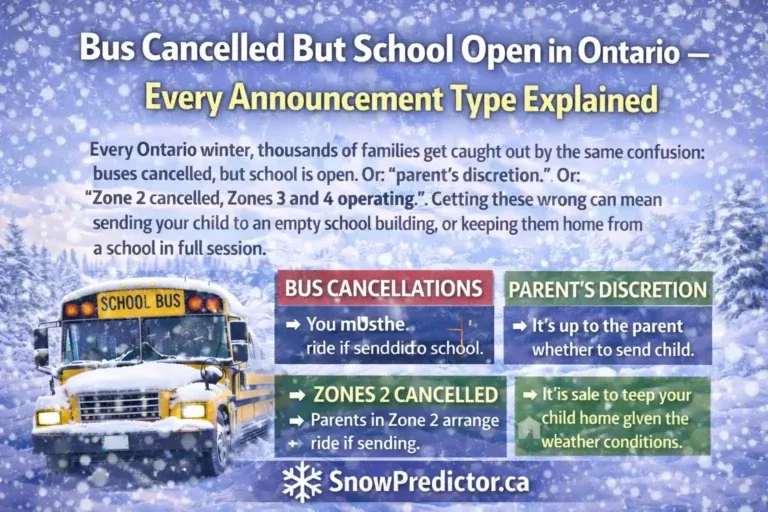
Many Canadian authorities can cancel transportation without closing schools. This creates the familiar buses cancelled schools open announcement. Students who can arrive safely by another method may still attend, while families using cancelled transportation must decide what to do.
The distinction is especially important in Ontario, where transportation consortia often communicate bus status separately from school boards. The guide to bus cancellation versus school closure explains the possible notice types.
5. Make and Communicate the Decision
The authorized decision-maker reviews weather, route and operational information. Possible outcomes include normal operations, partial transportation cancellation, all-bus cancellation, delayed opening, selected-school closure, system-wide closure or early dismissal.
Once decided, authorities may communicate through websites, email, text alerts, automated calls, social accounts, apps and local media. Families should use a first-party source rather than a screenshot or forwarded message that may omit affected zones.
Factors in How Schools Decide Snow Days Canada
The snow day decision process is based on expected impact. No single factor automatically creates a closure across Canada.
| Factor | Question Officials May Consider |
|---|---|
| Storm timing | Will the worst conditions overlap with transportation? |
| Snowfall rate | Can roads remain passable while snow continues? |
| Ice | Can buses, staff and walkers travel safely? |
| Visibility | Can drivers see roads, intersections and students? |
| Wind and drifting | Will cleared rural roads quickly become covered? |
| Temperature | Are extreme cold or flash freezing creating hazards? |
| Route geography | Are hills, bridges or remote roads affected? |
| Forecast trend | Are conditions improving or worsening before dismissal? |
| Building readiness | Are sites heated, powered, cleared and accessible? |
Snowfall Amount and Rate
There is no national centimetre threshold for winter school closures. A community accustomed to frequent snow may continue operating after an amount that causes severe disruption elsewhere. The rate and timing can matter more than the final total because roads may deteriorate faster than crews can clear them.
Freezing Rain and Flash Freezes
Freezing rain school closures can occur with little or no snow. Ice affects braking, turning, hills, sidewalks and school entrances. A rapid temperature drop after rain or melting snow can also create widespread black ice. These hazards are difficult to summarize using accumulation alone.
Blowing Snow and Visibility
Strong wind can lift falling or loose snow, obscure road edges and rebuild drifts after plowing. Rural routes across open ground are particularly exposed. Officials may cancel transportation even when new snowfall is modest.
Extreme Cold
Policies for extreme cold school closures differ widely. Authorities may consider wind chill, the time students spend waiting, vehicle reliability, local exposure and whether transportation can operate. An extreme cold warning should prompt close monitoring, but it does not create an automatic Canada-wide closure.
Why Timing Can Change the Decision
An identical snowfall total can produce different calls depending on the clock. Snow ending well before buses run gives road crews time to work. Heavy precipitation beginning just before pickup leaves less recovery time. Conditions expected to worsen during the afternoon raise questions about safely returning students home.
This is a central part of how schools decide snow days Canada. Officials do not only ask what has already fallen. They assess what routes may look like when buses depart, when staff arrive and when students leave school.
Early dismissal carries its own risks. Families must receive notice, younger children need supervision and transportation must be reorganized. Some authorities therefore publish separate procedures for decisions made after classes begin.
Why Urban and Rural Boards Decide Differently
Dense urban systems may have extensive municipal snow clearing, shorter routes, public transit and fewer students using yellow buses. Rural or mixed authorities may cover large areas with gravel roads, hills and exposed farmland.
Neither type follows an automatically stricter or more relaxed rule. The difference lies in operational exposure. A rural transportation cancellation may reflect one unsafe zone even while streets around an urban school look clear.
Microclimates add further variation. Lake-effect bands, coastal storm tracks, elevation and valley icing can affect nearby communities differently. The guide to Canadian microclimates and snow days explains those local contrasts.
How Schools Decide Snow Days Canada by Region
Local policy matters more than provincial stereotypes. These examples show why school closure decisions in Canada vary without creating universal rules.
Ontario
Boards and student transportation consortia commonly distinguish transportation cancellation from building closure. Simcoe County states that when buses are cancelled, schools remain open unless otherwise announced. Its morning cancellations apply for the entire day, so cancelled buses do not resume for afternoon travel.
Some Ontario notices also emphasize family judgment. A parent discretion day Ontario search usually reflects guidance that parents or guardians decide whether personal travel is safe when schools remain open.
Quebec
Centres de services scolaires and English-language school boards issue their own decisions. Families should check the organization responsible for their school because neighbouring systems can communicate separately.
British Columbia and the Prairies
School districts and divisions account for large differences between coastal, mountain, urban and rural conditions. Lower-elevation rain or ice can occur while higher routes receive snow. Prairie decisions may focus heavily on wind, drifting, visibility and extreme cold.
Atlantic Canada
Many families refer to storm days Atlantic Canada, reflecting events that may involve snow, rain, ice and wind rather than snow alone. Halifax Regional Centre for Education lists several possible outcomes, including delayed opening, bus cancellation, selected-school closure, full closure and early dismissal.
What Time Are Snow Day Decisions Announced?
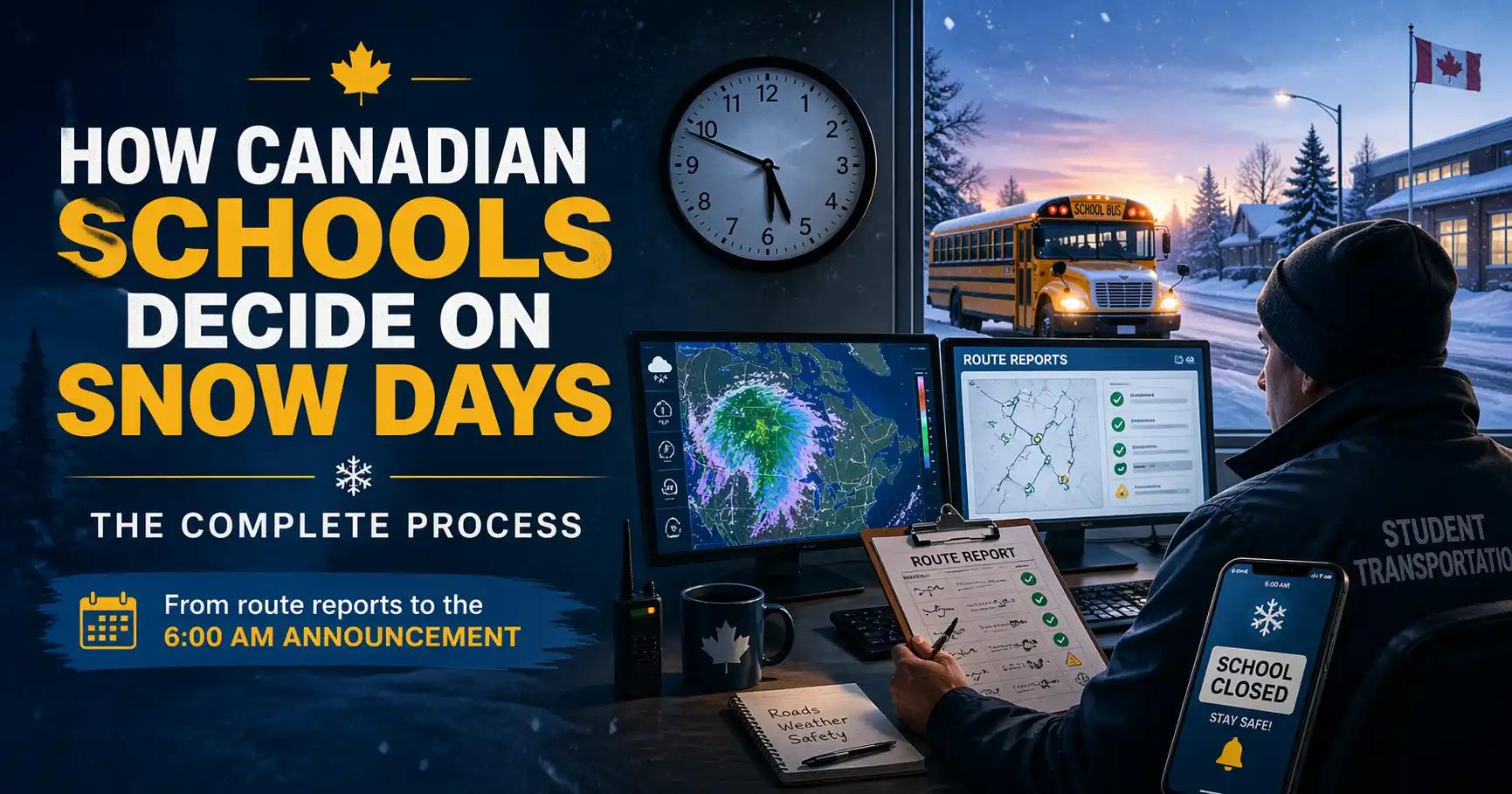
There is no universal school closure announcement time. Many authorities aim to communicate before morning transportation, often around 6:00 or 7:00 a.m., but deadlines and channels vary.
Simcoe County’s transportation consortium says it tries to decide before 6:00 a.m. and post announcements before 7:00 a.m. Halifax Regional Centre for Education says morning operational decisions are communicated as close to 6:00 a.m. as possible. These examples are not national rules.
Save your authority’s official status page and notification settings before winter weather arrives. The guide to when Canadian schools announce closures provides a fuller planning overview.
Where SnowPredictor Fits Into the Process
SnowPredictor uses forecast conditions to provide early planning guidance for snow day prediction Canada. It can help families identify elevated disruption risk before an announcement, but it cannot inspect roads, receive private contractor reports or make the decision.
This limitation is essential to understanding how schools decide snow days in Canada. A prediction estimates likely behaviour based on available information. An official school closure notice communicates the actual decision.
Use the estimate to prepare childcare or work flexibility, then confirm the result through the relevant school and transportation sources.
Frequently Asked Questions
Who Decides Whether Schools Close for a Snow Day in Canada?
The responsible school board, division, district or regional education authority makes the closure decision under its policy. Transportation consortia or departments may make separate school bus cancellations. The exact authority varies by location and outcome.
How Much Snow Is Needed to Close a Canadian School?
There is no Canada-wide threshold. Officials consider snowfall rate, timing, ice, visibility, wind, route exposure, road clearing and local capacity. A smaller ice event may be more disruptive than a larger snowfall.
Can Buses Be Cancelled While Schools Stay Open?
Yes. Many authorities treat transportation and building operations as separate decisions. Read the full notice to determine whether it affects all buses, selected zones, particular schools or every building.
What Time Are Snow Day Decisions Announced in Canada?
Times vary. Many authorities aim to announce before morning transportation, often around 6:00 or 7:00 a.m. Check your board or transportation organization’s published policy and subscribe to its first-party alerts.
Does a Snow Day Predictor Provide the Official Decision?
No. A predictor estimates disruption risk for planning. Only the responsible education or transportation authority can confirm a closure, delayed opening, early dismissal or bus cancellation.