When Does It Snow in Canada? Month-by-Month Guide
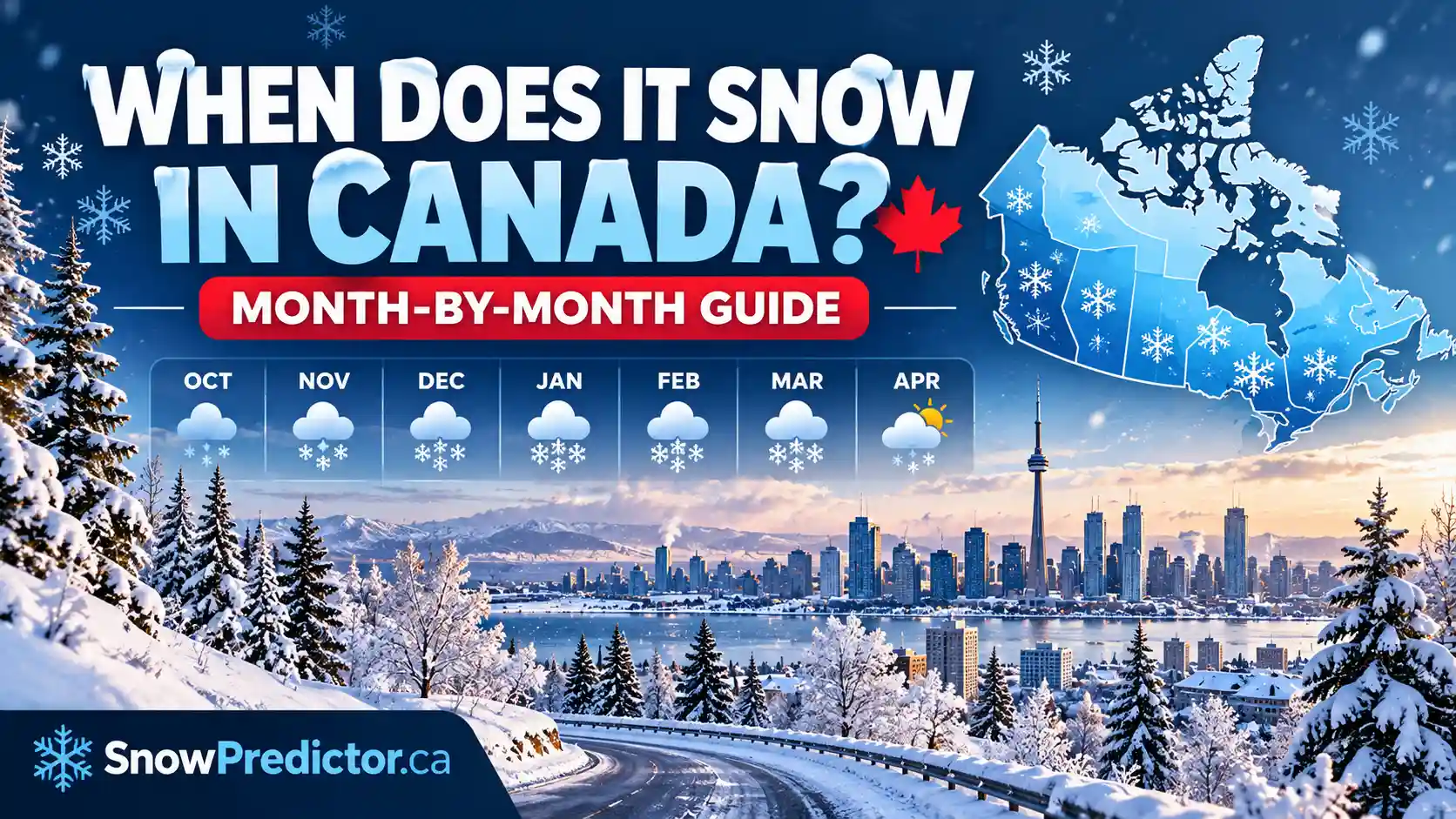
When does it snow in Canada? In most populated parts of the country, the practical snow season runs from October or November through March or April. Northern communities and the Canadian Rockies can see snow much earlier and later, while coastal Vancouver may wait until December for meaningful snowfall and can have winters with relatively little snow.
There is no single Canadian first-snow date. Canada covers Arctic, mountain, Prairie, Great Lakes, Atlantic and Pacific climates, so the answer changes dramatically by location. Environment and Climate Change Canada’s Climate Normals are based on long-term observations and show how strongly snowfall timing varies between Canadian locations.
For families watching the next storm rather than seasonal averages, the Canada Snow Day Predictor can help estimate whether forecast conditions may disrupt school. Seasonal averages describe what normally happens, while current forecasts determine when the next snow actually arrives.
When Does It Usually Snow in Canada?
For much of southern Canada, snow becomes increasingly likely during November, is common from December through March, and can continue into April.
That simple answer changes as you move north, west or higher into the mountains.
| Area | Typical Start of Snow | Most Consistent Snow | Late Snow Can Continue Into |
|---|---|---|---|
| Southern Ontario | October to November | December to March | April |
| Southern Quebec | October to November | November to March | April |
| Alberta Prairies | September to October | November to March | April or May |
| Canadian Rockies | September to October | November to April | May or later at elevation |
| Vancouver | November to December | December to February | March |
| Whistler mountains | October to November | November to April | May at higher elevations |
| Atlantic Canada | November to December | December to March | April |
| Northern Canada | September or earlier | October through spring | Late spring or early summer in some areas |
These are typical patterns rather than guaranteed dates. A warm autumn can delay the first meaningful snowfall, while an early Arctic air mass can bring snow weeks ahead of normal.
Canada’s far north is the clearest reminder that a national snow calendar does not work everywhere. In July 2026, Alert, Nunavut had already recorded 17 cm of snow during the month. Summer snow there is unusual for southern Canadians but not extraordinary for the High Arctic. The Weather Network.
When Does It Start to Snow in Canada?
The first snow usually appears in stages.
The far north and high mountains can receive snow in late summer or early autumn. Parts of Alberta, northern British Columbia and northern Ontario may see their first flakes during September or October.
Across many major southern cities, October and November are the transition months. Snow may fall briefly and melt, then become more frequent as December approaches.
This distinction matters because the first snowfall is not the same as the start of permanent winter snow cover. A city can record snow in October and then return to mild weather for several weeks.
Calgary shows how early snow can arrive on the Prairies. Environment and Climate Change Canada’s 1991–2020 normals place the average first fall snowfall at Calgary Airport around October 3.
Canada Snow by Month
September
September snow is mainly a northern and mountain story.
The Canadian Rockies can receive early snow at elevation, and colder northern regions may already be moving into their winter pattern. Snow in Toronto, Vancouver or other mild southern cities during September would be much less typical.
October
October is when the Canadian snow season begins expanding southward.
Snow becomes possible across Alberta, Saskatchewan, Manitoba, northern Ontario and mountain regions. Southern Ontario and Quebec can occasionally see early flakes, although consistent winter conditions usually arrive later.
If you are asking when does it snow in Canada in October, the answer is yes, but October snow is far more dependable in the Rockies, Prairies and north than in Toronto or coastal Vancouver.
November
November is one of the biggest transition months.
Many southern Canadian cities begin recording measurable snow, while northern and inland regions are already well into winter. Mountain destinations become increasingly snowy.
This is also when families should start treating overnight snowfall forecasts more seriously because early-season storms can create transportation problems before communities have fully settled into their winter routines.
December
By December, winter is established across much of Canada.
Toronto, Montreal, Ottawa, Calgary, Edmonton and many other cities can expect snow during the month, although individual storms and snow cover vary from year to year.
Vancouver remains one of the major exceptions. Snow is possible, but rain is much more common than in most Canadian cities. Historical snowfall data show Vancouver’s meaningful snow season is much shorter than inland Canada.
January
For most Canadians, January is the heart of the snow season.
The Weather Network reports that January is normally the snowiest month across much of the country and is the snowiest month for cities including Toronto, Ottawa, Montreal, Edmonton, Saskatoon, Halifax and St. John’s. Toronto Pearson, for example, averages about 31.5 cm of snow during January under current climate normals.
January is also usually the coldest part of the year across much of populated Canada.
February
February remains firmly within the winter season almost everywhere outside the mildest coastal areas.
Snowstorms, lake-effect snow, blowing snow and freezing rain can all affect school and transportation plans. Even where seasonal snowfall begins to decrease, existing snow cover and cold temperatures can keep winter conditions in place.
March
March does not mean snow is finished.
Southern Ontario and Quebec begin transitioning toward spring, but snowstorms remain possible. Alberta and the Canadian Rockies can stay very snowy.
Calgary is a particularly important exception to the idea that January must be the snowiest month everywhere. Long-term patterns show March is typically Calgary’s snowiest month, helped by spring storm systems interacting with cold air near the Rockies.
April
April snow becomes less dependable across southern cities but remains common enough to matter.
Late-season snow can affect Ontario, Quebec, the Prairies and mountain regions. In the Rockies, spring skiing and significant mountain snow can continue.
May to August
Most populated southern Canadian cities are largely snow-free from May through September.
The exceptions are high mountains and far northern regions. Snow can continue well into spring at elevation, and occasional summer snowfall is possible in the Canadian Arctic.
When Does It Snow in Toronto, Canada?
If you are searching when does it snow in Canada Toronto, expect the main snow season from roughly November through March.
October snow is possible but uncommon. April snow can also occur, but it is usually part of the spring transition rather than the core snow season.
January is normally Toronto’s snowiest month. Toronto Pearson averages about 31.5 cm in a typical January, although individual winters can differ sharply.
Families watching an approaching Toronto storm can use the Toronto Snow Day Predictor for local school-disruption planning.
When Does It Snow in Ontario, Canada?
Ontario has one of Canada’s widest ranges of winter conditions.
Southern cities such as Toronto and Windsor usually move into regular snow later than northern communities. Northern Ontario can see its first fall snowfall weeks earlier and can maintain snow cover much longer into spring.
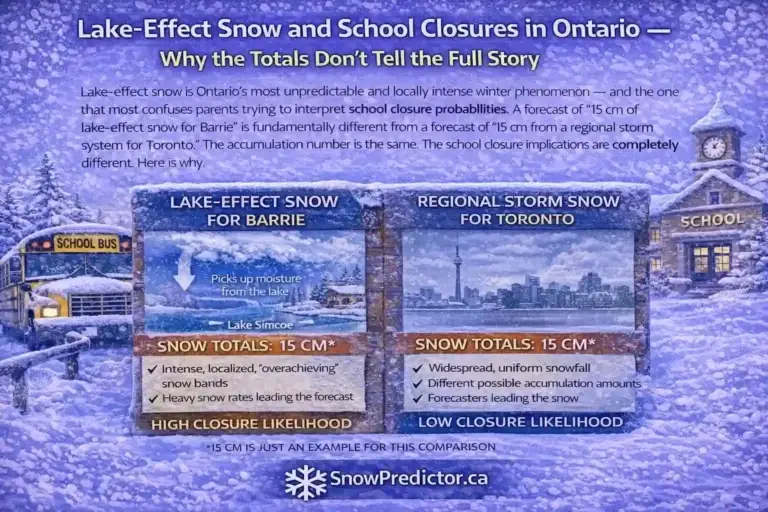
Snowbelt communities near Lake Huron and Georgian Bay can also experience frequent lake-effect snow that does not reach Toronto.
That means asking when does it snow in Ontario Canada requires a more local answer than simply checking a province-wide forecast.
When Does It Snow in Vancouver, Canada?
Vancouver has one of the mildest winter climates among major Canadian cities.
The first meaningful snowfall usually arrives around December, although snow can occur in November and occasionally earlier. Historical averages show the city receives far fewer snow days than Toronto, Montreal or Calgary.
Most Vancouver snow occurs between December and February. Some years produce several disruptive snow events, while others have very limited accumulation.
This is why when does it snow in Canada Vancouver has a very different answer from the same question for Alberta or Quebec.
The Vancouver Snow Day Predictor provides local school-closure context when winter weather reaches the Lower Mainland.
When Does It Snow in Alberta and Calgary?
Alberta can see snow much earlier than southern Ontario or coastal British Columbia.
Calgary’s long-term average first fall snowfall is around early October, but September snow is possible. Winter snow can continue through April, and spring storms sometimes reach May.
Unlike much of eastern Canada, Calgary often receives its greatest monthly snowfall in March rather than January.
The Calgary Snow Day Predictor is useful when current snowfall, cold or rapidly changing Chinook conditions may affect the school day.
When Does It Snow in Banff and the Canadian Rockies?
Banff and the Canadian Rockies have a longer snow season because of elevation.
Snow can appear at higher elevations during September and becomes much more common through October and November. Mountain winter conditions generally continue through April, while higher terrain can remain snowy well into May.
Visitors should not assume conditions in Calgary and Banff are the same. Elevation can turn rain or mild conditions on the plains into snow in the mountains.
For travellers asking where to find snow in Canada early or late in the season, the Rockies are among the more dependable choices.
When Does It Snow in Whistler, Canada?
Whistler’s mountain snow season is much longer and heavier than nearby Vancouver’s.
Whistler Blackcomb describes mid-November through late December as its early winter period and reports substantial November snowfall at mountain elevation. Ski operations generally continue through spring, with one mountain often remaining open into May.
So someone asking when does it snow in Whistler Canada should distinguish Whistler Village from the higher ski terrain. Snow can be abundant on the mountains while lower elevations experience milder conditions.
When Does It Snow in Quebec and Montreal?
Southern Quebec generally begins seeing snow during late autumn, with the most dependable winter conditions from November or December through March.
Montreal receives considerably more snow than Vancouver and usually maintains a much more consistent winter pattern.
Families can check the Montréal Snow Day Predictor when a winter storm may affect schools and transportation.
Northern Quebec has a much longer season. Recent climate research found that historical snow cover in northern Quebec can begin around late September and extend into late June, compared with roughly mid-November to early May in southern Quebec.
When Does It Snow in Niagara Falls, Canada?
Niagara Falls usually sees its main snowfall from November through March.
Its position in southern Ontario keeps the season shorter than northern Ontario, but Great Lakes weather can still produce significant winter storms. December, January and February provide the most dependable chance of seeing winter conditions.
Late autumn and early spring are less predictable. A November visit may bring snow or mild rain, while March can shift rapidly between winter and spring.
When Does It Snow the Most in Canada?
For the majority of Canadians, January is the snowiest month.
Southern Ontario, southern Quebec, much of Atlantic Canada and several Prairie cities usually reach their highest average monthly snowfall during January.
But there are important regional exceptions.
Calgary typically peaks in March. Vancouver normally receives its greatest average snowfall around December or January, while northern areas can have their snowiest period in autumn. Whistler’s mountain snowfall is especially strong from November into the heart of winter.
So the answer to when does it snow in Canada depends not only on latitude but also on elevation, proximity to large bodies of water and regional storm tracks.
Where Does It Snow in Canada at Christmas?
For the best chance of established snow around Christmas, look toward:
- Banff and the Canadian Rockies
- Whistler’s mountain terrain
- Alberta and the central Prairies
- Northern Ontario
- Quebec
- Northern and interior British Columbia
- Much of northern and inland Atlantic Canada
Toronto can certainly have snow at Christmas, but a white Christmas is not guaranteed every year. Vancouver is even less reliable at city level.
Mountain and northern destinations are generally safer choices when snow on the ground is a major part of the trip.
First Snow Is Not the Same as a Snow Day
A few centimetres of early snow do not automatically mean school closures.
School disruption depends on snowfall rate, storm timing, freezing rain, wind, visibility, roads, transportation routes and local decision-making. A 5 cm storm during a difficult morning commute may cause more problems than a larger snowfall that ends overnight.
That distinction is important for parents asking when does it snow in Canada because seasonal timing tells you when snow is likely, not whether tomorrow will be a snow day.
Are Canada’s Snow Seasons Changing?
Historical averages remain useful, but they should not be treated as permanent.
Canada’s 2026 Changing Climate Report found that snow-cover duration across the country has shortened overall during the past four decades, with especially notable reductions in northern Canada, southern Ontario and parts of eastern Canada. The report also projects shorter snow-cover seasons across Canada as warming continues.
That does not mean Canada will stop receiving major snowstorms. It means the timing, duration and form of winter precipitation can change, especially near the beginning and end of the season.
Frequently Asked Questions
What Months Does It Snow in Canada?
In most populated Canadian regions, snow can fall from October or November through March or April. Northern communities and mountain regions can see snow from September into late spring, while Vancouver usually has a shorter and less reliable snow season.
When Can We Expect Snow in Canada?
Northern and mountain areas may see snow in September or October. Many major southern cities begin seeing measurable snowfall during November, with regular winter snow becoming much more common by December.
Will Canada Have Snow in 2026?
Yes. Snow has already occurred in parts of Canada during 2026, including summer snowfall in the High Arctic. The Weather Network reported 17 cm at Alert, Nunavut, during July 2026. Snow will become increasingly common across colder regions as autumn moves toward winter, but exact dates for individual cities depend on current forecasts.
Which Month Is the Coldest in Canada?
Does It Snow in Canada in November?
Yes. November is an important transition month. Snow is already common across northern, Prairie and mountain regions, while many southern Canadian cities begin receiving their first meaningful snowfalls during November.