Snow Day Predictor vs AccuWeather: Which Should Canadians Use?
A winter forecast says 12 centimetres of snow, but parents still need the answer that affects tomorrow morning: will buses run and will schools open? A weather forecast and a school-closure estimate overlap, yet they do not serve exactly the same purpose.
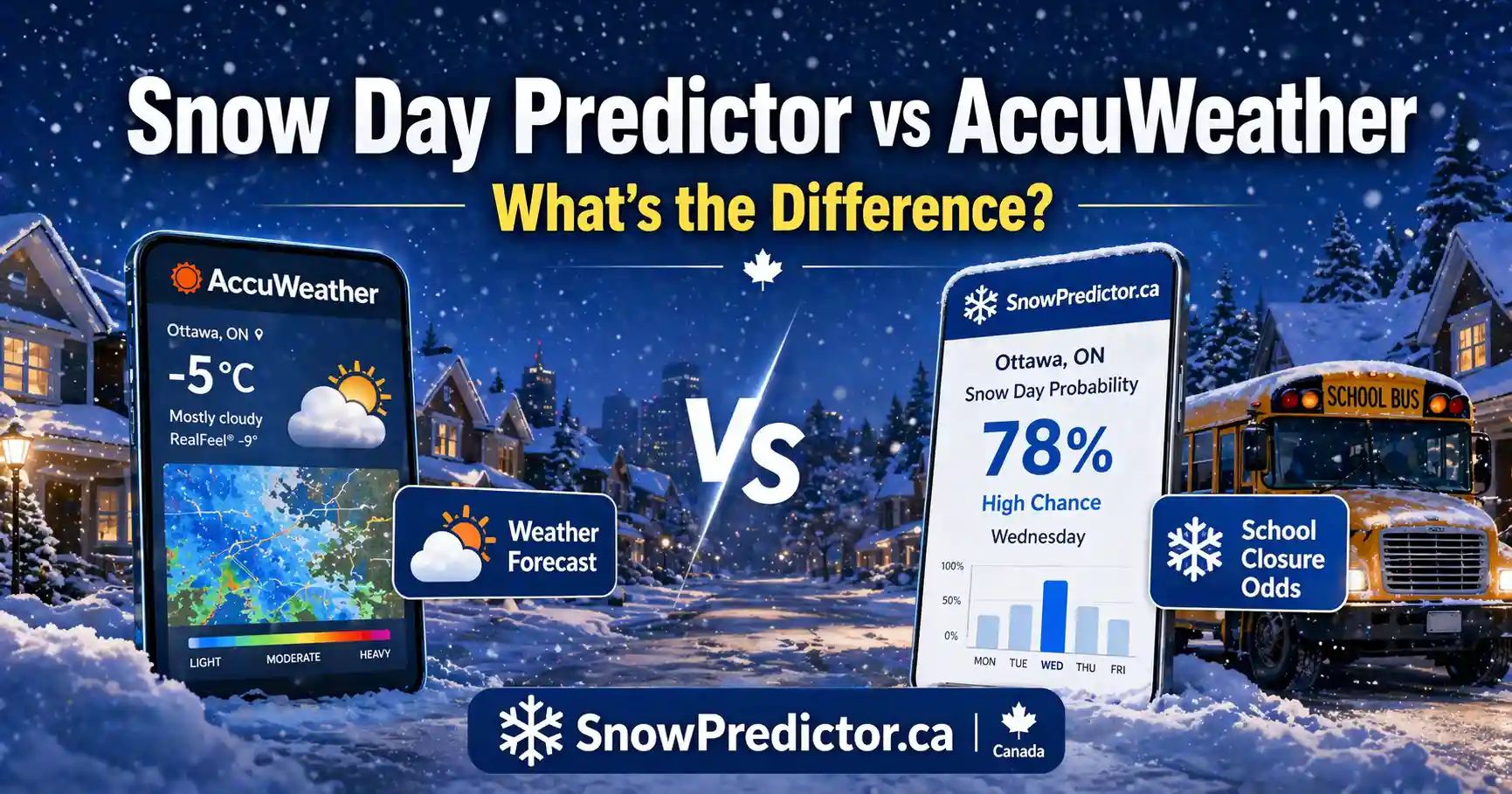
The Snow Day Predictor vs AccuWeather comparison is more nuanced than saying one predicts weather and the other predicts closures. AccuWeather is a global forecasting platform with hourly and extended forecasts, radar, weather alerts and a Snow Day Index on at least some Canadian location pages. SnowPredictor is a narrower tool built around estimated Canadian school-disruption risk.
This guide compares their outputs, strengths, limitations and best use cases. The practical answer is not to choose one blindly. It is to use the right tool for each question and confirm every operational decision with the responsible school authority.
Snow Day Predictor vs AccuWeather: Quick Comparison
| Feature | SnowPredictor | AccuWeather |
|---|---|---|
| Primary purpose | Estimate Canadian school disruption | Provide broad weather forecasting |
| Closure-related output | Location-based snow day percentage | Snow Day Index for supported locations |
| Detailed weather forecast | Limited compared with a full weather platform | Hourly, daily and extended forecasts |
| Radar | Not the main product | Interactive weather radar |
| Short-term precipitation | Closure estimate uses weather context | Minute-by-minute precipitation where available |
| Official weather alerts | Should be checked separately | Displays alerts from official authorities |
| School-board confirmation | No | No |
| Best use | Early school-day planning | Understanding storm timing and conditions |
Neither tool can issue an official school closure notice. Predictions and indices support planning; boards, districts, divisions and transportation authorities publish the final status.
What SnowPredictor Is Designed to Do
SnowPredictor Canada focuses on one outcome: the estimated chance that winter conditions will disrupt school operations for a selected Canadian location. The result is presented as a percentage that families can use when deciding whether to prepare flexible work or childcare arrangements.
A Canadian snow day predictor should consider more than daily snow accumulation. Relevant signals include precipitation type, timing, wind, visibility, temperature changes and local geography. A 10-centimetre snowfall ending early may create less disruption than freezing rain or rapidly falling snow during morning transportation.
This narrow focus is SnowPredictor’s main advantage. Users do not have to translate every weather variable into a possible board decision by themselves. The tool offers a direct planning signal.
Its limitation is equally important. A public predictor cannot inspect every road, receive private bus-contractor reports or know an administrator’s unannounced decision. Any claims about exact board calibration, accuracy or proprietary data require a published methodology and auditable evidence.
What AccuWeather Provides
AccuWeather Canada weather pages serve a much broader purpose. They provide current conditions, hourly and daily forecasts, radar, precipitation chances, temperatures, wind and other information for Canadian locations.
The platform also offers branded features such as:
- MinuteCast for short-term precipitation timing where available
- RealFeel temperature estimates
- Interactive weather radar
- Hourly and extended forecasts
- Winter-weather forecast pages
- Government-issued warnings and advisories
- Lifestyle and activity indices
MinuteCast Canada coverage provides minute-by-minute precipitation information for supported locations, generally over the next two hours. This can help users understand when precipitation may begin or end, but it does not confirm road safety or school status.
The RealFeel temperature is AccuWeather’s proprietary apparent-temperature measure. School authorities may use their own official forecasts, wind-chill information and policies, so RealFeel should not be treated as a closure threshold.
AccuWeather Also Has a Snow Day Index
Any fair Snow Day Predictor vs AccuWeather review must acknowledge the AccuWeather Snow Day Index. AccuWeather describes it as a prediction of how likely schools near a weather location are to close because of inclement weather. Canadian location pages have displayed percentage estimates for today or tomorrow.
That means the core distinction is not “AccuWeather never predicts school closures.” The more accurate comparison is:
- SnowPredictor presents itself as a dedicated Canadian school-disruption tool.
- AccuWeather provides a closure-related index inside a much larger global weather platform.
Availability may vary by location, season, page and device. Users should check whether the index appears for their Canadian city rather than assume complete nationwide coverage.
AccuWeather does not publicly expose every calculation behind a location’s Snow Day Index on the result page. SnowPredictor should likewise avoid claiming methodological superiority unless it publishes comparable data and independent validation.
Snow Day Predictor vs AccuWeather for Weather Detail
AccuWeather is the stronger option for investigating the storm itself. An AccuWeather winter weather forecast can show expected precipitation, hourly timing, temperature trends and wind. Radar can help users see where active bands are located, although radar is observational context rather than a school decision tool.
An effective weather app for snow days should help answer:
- When will precipitation begin and end?
- Will it be snow, rain, ice or a mixture?
- When is the heaviest period expected?
- Could wind reduce visibility?
- Will temperatures cross the freezing point?
- Is an official alert active?
AccuWeather is built to explore these questions. SnowPredictor condenses relevant conditions into a school-focused percentage and therefore provides less meteorological detail.
For the Snow Day Predictor vs AccuWeather weather-data category, AccuWeather wins. For users who only want a simple school-disruption estimate, SnowPredictor offers a more direct interface.
Which Tool Better Explains School Closure Risk?
SnowPredictor is designed to make the connection between weather and school operations explicit. Its output directly addresses school closure prediction, while AccuWeather’s main forecast requires more interpretation. AccuWeather’s Snow Day Index closes part of that gap where it is available.
The usefulness of either percentage depends on transparency and calibration. A school closure probability should not be confused with snowfall chance, forecast accuracy or the percentage of schools expected to close. If a tool shows 70%, it means closure is considered more likely than at 30%, not guaranteed.
Users should ask both providers the same questions:
- What exact outcome is being predicted?
- Is the target a building closure or bus cancellation?
- Which geographic area does the percentage represent?
- When was the estimate last updated?
- How was performance tested?
- Are event-level results available for review?
SnowPredictor’s specialized positioning is useful, but specialization alone does not prove higher accuracy. AccuWeather’s global scale and forecasting capability also do not prove its index better predicts a specific Canadian board. Without comparable validation, declaring an accuracy winner would be unsupported.
Snowfall Forecasts and Snow Day Probabilities Are Different
A snowfall forecast Canada result describes expected weather. A snow day probability estimates how an authority might respond to the resulting impacts. They can move in the same direction, but the relationship is not automatic.
For example, a larger snowfall ending before midnight may leave crews time to clear roads. A smaller amount falling rapidly during bus departures may create greater disruption. Freezing rain can also cancel transportation without producing a major snow total.
This difference is why parents should not look at an 80% precipitation chance and interpret it as an 80% closure chance. The percentages answer separate questions.
The guide to how a snow day predictor works explains how weather signals can be translated into planning estimates without claiming certainty.
Weather Alerts: What Each Tool Shows
AccuWeather displays Canadian weather alerts issued by official government meteorological authorities. These alerts provide important information about hazardous weather, timing, affected areas and possible impacts.
SnowPredictor may reflect weather conditions associated with an alert in its estimated risk, but users should still read the full official alert. An alert colour or warning does not automatically close a school because school closures are secondary operational outcomes.
Use the alert to understand the hazard. Use the predictor or index to assess possible disruption. Use the school authority to confirm the decision.
Local Coverage and Canadian Context
SnowPredictor’s strongest strategic advantage is its specific Canadian focus. Canadian education terminology and procedures vary by province: Ontario often distinguishes transportation cancellations from building closures, Quebec uses school service centres and Atlantic communities frequently use the term storm day.
AccuWeather serves millions of locations globally. That breadth supports weather coverage but means its interface is not built only around Canadian education systems.
However, SnowPredictor must prove any claim that it models individual boards or historical closure behaviour. A locally branded snow day calculator Canada tool is not automatically board-specific simply because it recognizes Canadian city names.
For snow day prediction Canada, credible local context should include:
- The correct school authority or transportation zone
- Urban, rural, coastal or northern route exposure
- Local precipitation type and storm timing
- A clear distinction between buses and buildings
- Current policy rather than outdated closure behaviour
Bus Cancellations Versus School Closures
Neither platform should lead users to assume that a high closure estimate means all buildings will close. School bus cancellations are often issued separately, particularly in Ontario. Schools may remain open for students who can arrive safely without cancelled transportation.
AccuWeather’s index describes likely school facilities closing, while a local authority may issue a bus-only decision. SnowPredictor must also state what its percentage targets. If the predicted outcome is unclear, users cannot fairly judge the result.
Read the guide to buses cancelled while schools remain open before interpreting either percentage against an Ontario notice.
How Canadian Families Should Use Both Tools
The best Snow Day Predictor vs AccuWeather workflow uses each platform for what it does best.
The Evening Before
- Open AccuWeather to inspect precipitation type, hourly timing, temperature and wind.
- Read any Environment Canada alert displayed through the platform or official source.
- Check SnowPredictor for a focused school-disruption estimate.
- If available, compare AccuWeather’s Snow Day Index without assuming either result is guaranteed.
- Prepare a flexible plan when conditions or estimates are elevated.
The Morning Of
- Check updated weather and active radar.
- Review whether the SnowPredictor estimate changed overnight.
- Go directly to the board and transportation status pages.
- Read the full wording, including zones and affected services.
- Follow the official notice rather than either prediction.
SnowPredictor is useful for a focused Canadian planning estimate. AccuWeather is useful for understanding the weather behind that estimate. Together they provide more context than either does alone.
Final Verdict: Which Tool Should You Choose?
In the Snow Day Predictor vs AccuWeather comparison, there is no honest single winner across every category.
Choose AccuWeather when you need detailed forecasts, radar, short-term precipitation timing, temperature trends and alerts. Check its Snow Day Index where available if you want a second closure-related estimate.
Choose SnowPredictor when you want a simple, Canada-focused school-disruption percentage and supporting guidance. Do not assume it is more accurate until comparative testing is publicly available.
For final status, choose neither. Only your school board, division, district or transportation authority can confirm whether schools are open, buildings are closed or buses are cancelled.
Frequently Asked Questions
What Is the Main Difference Between SnowPredictor and AccuWeather?
SnowPredictor focuses on estimated Canadian school-disruption risk. AccuWeather is a full weather platform offering forecasts, radar, alerts and, for supported locations, a Snow Day Index. They overlap, but their product scope differs.
Does AccuWeather Predict Snow Days in Canada?
Yes, AccuWeather has displayed a Snow Day Index on at least some Canadian winter-weather pages. Availability and presentation can vary by location, platform and season, so users should check their city directly.
Which Tool Is Better for Checking Snowfall Timing?
AccuWeather is better suited to detailed weather monitoring through hourly forecasts, radar and MinuteCast where available. SnowPredictor is designed to summarize possible school disruption rather than replace a complete weather forecast.
Can Either Tool Confirm a School Closure?
No. Both provide forecasts or estimates. Only the responsible school board, school division, district or transportation authority can confirm an official closure, delay, early dismissal or bus cancellation.
Should Canadian Parents Use SnowPredictor and AccuWeather Together?
Yes. Use AccuWeather to inspect the storm and SnowPredictor for a focused planning estimate. Then verify the final decision through the official education and transportation sources responsible for your school.