Special Weather Statement Canada: Could It Lead to a Snow Day?
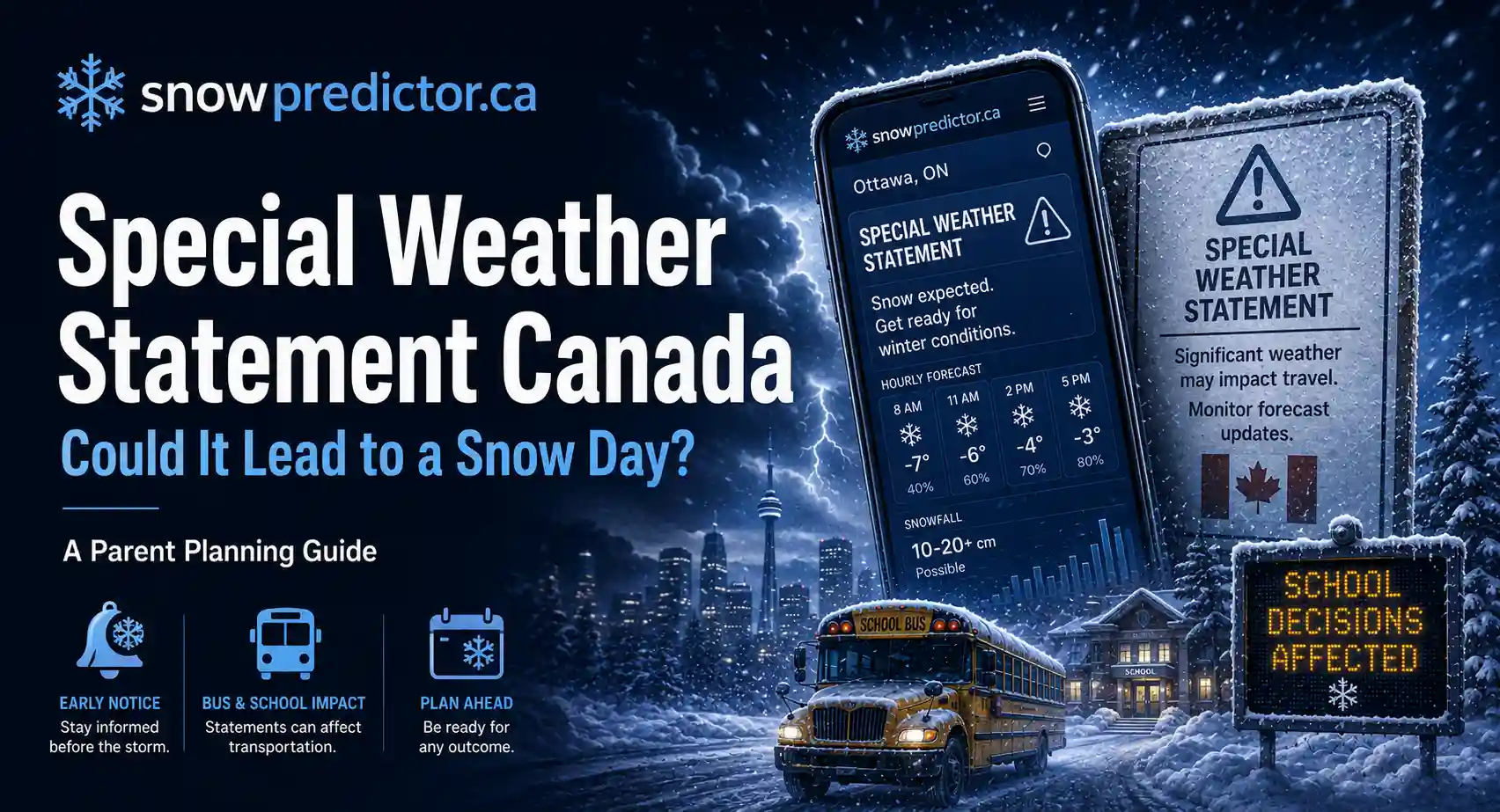
Canadian parents may see a special weather statement Canada notice before school and wonder whether it points to a snow day. It can describe snow, freezing rain, strong wind, rapidly changing temperatures or another developing hazard, but it is not a formal Warning, Advisory or Watch. Families should treat it as an early planning signal, then check weather, roads, transportation and school-board updates. The Canada Snow Day Predictor supports early preparation, while official sources provide final decisions.
What This Weather Message Means
A special weather statement Canada message is an informational notice issued by Environment and Climate Change Canada when conditions are unusual, inconvenient or potentially concerning. It can also provide more detail than a regular forecast when a situation is still developing.
The special weather statement meaning is not that severe weather is guaranteed. It means forecasters believe people need additional context about timing, uncertainty, possible hazards or travel impacts.
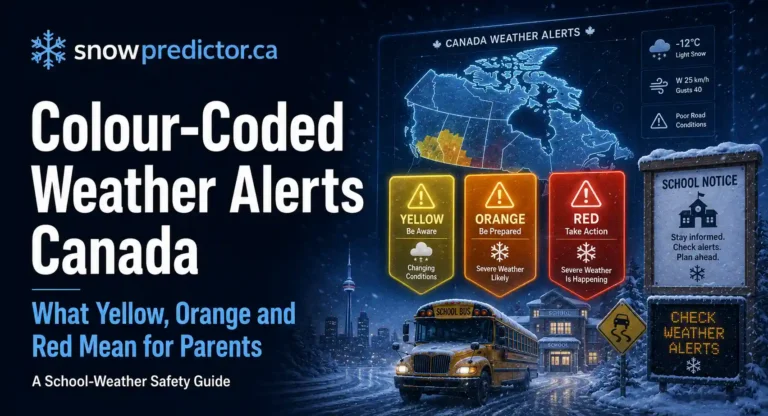
A statement is not one of Canada’s three formal colour-coded alert types. It does not receive a yellow, orange or red impact level, and it appears in grey on the official Weather Information map.
| Question | Practical Answer |
|---|---|
| Is it a formal weather alert? | No. It is an informational statement. |
| Can it describe serious weather? | Yes. It may discuss a developing or complicated hazard. |
| Does it cancel buses? | No. Transportation providers decide separately. |
| Does it close schools? | No. School boards make operating decisions. |
| Should parents ignore it? | No. It can provide valuable preparation time. |
Why Environment Canada Issues These Statements
An Environment Canada special weather statement gives forecasters room to explain a situation that does not yet fit neatly into a Warning, Advisory or Watch.
It may be issued when:
- A weather system could become disruptive, but important details remain uncertain
- Conditions are unusual for the season or region
- Several hazards may occur in sequence
- The event may cause inconvenience without meeting formal alert criteria
- More explanation is needed than a regular forecast provides
- A more serious event may be developing
- Travel impacts could occur during a busy commute
Unlike an Advisory, it can discuss winter weather, heavy rain, wind, heat, thunderstorms or rapid temperature changes.
Special Weather Statement Versus Warning
The special weather statement versus warning comparison is mainly about purpose, certainty and urgency.
| Message Type | What It Tells Families | Recommended Response |
|---|---|---|
| Special Weather Statement | Unusual or concerning weather needs extra explanation | Monitor updates and prepare |
| Watch | Conditions favour severe weather, but details remain uncertain | Get ready and watch for an upgrade |
| Advisory | Significant but generally less severe weather is expected | Take precautions |
| Warning | Severe weather is occurring or expected | Act promptly |
Canada’s formal warnings include messages such as a winter storm warning, snowfall warning, freezing rain warning, severe thunderstorm warning and heat warning. These alerts may carry yellow, orange or red colours according to expected impact and forecast confidence.
The weather advisory versus warning guide explains how formal alerts differ from informational statements.
Can the Message Become a Formal Alert?
Yes. A special weather statement Canada update may later be replaced by a Watch, Advisory or Warning if forecast confidence increases or the expected effects become clearer.
It may remain a statement, be revised or end without a formal alert. Forecasts change as new observations and guidance become available.
A formal alert becomes more likely when heavy snow, freezing rain, damaging wind, flooding or poor visibility is expected.
Families should open the newest version instead of relying on an old screenshot, cached result or notification preview.
Winter Hazards Commonly Described
A winter weather statement can discuss one hazard or several conditions occurring in sequence. Possible examples include:
- Developing snowfall with uncertain accumulation
- Rain changing to snow
- Freezing rain or freezing drizzle
- A flash freeze after daytime melting
- Strong wind and blowing snow
- Rapidly falling temperatures
- Difficult morning or evening travel
- Localised heavy snow bands
- Mixed precipitation
- A possible winter storm
A special weather statement snow message may appear before the track, timing or accumulation becomes certain. The details matter more than the title. Snow during the morning commute may disrupt travel more than a larger overnight amount cleared before buses begin.
Could It Lead to a Snow Day?
A special weather statement Canada notice can increase the possibility of a snow day, but it cannot confirm one.
The statement may be the first official sign that a system could affect the school day. If later forecasts show hazardous roads, freezing rain, low visibility, heavy snow or severe wind, transportation providers may cancel routes and school boards may change operations.
The final outcome depends on:
- Road conditions and visibility
- Snow or ice accumulation
- Plowing and treatment progress
- Rural, exposed or hilly routes
- Timing during the morning commute
- Conditions expected near dismissal
- Building access, staffing and power
- Local transportation procedures
Snow day probability is therefore influenced by the expected impact on school operations, not simply by the existence of the statement.
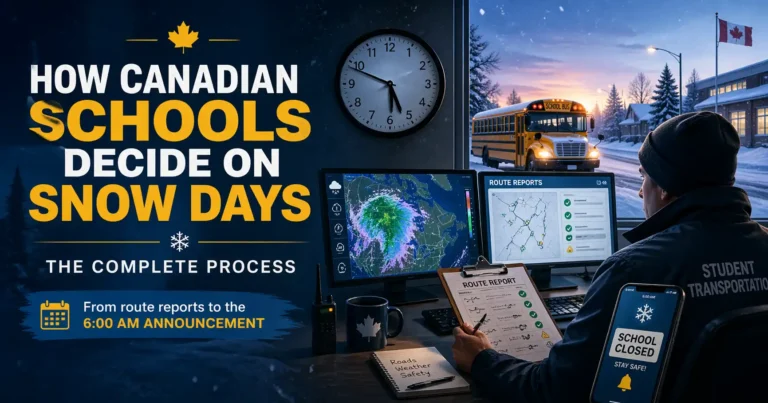
The guide to how Canadian schools decide on snow days explains how forecasts, route checks and local conditions shape decisions.
Does It Cancel School Buses?
No. Environment and Climate Change Canada issues the weather message, but local transportation providers decide whether buses operate.
School bus cancellations may follow if road checks, visibility reports, freezing precipitation, drifting snow or plowing conditions make routes unsafe. One weather zone may stop service while another continues because conditions can vary considerably across a large district.
Parents should check the transportation provider responsible for the child’s route instead of assuming that a regional statement affects every bus equally.
A cancellation may apply all day, so confirm whether afternoon service will operate.
Does Bus Cancellation Mean School Closure?
Not necessarily. Many Canadian boards treat transportation and building status as separate decisions.
Possible outcomes include:
- Buses and schools operating normally
- Selected routes or weather zones cancelled
- All buses cancelled while schools remain open
- A delayed opening
- Individual school closures
- A board-wide closure
- Changes to afternoon transportation or dismissal
Families should check both the bus notice and school closure weather updates. An open building does not make every route safe, and a cancelled route does not automatically cancel classes.
The bus cancelled but school open guide explains what families should consider when transportation stops but the building remains open.
How Parents Should Read the Full Statement
Do not stop at the headline. A special weather statement Canada message is most useful when parents read six details.
Affected Area
Confirm whether the home, school and route are included. A child may travel into a different forecast region.
Timing
Check when conditions are expected to begin, peak and end. Morning-commute timing can strongly affect transportation decisions.
Hazard
Identify whether the concern is snow, ice, wind, heavy rain, visibility, heat or a combination.
Forecast Uncertainty
Look for words such as “possible,” “may,” “expected” or “confidence is increasing.” These phrases explain why a formal alert has or has not been issued.
Possible Impacts
Pay attention to references to slippery roads, reduced visibility, flooding, outages, falling branches or delays.
Updates
Check whether the statement has been revised, ended or replaced by a formal alert.
How It Appears on Canada’s Weather Map
A special weather statement Ontario result may cover only one forecast region, not the entire province.
Canadian weather statements appear as grey areas on the official Weather Information map. Yellow, orange and red are used for formal Warnings, Advisories and Watches.
Parents can select the grey region to read the full text and view radar. Radar shows recent precipitation movement but cannot report every road, bridge, pavement or bus-stop condition.
A grey map area does not mean conditions are safe. It only means an informational message is active instead of a formal colour-coded alert.
The weather alerts map Canada guide explains how to compare the home, route and school.
A Reliable Before-School Check
When a special weather statement Canada notice is active, use the same order each time.
Check the Latest Official Message
Confirm that it is current and has not been replaced by a formal alert.
Review the Forecast and Radar
Look at the expected timing, precipitation movement and conditions near dismissal.
Check Road Information
Use the relevant provincial or territorial road service. Ontario families can review Ontario 511 for reported highway conditions, cameras and closures.
Check School Transportation
Look for route, zone or system-wide changes. Do not rely only on general news reports.
Check the School Board
Confirm whether the building is open, delayed or closed and whether childcare, activities or dismissal procedures have changed.
Inspect the Immediate Route
Look for untreated ice, drifting snow, poor visibility, standing water, fallen branches or an inaccessible stop.
This routine makes weather alerts before school easier to interpret without treating one message as a final decision.
Should Parents Drive If Buses Are Cancelled?
A personal vehicle is not automatically safer than a school bus. First determine why transportation was cancelled.
The bus route may include exposed roads or bridges, but the same snow, ice or poor visibility may affect a shorter family trip. Check travel advice, road reports and the return journey.
Do not drive around closures or begin a trip when visibility, flooding or ice prevents safe control. An open school does not guarantee safe private travel.
The winter weather safety checklist provides additional guidance for winter journeys.
Preparing the Night Before
A special weather statement Canada notice can provide useful preparation time before formal alerts or school announcements appear.
Families can:
- Charge phones and power banks
- Enable school and transportation notifications
- Confirm the child’s weather zone and route number
- Prepare suitable clothing and footwear
- Arrange backup childcare
- Decide who can collect the child
- Check the vehicle emergency kit
- Allow extra morning time
- Avoid promising that school will be cancelled
Prepare carefully for possible school disruption without treating it as confirmed.
How SnowPredictor.ca Supports Early Planning
Official statements explain the developing weather situation, but they do not estimate the final decision of a particular school board or transportation provider.
A special weather statement Canada notice is one input for planning. The Canada school-closure probability tool provides a location-based estimate that families can compare with later alerts, road reports, bus notices and board announcements.
The federal weather service provides weather information, road authorities report travel conditions, transportation providers decide whether buses operate and school boards decide whether buildings open.
The predictor supports planning, not official decisions.
Frequently Asked Questions
What Is a Special Weather Statement from Environment Canada?
It is an informational notice used when weather may be unusual, inconvenient or potentially concerning, or when forecasters need to provide more detail than the regular forecast. It is not a formal colour-coded alert and does not directly cancel buses or close schools.
Is Summer 2026 Going to Be Hot in Canada?
Seasonal outlooks have favoured above-normal temperatures across many parts of Canada during portions of summer and early autumn 2026. However, seasonal forecasts describe broad probabilities rather than the temperature of every day or community. Families should use the latest official local forecast for school, travel and health planning.
What Is the Coldest City in Canada Right Now?
The answer changes as weather stations report new observations. Iqaluit, Yellowknife and Whitehorse are often among the colder incorporated cities, while smaller northern communities may be colder. Check the current national conditions table for a live comparison.
Where Is the Cheapest and Warmest Place to Live in Canada?
There is no official place that is both Canada’s cheapest and warmest. Windsor, Ontario, is often considered a practical compromise because of its southern climate and generally lower housing costs than Toronto or Vancouver. Affordability still depends on rent, income, transport and household needs.
What Part of Canada Has the Worst Winter?
There is no single official answer. Saskatchewan and Manitoba are strong candidates for prolonged cold, wind chill and open-country blowing snow. Newfoundland and Labrador often experiences powerful Atlantic storms, strong wind, freezing precipitation and blizzards. Northern Canada is colder overall, so the answer depends on whether “worst” means coldest, stormiest or most disruptive.