blowing snow visibility school closures in Prairie Canada: A Parent’s Guide
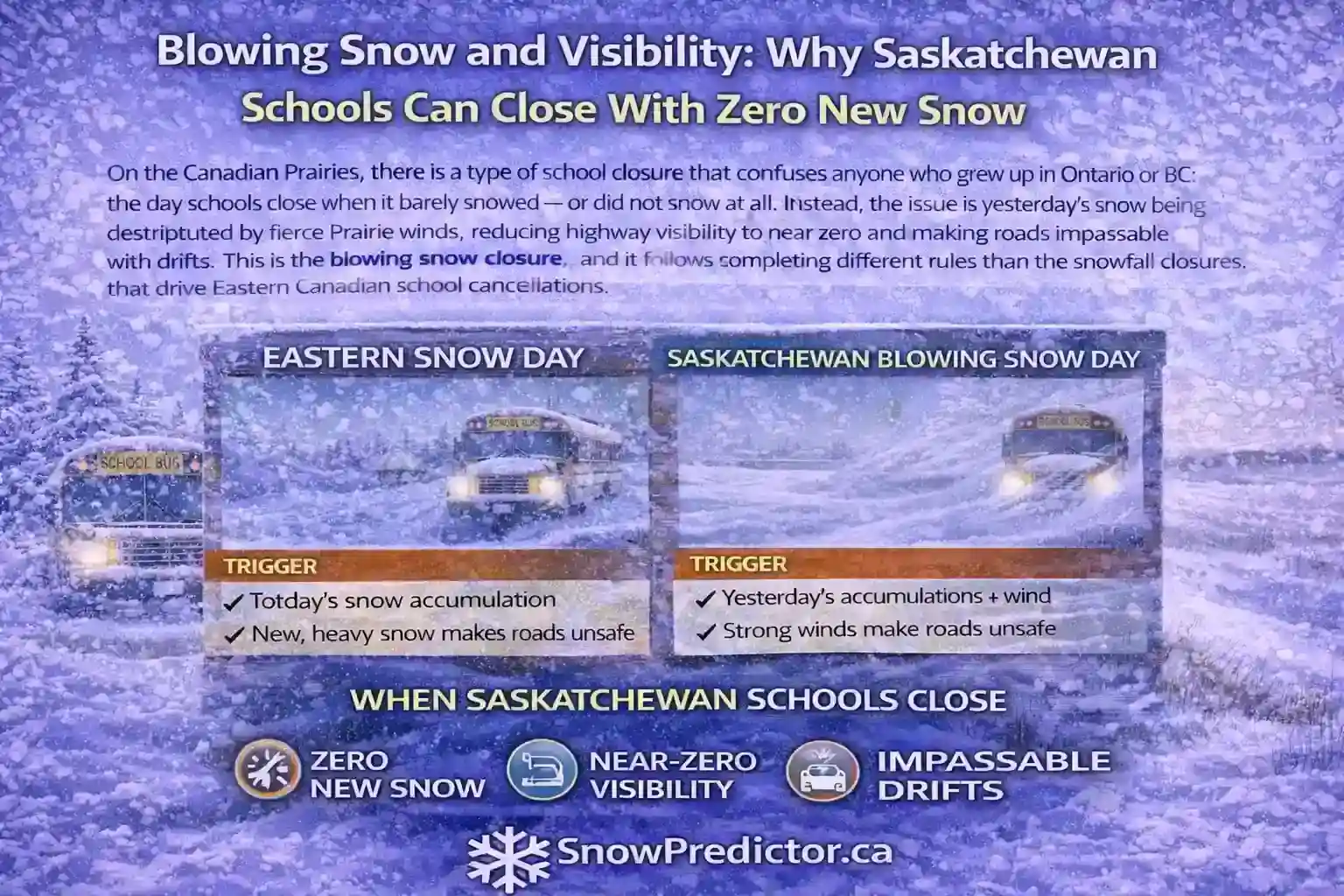
A school day can be disrupted even when no fresh snow appears in the overnight forecast. Across Saskatchewan, Manitoba and parts of Alberta, strong wind can lift yesterday’s loose snow from fields and road edges, push it across highways and create drifts soon after a plow passes. The sky may look clear from home while a rural bus route has dangerously limited visibility.
This is why blowing snow visibility school closures cannot be judged by new accumulation. Officials assess what drivers can see, whether routes are drifting shut and what the afternoon trip may bring. This guide explains blowing snow visibility school closures, Prairie exposure and how to confirm the official result.
Blowing Snow Closure Risk Across the Prairies
| Region | Typical Exposure | Main Transportation Risk | Useful Official Check |
|---|---|---|---|
| Southern Saskatchewan | Open fields, grid roads and limited wind barriers | Ground drifting and sharp visibility changes | Highway Hotline, division and bus notices |
| Central and rural Saskatchewan | Long rural routes and exposed approaches | Different conditions across one division | Local school division updates |
| Southern Manitoba | Flat terrain, highways and open agricultural land | Widespread blowing snow and road closures | Manitoba 511 and division notices |
| Rural Manitoba | Secondary roads and changing maintenance conditions | Drifts returning after clearing | Manitoba 511 and local transportation updates |
| Southern Alberta | Open rural corridors and strong wind events | Crosswinds, drifting and variable road visibility | Alberta 511 and school authority notices |
| Central Alberta | Mixed open land, towns and rural routes | Zone or route-specific cancellations | Division and transportation channels |
| Ontario snowbelts | Lake-effect snow combined with wind | Local whiteouts and rapidly changing routes | Ontario 511, consortium and board notices |
The table shows exposure, not fixed closure rates. Snow cover, maintenance, policies and routes vary locally.
What Causes Blowing Snow visibility School Closures?
Blowing snow occurs when wind lifts loose ground snow into the air. It can happen during snowfall, after a storm or under clear skies. Snow texture, wind, temperature and terrain affect its severity.
Fresh, dry snow moves more easily than wet or crusted snow. Open farmland has fewer barriers, while cuts, approaches and ditches collect uneven drifts.
A snowfall forecast estimates new precipitation. A blowing snow forecast describes snow moving from the ground, sometimes with fresh snowfall. A low accumulation forecast does not guarantee safe travel.
Why Blowing Snow visibility School Closures Depend on Visibility
A driver needs to identify curves, intersections, vehicles and changing surfaces. Visibility can fall abruptly between a sheltered street and an exposed highway.
Environment and Climate Change Canada’s current winter alert guidance says a blowing snow alert may be issued when wind is expected to create poor visibility of 800 metres or less. A blizzard alert represents more severe conditions, with widespread visibility of 400 metres or less in blowing snow. These are public weather-alert descriptions, not automatic school rules.
There is no national closure rule at one visibility distance. Claims that every Prairie operator requires 200 metres, or that one wind speed cancels transportation, are unsupported. Authorities assess local routes, observations and policies.
For this reason, poor visibility school closures may occur with little new snow, while a deeper snowfall may not close a school when wind is light, roads are being cleared and visibility remains manageable.
Blowing Snow, Drifting and Whiteouts Are Different
These terms are related but distinct.
- Drifting snow is snow moved by wind and deposited unevenly on or beside the road. A route can have reasonable visibility but still become blocked by drifts.
- Blowing snow is wind-driven snow that rises high enough to restrict horizontal visibility.
- A whiteout is an extreme loss of visual reference caused by snow, cloud and diffuse light. Drivers may struggle to distinguish the road, horizon and surrounding terrain.
- A blizzard combines strong wind with widespread, severely reduced visibility for a sustained period under official alert criteria.
All four can affect rural school bus safety, so officials evaluate actual transportation impacts.
Why Prairie School Closures Are Highly Localized
Saskatchewan school closures, Manitoba school closures and Alberta school closures do not follow one formula. Neighbouring divisions may decide differently.
Saskatchewan: Grid Roads and Wide Service Areas
School bus cancellations Saskatchewan families receive often reflect rural grid roads rather than city streets. One route may cross open land, sheltered areas and roads with different maintenance.
Saskatchewan’s Highway Hotline covers provincial highways, not every local road. Divisions also use driver, contractor and road-personnel reports, so nearby areas can decide differently.
Manitoba: Visibility Can Affect Travellers and Plows
The Manitoba government warns that wind can delay snow-clearing operations because drifting and poor visibility also affect maintenance crews. When visibility compromises safety, crews may reduce or suspend some work. That can allow drifts to rebuild and extend disruption after snowfall ends.
Manitoba 511 is a useful source for highway conditions and closures, but its own guidance notes that conditions can change and reported information may not describe every current location. Families should combine Manitoba 511 with the official school division announcement when checking Manitoba school closures.
Alberta: Wind, Terrain and Local Policies
Southern and central Alberta include exposed roads, rolling terrain, sheltered communities and areas affected by strong local wind. Conditions can therefore vary sharply inside one school authority.
Some authorities cancel selected routes while keeping schools open. Others may announce broader transportation changes or a building closure when access is unsafe. Alberta school closures should always be confirmed through the applicable public, Catholic, Francophone or independent school authority rather than a province-wide social post.
What Determines Blowing Snow visibility School Closures?
There is no single formula for school closures due to blowing snow. Public transportation guidance across Canada commonly identifies a combination of conditions:
- Actual visibility on bus routes and at intersections
- Drifting across highways, grid roads and school approaches
- Current and forecast wind direction and gusts
- Loose snow available for transport
- Road closures, travel advisories and collision risk
- Whether plows can operate and keep routes open
- Conditions expected during the afternoon trip
- Extreme cold, ice or fresh snowfall occurring at the same time
- Access for staff, students and emergency services
A gust alone cannot predict the outcome. Lower wind over fresh powder may cause more drifting than stronger wind over crusted ground.
Bus Cancellation and School Closure Are Separate
Many families search for blowing snow school cancellations when only transportation is affected. A cancelled bus does not automatically close the building.
Possible notices include:
| Notice | What It Generally Means | Parent Action |
|---|---|---|
| Individual route cancelled | One route will not operate | Verify both morning and afternoon service |
| Zone transportation cancelled | Buses in a named area are cancelled | Confirm whether the school remains open |
| Division-wide transportation cancellation | All division buses are cancelled | Read attendance and building instructions |
| Delayed opening | School or transportation starts later | Confirm revised times |
| Full school closure | The building is closed | Follow remote-learning or closure guidance |
Terminology differs by authority, so read the full notice. The guide to bus cancelled versus school closed explains the distinction, but Prairie families must follow local terminology.
Do not assume a morning cancellation will be reversed for dismissal. Many transportation authorities cancel both trips because they cannot guarantee that roads will improve. If a school remains open and a parent drives a child there, the family may also be responsible for arranging a safe return home.
How to Interpret Canadian Weather Alerts
Canada’s weather alerts now use colours to communicate expected impact. Yellow indicates moderate, localized or short-term disruption. Orange indicates major or widespread impacts, while red identifies extreme, dangerous and potentially life-threatening conditions. The colour adds impact context, but it does not issue a school decision.
A blowing snow warning Canada families receive should prompt closer monitoring of travel and school channels. A blizzard warning Canada alert indicates a more severe visibility threat. Check the alert’s exact area, timing, confidence and impact level because a warning for one forecast region may not cover your bus route.
Environment Canada’s visibility impact guidance notes that moderate impacts can make routes difficult to navigate and lead to delays or closures. High impacts can make travel dangerous or impossible and may strand vehicles. These descriptions explain why visibility can outweigh snowfall totals in a morning transportation assessment.
How to Verify Blowing Snow visibility School Closures
For school bus cancellations Canada families should use this order, not a shared screenshot:
- Check the local Environment Canada alert and hourly forecast.
- Review winter road conditions Canada sources, such as Saskatchewan Highway Hotline, Manitoba 511 or Alberta 511.
- Open the school division’s official website, app, email or text alert.
- Check the transportation provider if it publishes route-specific information.
- Confirm whether the notice covers buses, buildings or both.
- Verify whether afternoon transportation is also cancelled.
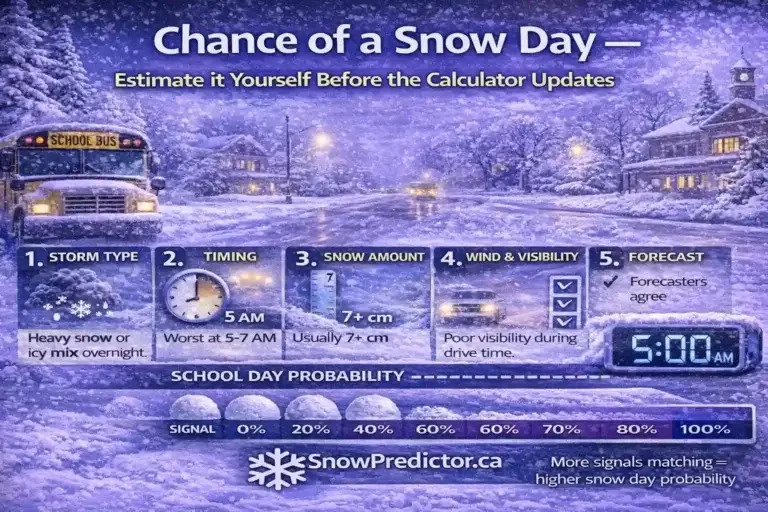
SnowPredictor Canada can help organize forecast signals into an early planning probability. For a more responsible snow day prediction Canada estimate, use wind, existing snow cover, visibility alerts, timing and road conditions together. The tool does not replace the final notice from a school division or transportation provider.
A Better Way to Prepare for a Blowing Snow Day
Preparation matters because conditions and decisions may change before the morning commute. Families should identify their division, bus operator and route number before winter weather arrives. Save official pages as bookmarks and enable direct notifications where available.
Also prepare for the possibility that buses are cancelled while school remains open. Decide who can provide care, whether remote work is possible and how the school wants weather-related absences reported. Never drive around a barricade or use a closed highway to reach school.
The guide to Canadian school closure announcements explains typical reporting windows. Families comparing weather tools can also review the best snow day prediction apps in Canada while keeping official sources first.
Frequently Asked Questions
Can Schools Close Because of Blowing Snow Without New Snowfall?
Yes. Strong wind can lift loose snow already on the ground, reduce visibility and form new drifts even under a clear sky. blowing snow visibility school closures depend on the resulting route conditions, not only the amount of new snow in the forecast.
What Visibility Causes School Closures in Canada?
Canada has no universal school-closure visibility threshold. Environment Canada uses visibility to describe weather hazards, but transportation providers and school authorities make local operating decisions. They consider actual route visibility, road conditions, drifting, forecasts and the return trip.
Does a Blowing Snow Warning Automatically Cancel School?
No. A warning identifies hazardous weather but does not close a school or cancel a bus. The applicable school authority or transportation provider publishes the official decision. Check the warning area and then verify the local notice.
What Wind Speed Causes blowing snow visibility school closures?
No single wind speed guarantees a closure. The outcome depends on loose snow cover, gusts, temperature, terrain, road exposure, visibility and maintenance. A lower wind over fresh powder may cause more disruption than a stronger wind over crusted or bare ground.
Why Are Buses Cancelled When Roads Look Clear in Town?
Town streets may be sheltered and cleared while rural routes cross open fields where drifting and visibility are worse. A transportation decision covers the route’s most hazardous sections, not only conditions outside one home or school.