Ottawa vs Toronto Snow Days: Which Ontario City Gets More?
Ottawa and Toronto are only about 350 kilometres apart, yet their winter school disruptions can feel very different. Ottawa is colder, snowier and responsible for transportation across urban, suburban and rural communities. Toronto receives less snow, has dense road and transit networks, and serves a student population that relies less heavily on school buses.
The simple answer to Ottawa vs Toronto Snow Days is that Ottawa faces more weather conditions capable of disrupting school transportation. That does not prove a fixed number of full school closures per year. In both cities, buses may be cancelled while buildings remain open, and boards do not publish one standardized historical dataset covering every weather-related outcome. This comparison therefore uses Environment and Climate Change Canada’s 1991–2020 climate normals, current school-board procedures and transportation policies. It explains which city is snowier, why route geography matters and what parents should check when a storm approaches.
Ottawa vs Toronto Snow Days: Quick Comparison
| Factor | Ottawa | Toronto | Practical Effect |
|---|---|---|---|
| Average annual snowfall | 231.9 cm at Ottawa International Airport | About 122.4 cm at Toronto City | Ottawa receives roughly 90% more at these stations |
| Winter setting | Ottawa Valley, colder continental climate | Lake Ontario shoreline, denser urban environment | Different temperatures, precipitation types and cleanup demands |
| Transportation area | Urban, suburban and rural communities | Predominantly urban, with comparatively low TDSB bus use | Rural and exposed routes can raise cancellation risk |
| Weather transportation decision | OSTA for OCDSB and OCSB services | Toronto Student Transportation Group and boards | Check the correct transportation authority |
| Buses cancelled, schools open? | Yes, under the stated OCDSB weather process | Possible; transportation and closure are separate decisions | Never treat “buses cancelled” as “school closed” |
| Typical notice target | Posted by approximately 6:00–6:15 a.m. | TDSB says required decisions are posted by 6 a.m. | Verify early through official channels |
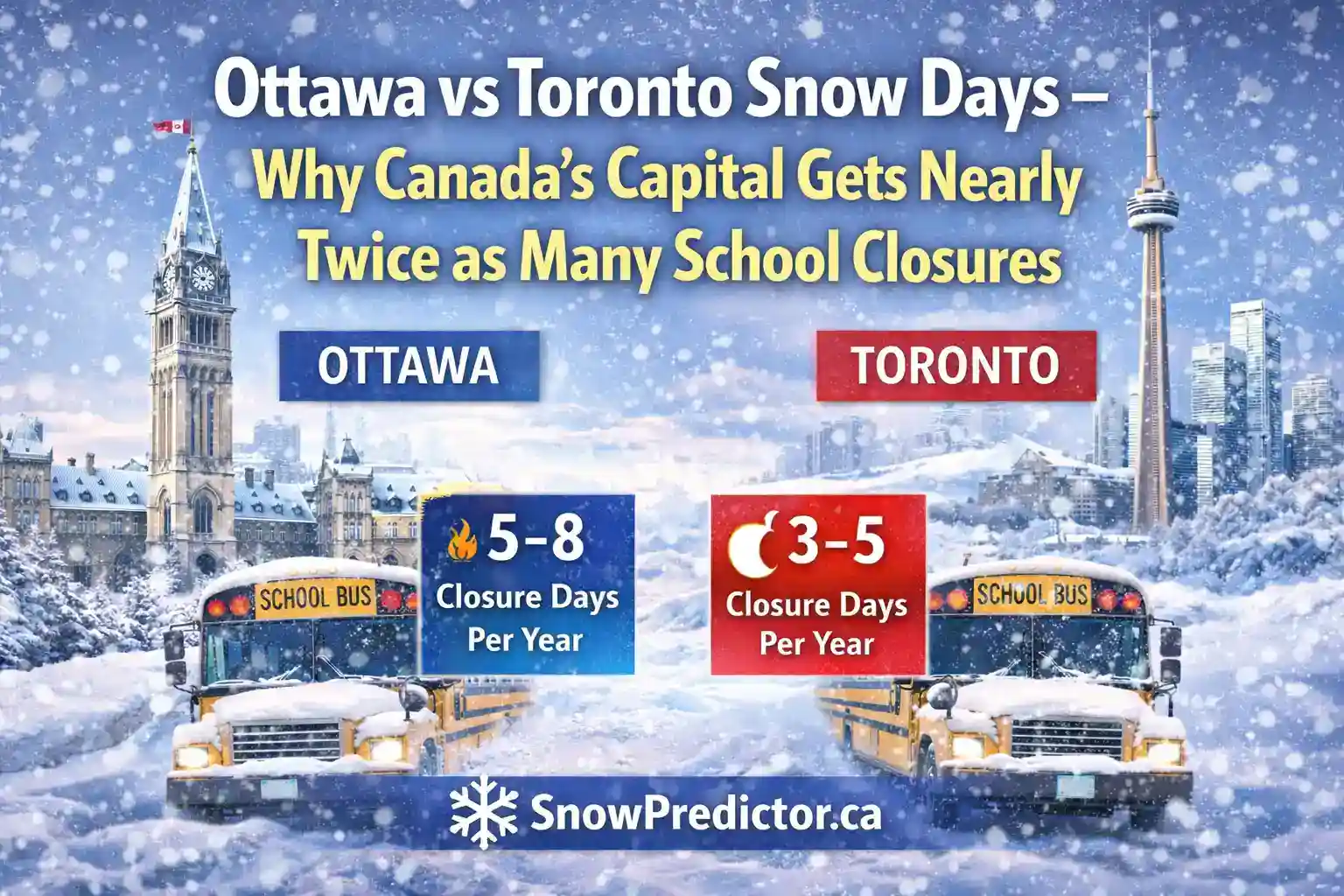
| Verified annual closure average | No standardized public citywide series | No standardized public citywide series | Precise rate claims require documented records |
The snowfall figures are station-specific climate normals, not measurements for every neighbourhood. Local totals vary across each city.
The Direct Answer: Ottawa Is Much Snowier
Environment and Climate Change Canada’s 1991–2020 normals list average annual snowfall of 231.9 centimetres at Ottawa International Airport. The Toronto City station’s monthly snowfall values total approximately 122.4 centimetres. On that matched normal period, the Ottawa station receives about 109.5 centimetres more, or roughly 1.9 times Toronto City’s total.
That Ottawa vs Toronto snowfall difference is not a closure formula. Ten centimetres falling gradually on a weekend may have little effect, while less snow during the morning commute with ice or wind can be disruptive.
Station selection matters. Toronto Pearson, downtown and lakeshore communities do not record identical conditions. Ottawa International Airport cannot represent every rural road. Climate normals describe station averages, not an entire school system.
Why Ottawa Has Greater Transportation Disruption Risk
More Snow and a Longer-Lasting Snowpack
Ottawa winter weather brings more annual snow and colder conditions. Snow can remain on the ground, create packed surfaces and reduce salt effectiveness. Repeated events may narrow roads and complicate snowbank management.
Toronto winter weather is influenced by Lake Ontario and the urban heat island. Major storms, flash freezes and freezing rain can cause disruption without matching Ottawa’s seasonal snowfall.
Ottawa’s Urban, Suburban and Rural Routes
Ottawa Student Transportation Authority states that its system serves urban, suburban and rural communities and that conditions can vary from one community to another. This is critical. A downtown arterial road may be treated and passable while a rural concession road remains snow-covered, icy or exposed to drifting.
Long rural routes create more exposure. A bus may travel before sunrise across roads with different plowing schedules. Decisions must consider the network, not one airport measurement.
Toronto’s Lower Dependence on School Buses
The Toronto District School Board says approximately 93% of its students do not use school buses. Many walk, use public transit or have other arrangements. This helps explain why Toronto bus cancellations do not automatically require systemwide Toronto school closures.
Toronto is not immune. Dense traffic, parked vehicles, limited snow storage, sidewalks and streetcars create different risks. Severe accumulation can overwhelm urban clearing and produce rare widespread closures.
Ottawa vs Toronto Snow Days: Bus Cancellation Is Not Closure
Many discussions about Ottawa vs Toronto Snow Days compare different outcomes without noticing. A “snow day” may mean:
- All school-bus and van transportation is cancelled
- Selected routes or transportation zones are cancelled
- Schools remain open for students who can arrive safely
- Classes or programs are cancelled
- School buildings and administrative sites are closed
These events should not be counted as if they were identical. Ottawa bus cancellations can affect many students while Ottawa school closures remain uncommon. The OCDSB transportation page states that when OSTA cancels transportation because of bad weather or poor road conditions, transportation is cancelled to all schools, but schools remain open. Parents who drive children in must arrange transportation home.
TDSB likewise treats transportation cancellation, classes, programs and building closure as separate operational decisions. Its severe-weather guidance describes full closure as something that occurs on rare occasions. Read the bus cancelled versus school closed guide before comparing annual figures.
How Ottawa Makes Weather Transportation Decisions
OSTA manages transportation for the Ottawa-Carleton District School Board and Ottawa Catholic School Board. Its inclement-weather information says it weighs the risk created by each event and its effects on the local environment and potential for accidents. The organization emphasizes that Ottawa Valley weather and conditions across its service area can vary.
Factors may include:
- Current and forecast precipitation
- Snowfall timing and intensity
- Freezing rain and road icing
- Visibility, wind and drifting snow
- Temperature and changing surface conditions
- Conditions across urban and rural routes
OCDSB directs families to check OSTA information after 6:15 a.m., while OSTA safety material says cancellation messages are distributed by 6 a.m. The sensible practice is to begin monitoring official channels at 6 a.m. and confirm the final status directly. Weather cancellations apply for the full day, even if conditions later improve.
Parents can use the Ottawa snow day predictor as an early planning tool, then verify the outcome with OSTA and their board.
How Toronto Makes Snow-Day Decisions
TDSB says an early-morning team involving senior leadership, transportation and communications staff reviews current weather, forecasts and road conditions. If cancellation or closure is necessary, information is posted on the TDSB website and social channels by 6 a.m.
The decision carries a different operational scale. TDSB reports approximately 239,000 students across its schools and sites. Closing buildings affects students, staff, childcare programs and families across the city, which is one reason full closures are treated as rare measures rather than automatic responses to a snowfall warning.
Toronto families must still identify their specific board. TDSB and the Toronto Catholic District School Board communicate their own operational decisions, while transportation information may appear through the Toronto Student Transportation Group. A general news headline is less reliable than the authority responsible for the child’s school and route.
For historical context, see the TDSB snow day history rather than relying on social-media memories of a few exceptional storms.
Why Freezing Rain Can Matter More Than Snowfall
The city with more snow does not automatically experience the more disruptive event every time. Freezing rain can coat roads, sidewalks, trees and power lines with ice. School buses require reliable braking and turning across entire routes, making even limited ice accumulation important.
Ottawa’s valley setting can support situations where cold air remains near the surface while warmer air moves above it, creating freezing rain. Toronto also experiences ice and flash freezes, particularly when temperature passes rapidly through 0°C. In either city, storm timing and road temperature matter more than the headline precipitation total.
The comparison of freezing rain versus snow bus cancellations explains why a modest-looking ice forecast may present greater transportation risk than a larger amount of manageable snow.
Can Ottawa vs Toronto Snow Days Be Ranked Annually?
Not responsibly from the available public evidence. Search results often repeat precise annual estimates for Ottawa snow days and Toronto snow days without identifying the underlying records, date range or outcome definition. Such numbers may combine bus cancellations, board closures, individual schools and weather-related absences.
A defensible Ontario school closure comparison covering school snow days in Ontario would need:
- The same school years for both cities
- Archived official notices for every event
- Separate labels for transportation and buildings
- Consistent treatment of partial or board-specific decisions
- Documentation of non-weather operational cancellations
Without that dataset, the accurate conclusion is narrower: Ottawa receives substantially more average annual snowfall and operates transportation across a broader mix of route environments. Those conditions support a higher general risk of weather-related transportation disruption. They do not justify an invented claim that one city records an exact multiple of full closures.
What Parents Should Check Before School
Use this routine when wondering which city gets more snow days or whether tomorrow will bring one locally:
- Check Environment and Climate Change Canada alerts for the exact area.
- Review a local probability on SnowPredictor.
- Identify whether the concern is buses, classes, programs or buildings.
- Check OSTA and OCDSB or OCSB in Ottawa; check the applicable Toronto board and transportation provider in Toronto.
- Confirm the notice around the authority’s stated morning publication time.
- Arrange both drop-off and pickup if buses are cancelled but school remains open.
The predictor helps families prepare; it cannot authorize an absence or confirm an operational decision.
Final Verdict
The evidence-based Ottawa vs Toronto Snow Days verdict is that Ottawa is the snowier city and carries greater underlying transportation risk. Its airport normal is 231.9 centimetres annually, compared with about 122.4 centimetres at Toronto City, and its bus network spans urban, suburban and rural communities.
Toronto gets fewer centimetres on average, but major snow, ice and flash-freeze events can still force rare full closures. The key is to compare like with like. Bus cancellation frequency is not school closure frequency, and snowfall is not a direct count of days off.
Frequently Asked Questions
Does Ottawa get more snow days than Toronto?
Ottawa has more snowfall and greater route exposure, so weather-related transportation disruption is generally a larger concern. However, no standardized public dataset proves a precise annual difference in full school closures.
How much snow do Ottawa and Toronto receive annually?
The 1991–2020 climate normals report 231.9 centimetres at Ottawa International Airport. Monthly values for the Toronto City station total approximately 122.4 centimetres. Totals vary by station and neighbourhood.
Do Ottawa schools close when buses are cancelled?
Not automatically. OCDSB says that when OSTA cancels transportation because of weather or poor roads, transportation is cancelled to all schools while schools remain open. Families choosing to drive must arrange the return journey.
Are full school closures common in Toronto?
TDSB describes severe-weather building closures as rare. Buses, classes or programs may be affected separately, so families must read the exact official notice rather than assuming every disruption closes buildings.
What causes more cancellations: snow or freezing rain?
Either can cause disruption. Freezing rain may create dangerous braking and walking conditions with little visible accumulation, while heavy or rapidly falling snow can overwhelm plowing and reduce visibility. Timing and road conditions decide the practical impact.