TDSB Snow Day History: Toronto’s Major School Closures Since 1999
The Toronto District School Board rarely closes its entire system for winter weather. That is why every city-wide closure becomes part of Toronto memory. Parents remember rearranging work, while students remember waking early to hear whether hundreds of schools would open.
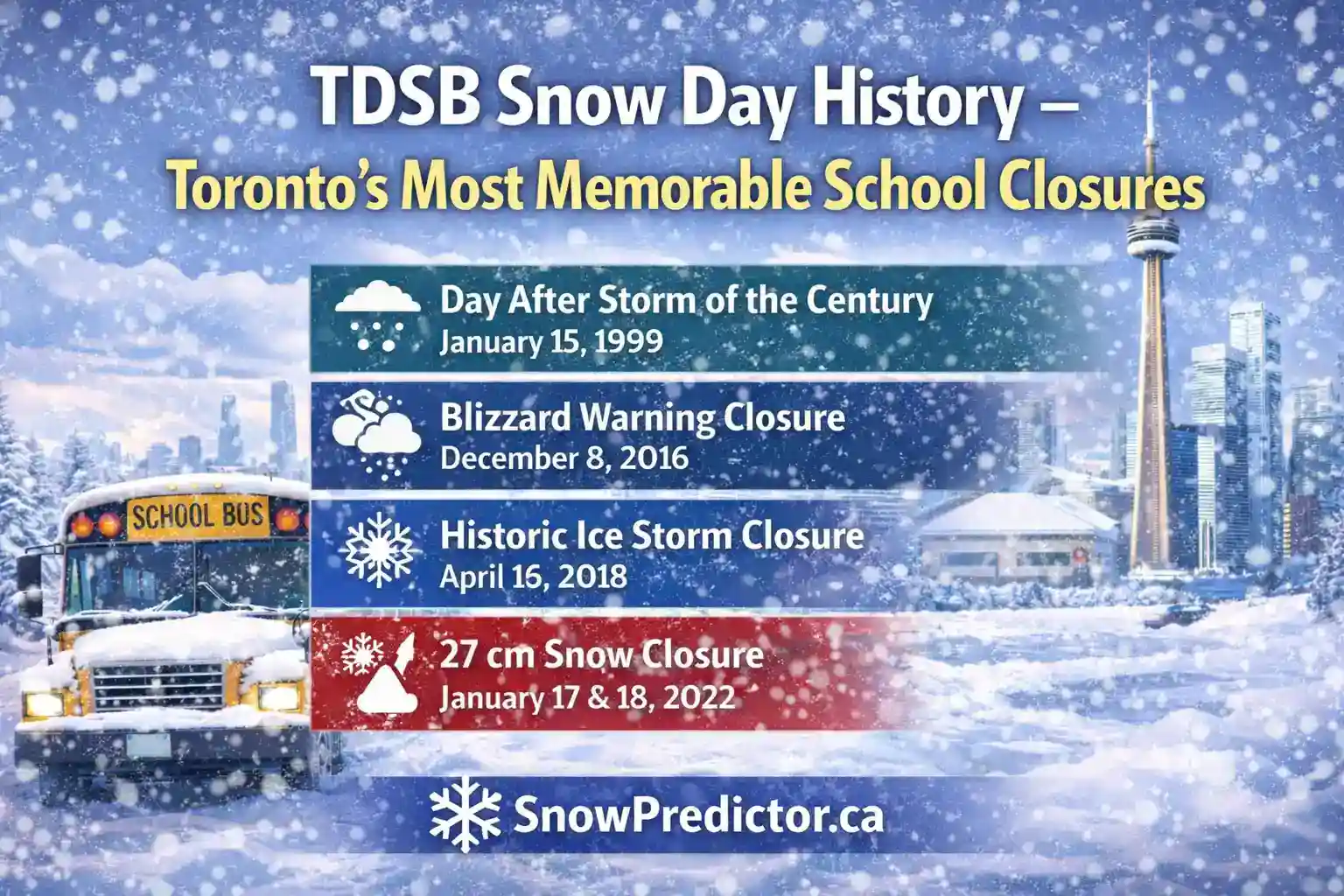
This TDSB snow day history reviews documented major closures since the board was created in 1998, including the 1999 snow emergency, the controversial 2011 decision, the first closure in eight years in 2019, the two-day disruption in 2022 and major closures in January 2026.
There is no complete public TDSB database listing every weather disruption in one place. The timeline below uses documented board notices and contemporary reporting. It avoids treating an estimate as an official annual average.
TDSB School Closures at a Glance
| Date or Period | What Happened | Why It Matters |
|---|---|---|
| January 1999 | Toronto schools were disrupted during the major snow emergency | Established the modern benchmark for severe Toronto snow |
| February 2, 2011 | TDSB closed during a forecast blizzard | First widely remembered system closure since 1999 |
| February 12, 2019 | Schools and administrative sites closed | First TDSB system-wide snow day since 2011 |
| January 17 and 18, 2022 | In-person learning was disrupted for two days | Heavy snow, roads and roof clearing extended the impact |
| January 15, 2026 | Schools closed during a major southern Ontario storm | One of multiple rare closures in the same month |
| January 26, 2026 | Schools, sites and administrative buildings closed | Exceptional snowfall left Toronto facing prolonged cleanup |
This Toronto snow day history and school closure record covers major documented events, not every transportation cancellation, localized issue or early dismissal.
What TDSB Snow Day History Shows About Rare Closures
The rarity seen throughout TDSB snow day history does not mean Toronto avoids winter. It reflects how the city and board operate.
Dense Urban Road Network
Toronto has a large network of arterial roads, frequent transit service and extensive municipal winter maintenance. Main routes often become passable sooner than rural roads serving boards outside the city.
Limited Rural Transportation Exposure
Many Ontario boards operate long bus routes across exposed county roads. TDSB serves a dense urban area where many students live closer to school or use public transit. This reduces, but does not eliminate, transportation risk.
Size of the School System
TDSB serves approximately 239,000 students across hundreds of schools and sites. Closing the system affects families, staff, childcare, meals, programs and workplaces throughout Toronto.
The board says any decision to cancel transportation, classes, programs or close sites can significantly affect thousands of families and is not taken lightly.
Toronto Is Not a Lake-Effect Snowbelt
Toronto can receive lake-enhanced snow, but it is not exposed to Georgian Bay bands in the same way as Barrie and Simcoe County. Narrow Georgian Bay bands can produce major local differences that regularly disrupt rural transportation north of Toronto.
January 1999: Toronto’s Modern Snow Emergency
The January 1999 storms remain the event against which later Toronto snow days are compared. Repeated snowfall overwhelmed roads, limited transportation and led then-mayor Mel Lastman to request military assistance.
The current TDSB had been formed only a year earlier through the amalgamation of Toronto-area boards. School operations were disrupted as the city struggled with snow removal and transportation.
The event matters to TDSB closure history because it established an extreme reference point. For years afterward, students and media compared every approaching storm with 1999 and asked whether conditions were severe enough to close Toronto again.
February 2, 2011: A Controversial Snow Day
The TDSB snow day 2011 decision became memorable for a different reason. Forecasts warned of a major Groundhog Day blizzard, and Toronto public and Catholic schools closed.
The storm produced less snow in parts of Toronto than many expected. That led to criticism after the decision, but administrators had to act early using forecasts available before morning travel began.
The lesson is important: a closure decision is based on expected safety conditions, not a snowfall measurement taken after the event. Forecast uncertainty can make a reasonable early decision look unnecessary later.
Contemporary reporting described 2011 as the first broad Toronto public-school snow day since the 1999 emergency. It then took another eight years before the next system-wide TDSB snow closure.
February 12, 2019: First Closure Since 2011
The TDSB snow day 2019 event involved a combination of snow, ice pellets and freezing rain. TDSB announced that schools and administrative sites would close.
CityNews reported it as the board’s first snow day since 2011. That directly contradicts claims that TDSB had closed for snow in 2016 or experienced two consecutive system-wide snow closures in January 2019.
Freezing rain made the event more dangerous than a basic snowfall total suggested. Ice affects sidewalks, roads, school entrances, staff travel and vehicle braking. Mixed precipitation is one of the clearest ways a storm can exceed Toronto’s usual ability to keep operating.
January 17 and 18, 2022: Two-Day Disruption
The TDSB snow day 2022 event followed a powerful storm that dropped more than 40 centimetres in parts of the Greater Toronto Area. Roads, transit and snow-clearing operations struggled with rapid accumulation.
The disruption continued into January 18. A TDSB notice explained that heavy snow still needed to be removed from the roofs of 36 schools before those buildings could be occupied. Road and weather conditions had prevented that work from being completed.
TDSB therefore closed schools to in-person learning for a second day. Before-school and after-school programs were also closed, while families were told to contact individual childcare operators because some arrangements could differ.
The 2022 event shows why a TDSB snow day can extend after snowfall stops. Buildings, roofs, sidewalks, parking areas and emergency access must be safe before a large system can reopen.
January 2026: Two Major Closures in One Month
January 2026 added an unusual chapter to TDSB snow day history. Toronto experienced two major closure events within the same month.
January 15, 2026
Heavy snow affected Toronto and surrounding regions. Schools closed across several Greater Toronto Area boards as road and travel conditions deteriorated.
The TDSB snow day 2026 decision reflected a widespread southern Ontario storm rather than a narrow local snow band. Toronto, York, Peel and Halton schools were among those affected.
January 26, 2026
Another major storm produced exceptional snowfall across Toronto. Reporting described nearly 60 centimetres in parts of the city, major flight disruptions and hundreds of traffic collisions.
TDSB announced that schools, sites and administrative buildings would close on January 26 because of the storm’s continuing effects. Schools reopened afterward as cleanup progressed.
Two closures in one month were notable precisely because complete Toronto school closures are normally rare.
What Conditions Can Close TDSB Schools?
No single snowfall number automatically closes the board. Official TDSB guidance says a team including senior leadership, transportation and communications staff reviews current weather, forecasts and road conditions early in the morning.
Factors that can increase closure risk include:
- Heavy overnight accumulation
- Snowfall continuing through the morning commute
- Freezing rain or ice pellets
- Rapid accumulation that outpaces road clearing
- Poor visibility and strong wind
- Unsafe sidewalks, entrances and parking areas
- Problems clearing school roofs or emergency access
- Back-to-back storms that limit recovery time
The history suggests that city-wide closures happen when several risks combine. A moderate daytime snowfall often does not produce the same operational problem as rapid overnight snow followed by ice.
What Usually Does Not Close TDSB
Toronto schools often remain open during routine winter weather. Light or moderate snow does not automatically lead to a closure, especially when it ends early enough for roads and school sites to be treated.
Cold temperature alone is also less likely to close TDSB than a Prairie or rural board. However, families should still follow cold-weather instructions, dress children properly and make their own safety decisions when schools remain open.
Parents and caregivers have the final choice about sending a child when TDSB schools remain open during severe weather. Absences should be reported through the school’s normal process.
TDSB Versus SCDSB Snow-Day Frequency
The contrast between Toronto and Simcoe County explains why geography matters more than distance.
| Factor | TDSB | SCDSB |
|---|---|---|
| Primary area | Dense Toronto urban system | Barrie and Simcoe County |
| Main winter risk | Large regional storms and mixed precipitation | Georgian Bay lake-effect snow |
| Road network | Mostly urban streets and arterials | Urban, rural and exposed county roads |
| Transportation | Public transit and some school buses | Extensive school-bus network |
| Disruption pattern | Rare system-wide closures | More frequent transportation cancellations |
The SCDSB snow day history explains why Simcoe County experiences more winter transportation disruption.
What TDSB Snow Day History Shows About Closure Decisions
Very early in the morning, TDSB senior staff review forecast and road information. The board states that necessary cancellation or closure information is posted on its website and social media by 6 AM.
A TDSB snow day announcement may affect:
- Schools and administrative sites
- Student transportation
- Childcare programs located in schools
- Before-school and after-school programs
- Continuing education and permits
- Scheduled events and activities
When schools close, TDSB says there will be no principals, teachers or other regular staff onsite to supervise students. Families should never send a child to a closed building.
Using TDSB Snow Day History and Checking Current Status
Historical patterns cannot confirm whether schools will close tomorrow. Use the Toronto Snow Day Predictor for an independent probability, then verify the final decision through official TDSB channels.
Check in this order:
- TDSB severe-weather webpage
- Official TDSB website and social accounts
- SchoolMessenger or direct school communications
- Student transportation notices
- Local Toronto news outlets
The snow day probability guide explains how to use a forecast percentage without treating it as certainty.
Understanding the Limits of the Historical Record
The TDSB snow day history is not a complete daily attendance database. Some old reports use “snow day,” “classes cancelled,” “schools closed” and “transportation cancelled” inconsistently.
Pandemic-era operational changes also complicate 2022 comparisons because remote and in-person learning rules were changing. This article therefore focuses on documented system-wide weather disruptions and explains their context instead of inventing a precise annual closure average.
Frequently Asked Questions
How Often Does TDSB Close for Snow?
Complete TDSB closures are historically rare. Documented major system-wide weather closures occurred in 2011, 2019, 2022 and twice in January 2026, with the 1999 snow emergency serving as an earlier benchmark.
When Was the TDSB Snow Day Before 2019?
The previous widely reported system-wide snow day occurred on February 2, 2011. Contemporary reporting described February 12, 2019 as TDSB’s first snow day since 2011.
Did TDSB Close for Two Days in 2022?
Yes. The January storm disrupted in-person learning on January 17, and TDSB kept schools closed on January 18 because roads remained difficult and snow had to be removed from the roofs of 36 schools.
What Time Does TDSB Announce a Snow Day?
TDSB says closure or cancellation information will be posted on its website and social media by 6 AM when severe weather requires an operational change.