AccuWeather Snow Day Calculator Canada: How to Find and Use It
Canadian families often open AccuWeather before a winter storm to check snowfall, temperature and timing. What many users do not realize is that AccuWeather also displays an estimate of whether nearby schools may close. The feature is usually labelled Snow Day Index or Snow Day Forecast rather than calculator.
The AccuWeather Snow Day Calculator search therefore leads to a real closure-related feature, not merely a standard weather page. Canadian winter-weather pages for locations including Toronto, Hamilton, Calgary, Winnipeg and smaller communities have displayed school-closure percentages for today or tomorrow.
This guide explains how to find the index, what its percentage means and how it differs from WinterCast, MinuteCast and precipitation probability. It also compares AccuWeather with SnowPredictor and shows where families must check for the final decision.
Does the AccuWeather Snow Day Calculator Exist in Canada?
Yes. AccuWeather describes its AccuWeather Snow Day Index as a prediction of how likely local school facilities near a weather location are to close because of inclement weather. The result can appear as a percentage beside a date such as today or tomorrow.
The confusion comes from naming. Users search for a calculator, but AccuWeather generally calls the feature an index or forecast. It also sits inside the broader Winter Weather section rather than functioning as a separate Canadian calculator website.
Availability and presentation can vary by location, season, page design and device. A feature appearing for one city does not prove identical coverage for every Canadian municipality, postal code or school board.
AccuWeather Snow Day Calculator: Quick Feature Guide
| Feature | What It Shows | What It Does Not Confirm |
|---|---|---|
| Snow Day Index | Estimated likelihood of nearby school closure | Your specific board’s final decision |
| WinterCast | Winter precipitation and snowfall outlook | School operating status |
| MinuteCast | Short-term precipitation timing where available | Bus-route safety |
| Hourly forecast | Temperature, precipitation and wind by hour | Building closure |
| Radar | Current precipitation location and movement | Future board decision |
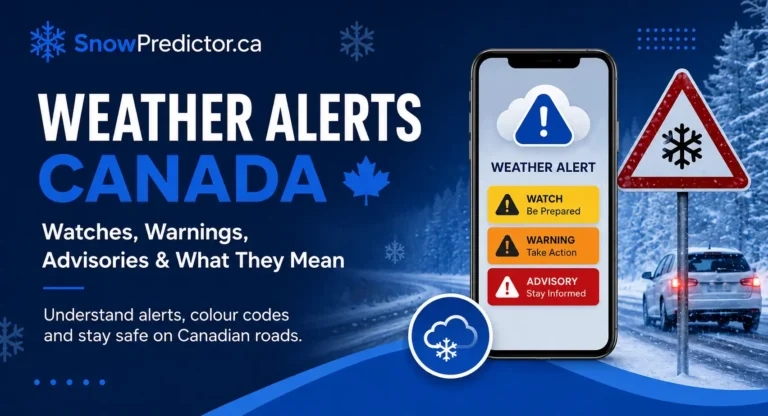
| Weather alerts | Hazard information from official authorities | Automatic school cancellation |
These tools are complementary. The index provides a closure estimate, while the forecast features help users understand the weather behind it.
How to Find the AccuWeather Snow Day Index
The exact interface may change, but this process generally works:
- Open AccuWeather and search for your Canadian city or postal-code area.
- Select the correct province and location from the results.
- Open the location’s Winter Weather page or winter forecast section.
- Look for Snow Day Forecast, Snow Day Index or school-closure wording.
- Confirm whether the displayed estimate refers to today or tomorrow.
- Review the accompanying winter forecast before interpreting the percentage.
If the feature does not appear, try AccuWeather’s website as well as its app because navigation and available panels can differ. Searching the web for your city plus “AccuWeather winter weather forecast” may also lead directly to the relevant location page.
Do not select another city solely to obtain a result. The AccuWeather Snow Day Calculator estimate is tied to the chosen weather location, and nearby communities may face different snowfall, ice or school authorities.
Why the Index May Show 0% or Disappear
A zero result does not always indicate a technical problem. During summer or periods without winter weather, Canadian location pages may display 0% because no relevant closure risk exists. An off-season result should not be used to judge how well the index performs during active storms.
The panel may also be harder to find when AccuWeather changes its navigation, when a location has limited winter-page coverage or when the app and website present different features. Confirm that you opened the correct AccuWeather Canada winter weather page before assuming the feature is unavailable.
If no index appears, use the hourly forecast, radar and official alerts for weather planning. Then check your board or transportation authority directly. Do not interpret a missing panel as confirmation that schools will open.
What Does the Closure Percentage Mean?
The percentage is an estimated school closure probability for school facilities near the selected location. AccuWeather says the index is based on its latest weather forecast information.
A displayed 70% does not mean:
- Seventy percent of schools will close
- The weather forecast is 70% accurate
- There is a 70% chance of snowfall
- Your individual school has announced closure
- Buses and buildings will receive the same decision
It means the index currently estimates a 70% likelihood of the described closure outcome. Even a high percentage leaves uncertainty.
Users who need help interpreting a snow day probability can read the snow day percentage guide. A probability is planning information, not a promise.
Snow Day Index Versus Precipitation Probability
Precipitation probability answers whether measurable precipitation may occur within a forecast area and period. It does not estimate what a school authority will do.
The AccuWeather snow day forecast attempts to answer a secondary impact question: could the expected winter weather cause school facilities to close? That assessment can be influenced by snow, ice, cold or other hazardous conditions.
A 90% chance of snow can accompany a low closure estimate if accumulation and timing appear manageable. A lower precipitation chance could still concern families if the possible event involves freezing rain during morning transportation.
Never copy the precipitation percentage and call it a snow day chance. The two values represent different events.
Snow Day Index Versus WinterCast
AccuWeather WinterCast focuses on winter weather conditions such as snowfall probability, expected accumulation and storm information. It helps users understand what may fall and how the winter event could develop.
The Snow Day Index focuses on potential school closure. WinterCast supplies weather context; the index expresses a possible operational consequence.
| Question | Better AccuWeather Feature |
|---|---|
| How much snow may fall? | WinterCast or winter-weather forecast |
| When may precipitation begin? | Hourly forecast or MinuteCast |
| Where is precipitation now? | Radar |
| Is hazardous weather officially flagged? | Weather alerts |
| How likely are nearby schools to close? | Snow Day Index |
Families should inspect both the weather and the index rather than relying on one percentage without context.
Snow Day Index Versus MinuteCast
AccuWeather MinuteCast provides short-term, minute-by-minute precipitation information for supported locations. It may show precipitation type, intensity, start time and end time during the near-term period.
MinuteCast can help someone see whether snow or rain is about to begin, but it cannot inspect untreated roads or confirm transportation status. It also covers a different time horizon from a next-day closure estimate.
Use MinuteCast for immediate precipitation awareness. Use the index for estimated school disruption. Use official education and transportation sources for confirmation.
Which Weather Factors Can Affect the Index?
AccuWeather does not expose every calculation behind each public result. Users should therefore avoid inventing exact weights or thresholds. In general, winter closure risk can be influenced by:
- Expected snowfall amount and rate
- Rain, snow, ice pellets or freezing rain
- Storm start, peak and end times
- Air temperature and rapid cooling
- Wind and blowing snow
- Visibility during travel hours
- Active winter-weather alerts
- Conditions expected later in the school day
An AccuWeather school closure prediction may use forecast information, but public users cannot assume it includes private road inspections, staffing information or every board’s current policy unless AccuWeather explicitly documents that coverage.
How Accurate Is the AccuWeather Snow Day Calculator?
No public percentage should be accepted without knowing how it was tested. AccuWeather is an established weather provider, but accurate weather forecasts and accurate school-decision forecasts are separate questions.
A credible evaluation of the AccuWeather Snow Day Calculator would need:
- Timestamped estimates saved before each decision
- A defined outcome, such as building closure
- The exact Canadian locations tested
- Links to official closure results
- An entire sample rather than selected storms
- Separate treatment of bus-only cancellations
- Calibration results for each probability band
- Comparison with simple baselines and competing tools
Without a shared, auditable dataset, it is not responsible to claim AccuWeather or SnowPredictor wins nationally. The guide to snow day calculator accuracy explains how easy accuracy percentages are to inflate.
Why Canadian Location Context Matters
A snow day calculator Canada tool must handle major regional differences. Barrie can receive lake-effect snow while Toronto sees much less. Vancouver may be disrupted by modest snow or freezing rain, while Prairie divisions can face extreme cold, wind and drifting.
School systems also differ. A city can contain several boards, and a board may cover urban streets and rural roads. A weather-location estimate does not necessarily align perfectly with a school or transportation boundary.
This is the central limitation of any broad Canadian snow day calculator. Hyperlocal weather wording does not prove route-level or board-level knowledge.
AccuWeather Versus SnowPredictor
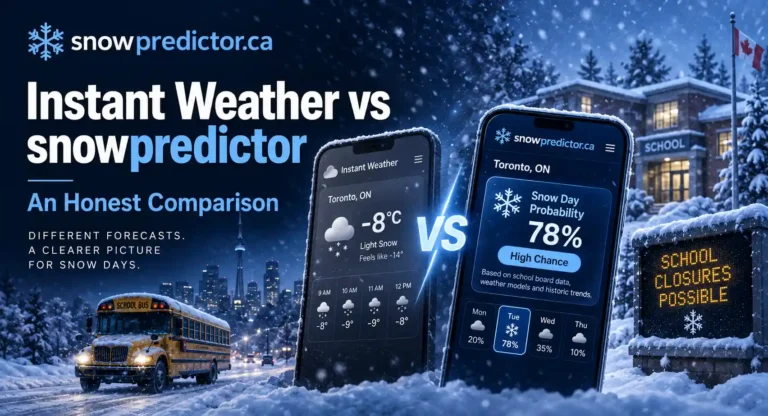
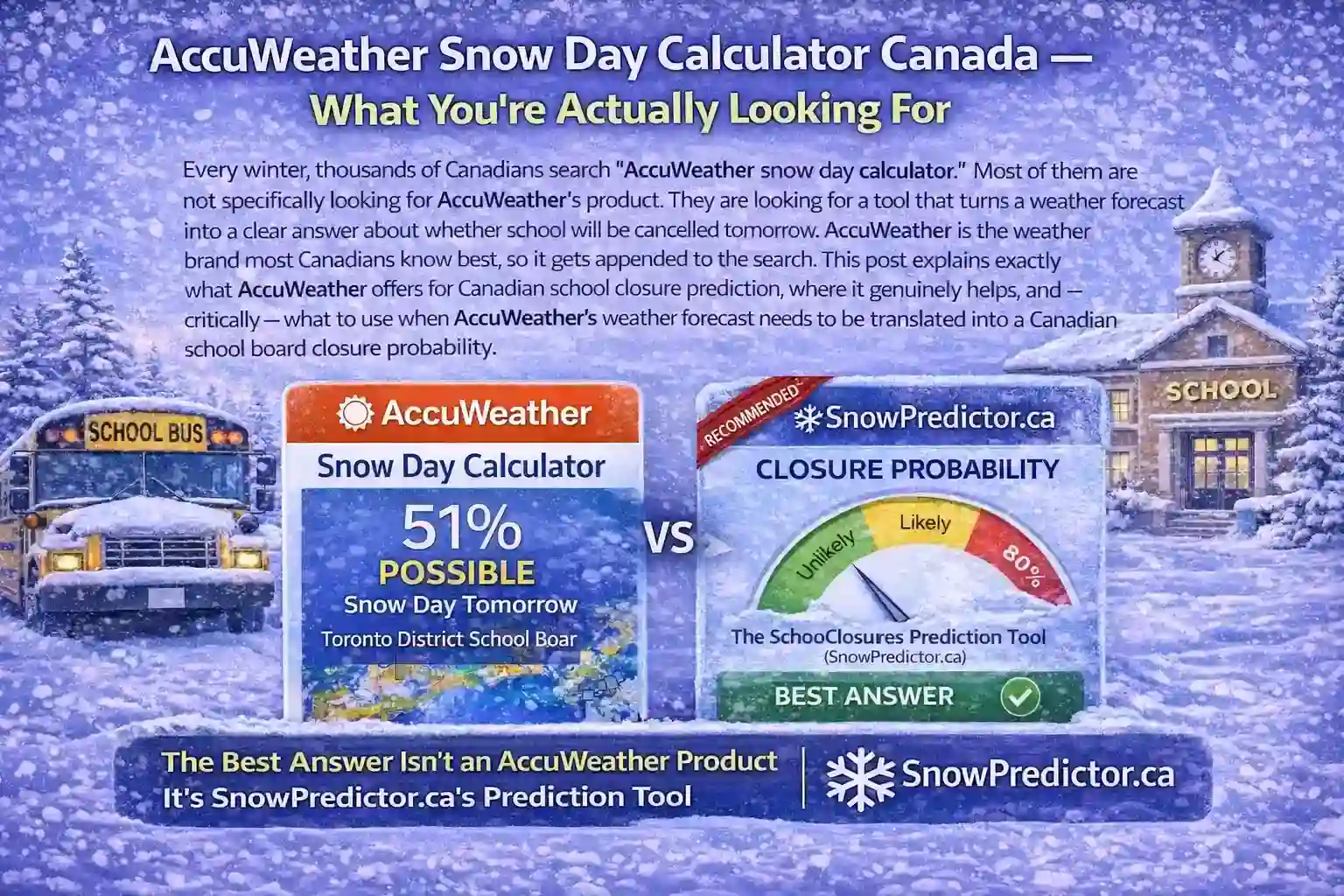
The SnowPredictor vs AccuWeather comparison is not simply “weather app versus closure tool” because both can display closure-related percentages.
| Category | AccuWeather | SnowPredictor |
|---|---|---|
| Product scope | Global weather platform | Canadian school-disruption tool |
| Closure estimate | Snow Day Index for supported locations | Location-based snow day percentage |
| Weather detail | Extensive forecasts, radar and alerts | Less detailed than a full weather app |
| Canadian education focus | Not its only purpose | Central product focus |
| Official confirmation | No | No |
| Public comparative validation | Not sufficient to declare a winner | Not sufficient to declare a winner |
AccuWeather is stronger for exploring the complete winter weather forecast Canada picture. SnowPredictor offers a simpler snow day predictor Canada experience focused on Canadian family planning.
SnowPredictor should not claim that AccuWeather lacks a snow day feature. Its stronger argument is that a dedicated Canadian tool can present local education context more directly. Any claimed accuracy advantage still requires transparent comparative testing.
Bus Cancellation Is Not Always School Closure
An important limitation of the AccuWeather Snow Day Calculator is the potential mismatch between “school facilities closed” and the announcements Canadian families receive.
In Ontario, school bus cancellations can occur while buildings remain open. Transportation may also be cancelled only in selected zones. AccuWeather’s location percentage does not replace the wording of the local announcement.
Read the guide to bus cancellations versus school closures before deciding whether an index correctly predicted an Ontario outcome.
How Canadian Families Should Use the Tools
Follow this routine during a winter event:
- Check the correct AccuWeather Canadian location.
- Review WinterCast, hourly timing, temperature and wind.
- Read active weather alerts Canada information.
- View the Snow Day Index if available.
- Compare SnowPredictor for another planning estimate.
- Prepare flexible arrangements when risk is elevated.
- Recheck the weather if the storm changes.
- Confirm the result with the responsible authority.
For every snowfall forecast Canada result, remember that weather services forecast conditions. School boards and transportation organizations decide operations.
Frequently Asked Questions
Does AccuWeather Have a Snow Day Calculator in Canada?
Yes. The feature is generally called the Snow Day Index or Snow Day Forecast. It has appeared on winter-weather pages for various Canadian locations and estimates how likely nearby school facilities are to close.
How Do I Find AccuWeather’s Snow Day Index?
Search AccuWeather for your city, open its Winter Weather page and look for the Snow Day Forecast or Index. Availability and placement may vary by location, platform and season.
What Does the AccuWeather Snow Day Percentage Mean?
It estimates how likely school facilities near the selected weather location are to close because of inclement weather. It is not a snowfall chance, accuracy score or official school closure notice.
Is the Snow Day Index the Same as WinterCast?
No. WinterCast focuses on winter weather, including snowfall probability and accumulation. The Snow Day Index estimates possible school closure likelihood based on forecast information.
Can AccuWeather Confirm That a Canadian School Is Closed
No. Check the relevant school board, school division, district or student transportation authority. Only those organizations can confirm closures, delayed openings, early dismissals or bus cancellations.