Extreme Cold Day School Closures in Canada: When Is It Too Cold for School?
A clear winter morning can disrupt school even when no snow is falling. Extreme cold day school closures Canada are possible when low temperatures and wind chill threaten students waiting outdoors, affect school buses or create problems with heating and emergency access. However, Canada has no national temperature that automatically closes every school.
The most common source of confusion is the difference between transportation and building operations. A school division may cancel buses while keeping schools open for students who can arrive safely. This guide explains how authorities assess cold, what official wind chill ranges mean, why local policies differ and how families should confirm the morning decision.
Table of Contents
- What temperature is too cold for school?
- Why is there no national rule?
- How does wind chill affect decisions?
- What is the difference between bus cancellation and closure?
- How do regional approaches differ?
- What should families do?
What Temperature Is Too Cold for School in Canada?
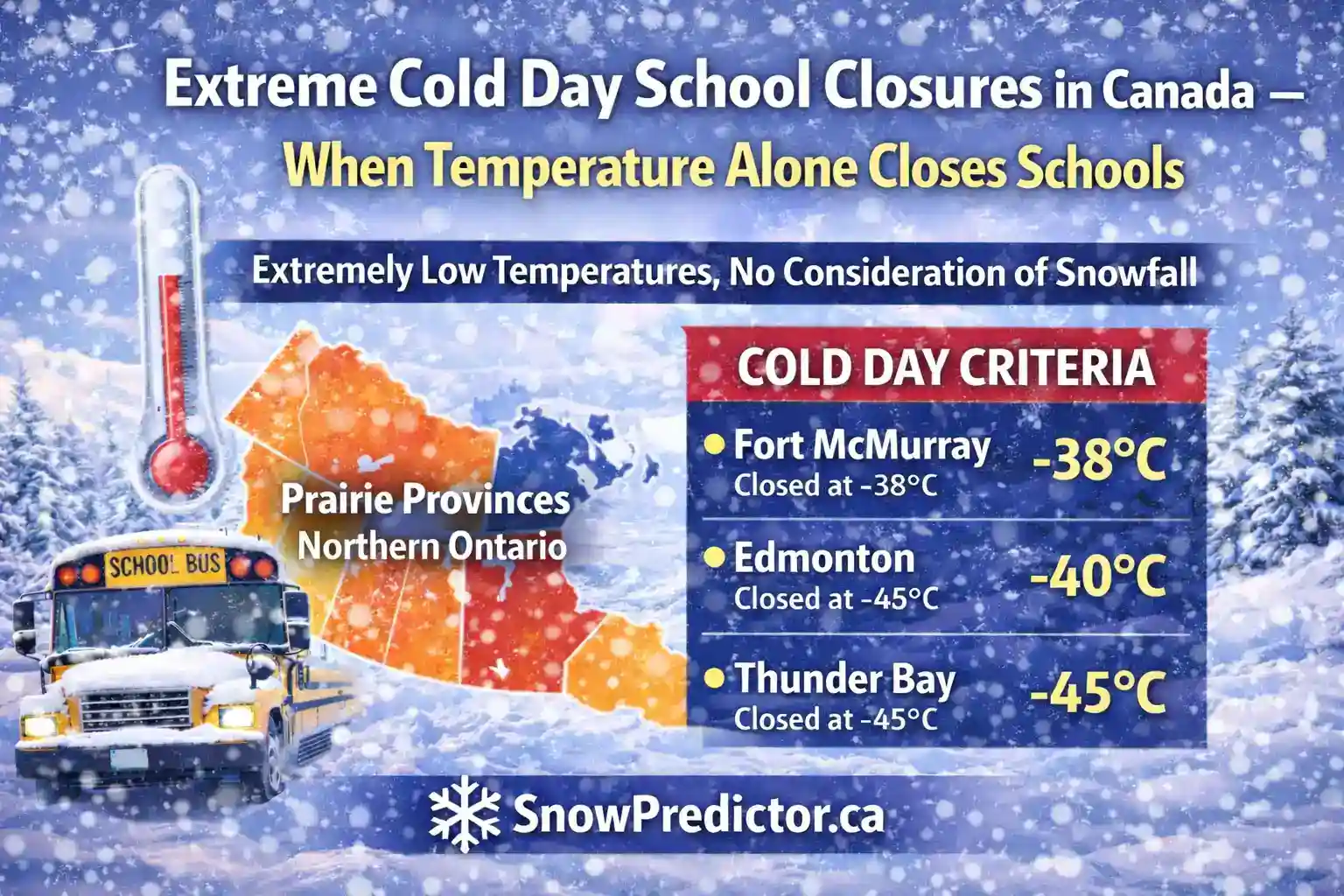
There is no universal school-closing temperature in Canada. Each school board, district, division or transportation authority applies its own procedure based on local climate, routes, buildings and student exposure.
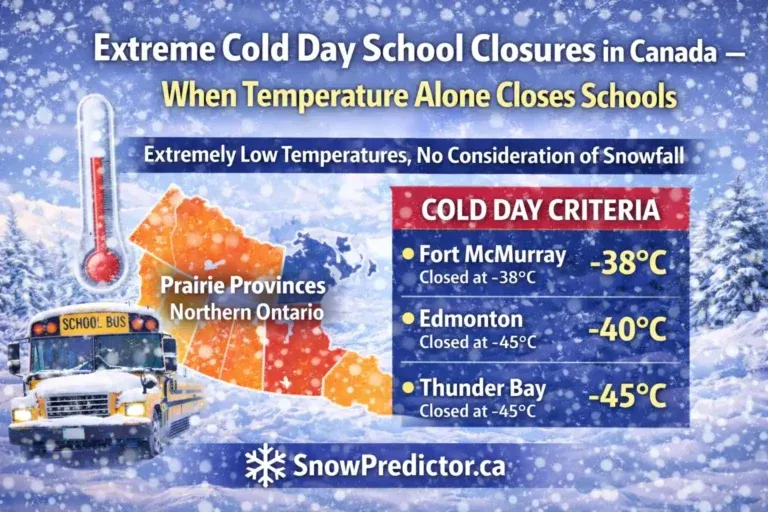
Some Prairie school systems publish numerical wind chill or air-temperature triggers for reviewing or cancelling transportation. Others use flexible guidance and assess each event individually. A threshold can mean any of the following:
- Officials begin reviewing transportation conditions
- Selected rural routes stop operating
- All school buses are cancelled
- Outdoor recess moves indoors
- Schools remain open without transportation
- Individual buildings or an entire system close
This is why a search for school closure temperature Canada cannot produce one dependable national number. Even when two authorities refer to the same temperature, they may connect it to different actions.
Families should read the verb attached to the threshold. “Transportation will be cancelled” is not the same as “schools will be closed,” and “may be cancelled” is not a guaranteed result. This makes extreme cold day school closures Canada locally defined outcomes.
Why Is There No National School-Closure Temperature?
Canada has no federal education department that makes local weather decisions for every school. Provinces and territories oversee education, while regional education and transportation organizations usually decide whether their services can operate safely.
Local differences shape extreme cold day school closures Canada and include:
- Distance and time students spend at bus stops
- Length of urban and rural routes
- Availability of heated shelters
- Bus reliability in severe cold
- Local experience with prolonged low temperatures
- Public transit and alternative transportation
- Building heating, power and emergency systems
- Student age and accessibility needs
A rural Prairie division may operate long routes across open terrain, while a large urban board may serve many students who walk or use public transit. Northern communities are accustomed to colder winters but may face greater distances and fewer backup services.
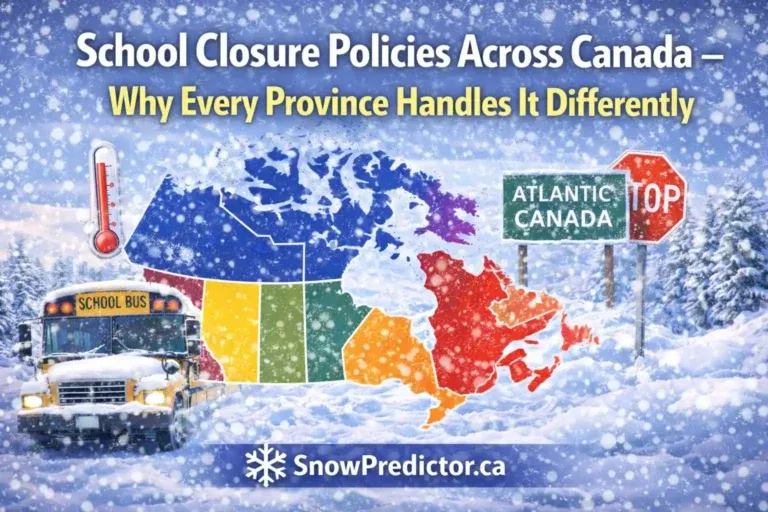
For a broader comparison of responsibilities, read the guide to school closure policies in Canada by province. It explains why national weather alerts and local school decisions serve different purposes.
How Does Wind Chill Affect School Decisions?
Wind chill helps authorities assess the rate at which exposed skin loses heat. It is not the actual air temperature, but it represents how cold the combined effect of temperature and wind feels on exposed skin.
Environment and Climate Change Canada classifies wind chill risk as follows:
| Wind Chill Value | Official Risk Level | Approximate Exposed-Skin Freezing Time |
|---|---|---|
| -10 to -27 | Moderate | Risk increases with prolonged exposure |
| -28 to -39 | High | 10 to 30 minutes |
| -40 to -47 | Very high | 5 to 10 minutes |
| -48 to -54 | Severe | 2 to 5 minutes |
| -55 or colder | Extreme | Less than 2 minutes |
These ranges explain why wind chill school closures and transportation reviews become more likely during a windy Arctic outbreak. They are health-risk categories, not automatic school rules.
The practical concern is exposure. Children may wait outside, walk farther than expected when transportation fails or wear clothing that becomes damp. Bus breakdowns also create a different risk during extreme cold because students may need safe shelter quickly.
Does a Bus Cancellation Mean the School Is Closed?
No. Bus cancellation and school closure are separate operational decisions. During extreme cold day school closures Canada, transportation may be cancelled first while buildings remain open, heated and staffed.
When Buses Are Cancelled but Schools Stay Open
This response limits outdoor waiting and reduces the risk of bus breakdowns without removing a supervised place for students who arrive independently. If parents drive a child to an open school, they may also be responsible for afternoon pickup because morning cancellations often last all day.
An announcement may apply to:
- All buses in the authority
- Rural routes only
- Selected geographic zones
- Individual routes or vehicles
- Morning and afternoon transportation
- Transportation for specific programs
Read the guide to bus cancellations versus school closures in Ontario for a detailed explanation of these outcomes.
When the School Building Closes
Full cold weather school closures are generally reserved for situations in which safe building operations or access cannot be maintained. Extreme cold may combine with dangerous roads, poor visibility, power failure, heating problems, staffing shortages or limited emergency access.
A system may close selected schools rather than every building. Families should never assume a public-board notice automatically covers nearby Catholic, francophone, independent or First Nations schools.
What Factors Do Officials Review Before Cancelling School?
Officials assess the conditions expected during student pickup, travel and dismissal, not simply the lowest number displayed in a weather app. The return trip matters because students must also reach home safely later in the day.
Decision factors can include:
- Forecast and observed air temperature
- Wind chill during bus-stop and travel periods
- Duration of the cold event
- Extreme cold warnings and forecast confidence
- Bus starting, heating and mechanical reliability
- Route length and access to shelter
- Road conditions and visibility
- Building heat, power and water
- Staffing and emergency-response capacity
- Conditions expected at dismissal
The guide to how Canadian schools decide snow days explains how weather information, route checks and transportation reports contribute to the final decision.
How Do Extreme Cold Policies Vary Across Canada?
The effect of cold differs by region because climate, transportation networks and operating experience are not uniform. Extreme cold day school closures Canada therefore cannot be predicted by applying one province’s threshold to another.
Manitoba and Saskatchewan
Prairie divisions often pay close attention to wind chill, route exposure and long-distance transportation. Some publish local thresholds for bus cancellation, but families must verify the current school-year procedure and the action connected to the number.
Manitoba divisions may separately publish rules for indoor recess, transportation and buildings. For example, Winnipeg School Division’s current cold-weather guidance moves recess indoors when wind chill reaches -28°C. That is an indoor-recess guideline, not proof that schools close at -28°C.
Saskatchewan’s open terrain adds blowing snow and visibility to the decision. A cold day can also involve drifting snow, so route conditions may differ across one large division.
Alberta
Alberta school authorities set their own operating procedures. A threshold used by a rural division near Edmonton does not automatically apply to Calgary, another district or a separate school system serving the same area.
Families should check whether the policy refers to current temperature, forecast temperature, wind chill or a combination. They should also determine whether crossing the threshold starts a review, cancels buses or closes buildings.
Ontario
Ontario has no province-wide cold cutoff for schools. Transportation consortia and boards can make separate decisions, and northern communities face different route exposure from large southern cities.
An extreme cold school bus cancellation can leave buildings open. Parents should check both the school board and the transportation provider because one may publish the bus status while the other explains classes, programs and buildings.
British Columbia, Quebec and Atlantic Canada
Cold alone may be less common as the primary cause of disruption in many coastal or southern communities. Freezing rain, wet snow, steep roads, wind, power failures and mixed-precipitation storms may create greater operational risk.
Northern and interior areas still experience severe cold, but district-level rules remain decisive. The nearest major city’s policy may not apply to a remote route or neighbouring authority.
Does an Extreme Cold Warning Close Schools?
No. An Environment and Climate Change Canada warning identifies dangerous weather conditions, but it does not order schools or buses to close. Education and transportation authorities use the warning as one input in their own decision process.
A warning is important because it communicates health risk, expected duration and the affected region. Officials may combine it with local measurements, route reports, transportation reliability and building conditions.
Families should treat the warning as a reason to prepare, not as an attendance announcement. Check the timestamp and exact warning area, then wait for the responsible school authority’s decision.
How Can Families Estimate the Chance of a Cold Day?
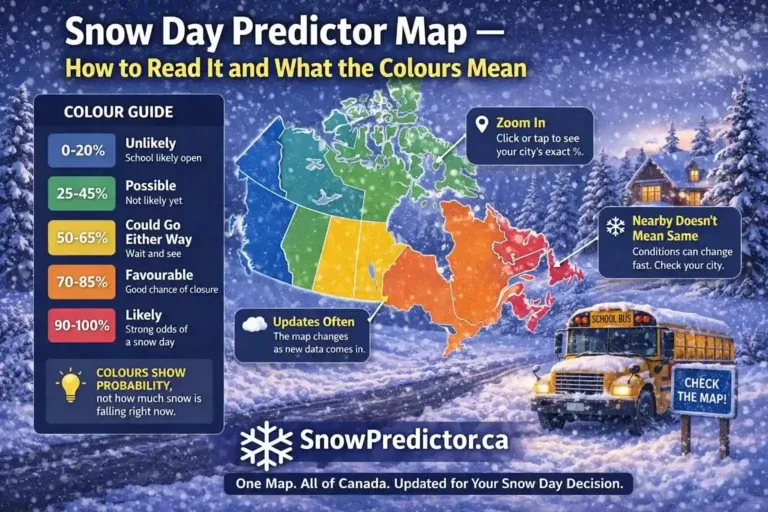
Use the local morning forecast and school policy together. A weather-based predictor can support planning, but it cannot confirm extreme cold day school closures Canada because only the responsible authority controls school and transportation operations.
Enter the correct community into SnowPredictor and compare the estimate with:
- Morning air temperature and wind chill
- Current government weather warnings
- The authority’s published cold-weather procedure
- Route-specific transportation updates
- Building, class and program announcements
Location accuracy matters. The temperature at a major airport or city centre may not represent a rural bus route, exposed highway or valley community.
Use the result to prepare childcare, work and transportation options. Recheck the official notice at the authority’s stated morning announcement time.
What Should Parents Do on an Extreme Cold Morning?
Keep children indoors until transportation is confirmed, check the full official notice and prepare a safe alternative before departure. Reducing uncertain outdoor waiting is one of the simplest ways to lower frostbite risk at bus stops.
Follow this checklist:
- Enable board, school and route notifications
- Confirm whether buses, buildings and classes have separate statuses
- Arrange both drop-off and pickup when transportation is cancelled
- Use warm layers and a wind-resistant outer layer
- Cover the head, hands, face and other exposed skin
- Choose insulated, waterproof footwear
- Keep emergency contacts and backup care arrangements current
- Avoid relying on an undated screenshot or notification preview
The Canadian winter weather safety checklist covers clothing, vehicle supplies, communications and home preparation.
If a child shows numbness, pale or waxy skin, unusual tiredness, confusion or persistent shivering, move them into shelter and seek appropriate medical guidance. School attendance decisions should not override an immediate health concern.
Why Can Old Temperature Lists Be Misleading?
Old lists can confuse a bus threshold with a building closure, apply one division’s number nationally or omit the measurement time. Extreme cold day school closures Canada depend on the current policy, not a copied graphic with no date or source.
Before relying on a threshold, verify:
- Which authority published it
- Which school year or revision date it covers
- Whether it uses air temperature, wind chill or either
- Which weather station or forecast period applies
- Whether it triggers review, bus cancellation or school closure
- Whether the cancellation lasts for the full day
Searches for schools closed due to cold often mix several outcomes. A school may stay open after buses stop, outdoor recess may move indoors without affecting transportation, or only a few routes may be cancelled.
Final Answer: When Is It Too Cold for School?
It is too cold for normal school operations when the responsible authority determines that student exposure, transportation or building conditions cannot be managed safely. There is no Canada-wide numerical cutoff.
The evidence-based approach to extreme cold day school closures Canada is straightforward: use official wind chill guidance to understand the health risk, read the local policy to understand possible actions and check the live morning announcement for the final decision.
Frequently Asked Questions
What temperature closes schools in Canada?
No single temperature closes every Canadian school. Local boards, districts, divisions and transportation authorities establish their own procedures, and a numerical threshold may cancel buses without closing buildings. Check whether your authority uses air temperature, wind chill or both, and confirm the exact action through its current morning notice.
Do schools close when wind chill reaches -40°C?
Not automatically. Environment and Climate Change Canada classifies wind chill from -40 to -47 as a very high exposure risk, but that health category is not a national school-closing rule. Some local authorities use values near this range when reviewing transportation, while others rely on broader operational assessments and may keep schools open.
Can schools remain open when buses are cancelled for cold?
Yes. Schools can remain open when buses are cancelled because transportation and building operations are separate decisions. Families who drive a child to an open school may need to arrange afternoon pickup as well. Read the entire notice to determine which routes, classes, programs and buildings are affected and whether transportation is cancelled for the full day.
Does an extreme cold warning close schools in Canada?
No. A government extreme cold warning communicates dangerous weather and exposure risk, but it does not close schools. Local education and transportation authorities decide operations using the warning, forecast wind chill, route conditions, bus reliability and building safety. Families should monitor the warning for preparation and the school authority for the official decision.
How quickly can exposed skin freeze in extreme wind chill?
Environment and Climate Change Canada says exposed skin can freeze in 10 to 30 minutes at wind chill values from -28 to -39. At -40 to -47, freezing can occur in 5 to 10 minutes, and at -48 to -54 it can occur in 2 to 5 minutes. Clothing, shelter and exposure duration remain important.