How Does a Snow Day Predictor Work? A Clear Canadian Guide
A weather app can tell you that 15 centimetres of snow is expected, but it cannot automatically tell you whether your school will close. That decision depends on more than snowfall. Ice, wind, visibility, storm timing, road conditions, bus routes and local operating practices can all change the outcome.
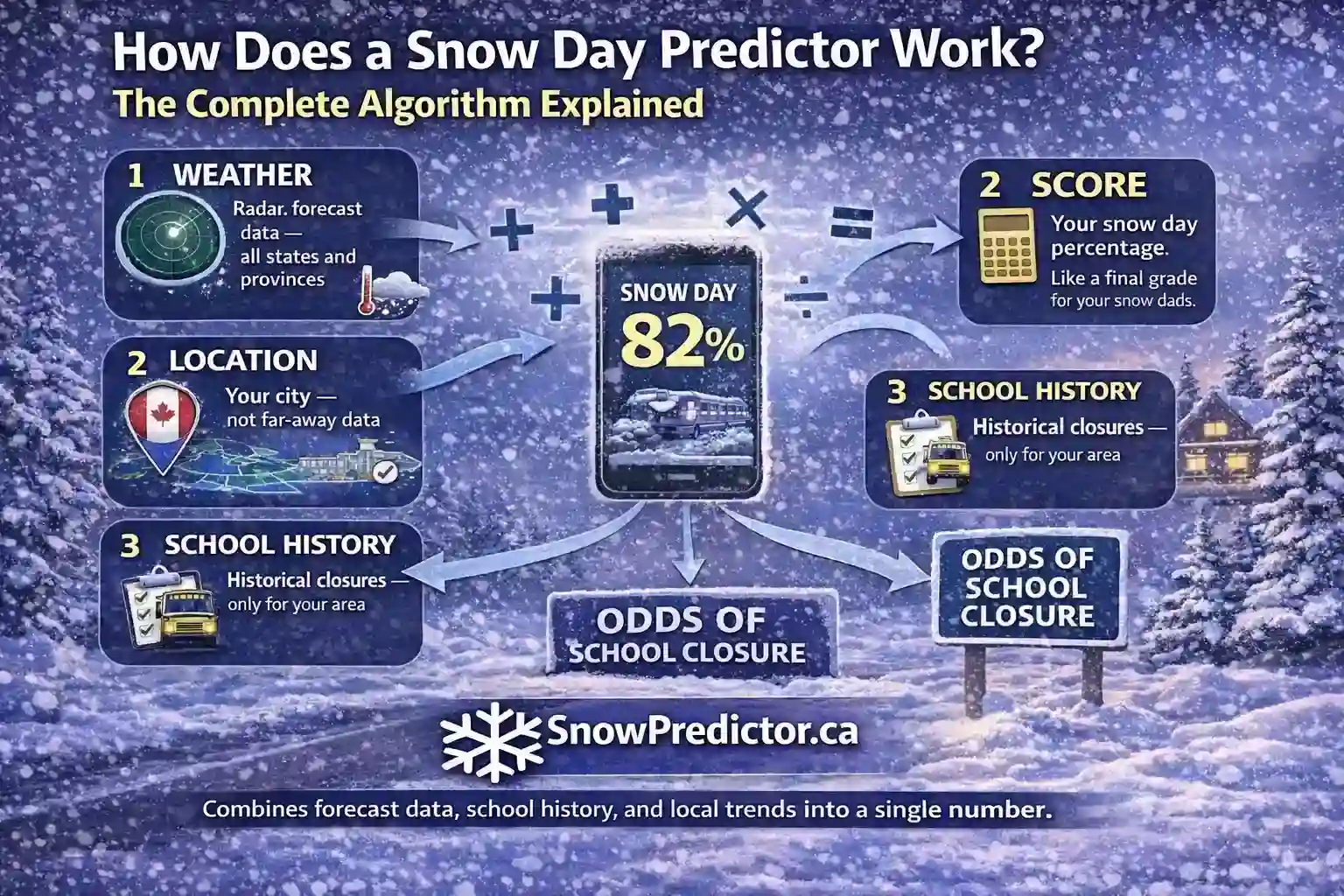
So, how does a snow day predictor work? It collects relevant forecast information, evaluates the conditions most likely to disrupt school travel and converts those signals into an estimated closure probability for a location. A useful predictor adds local context instead of treating every Canadian community alike.
This guide explains the process from location matching and weather inputs to probability output. It also shows why families must verify every result with their school authority.
What Is a Snow Day Predictor?
A snow day predictor estimates whether winter weather may lead to a school closure. Unlike a general forecast, it asks whether expected conditions could disrupt school operations or transportation.
A snow day calculator Canada result usually appears as a percentage or risk category. It represents an estimated outcome for a selected place and date, not an announcement or the share of schools that will close.
| Tool | Main Question Answered | Typical Output |
|---|---|---|
| Weather forecast | What weather is expected? | Snow, ice, temperature and wind |
| Weather alert | What hazard and impact require attention? | Advisory, watch or warning |
| Snow day predictor | Could these conditions disrupt school? | Estimated closure probability |
| School authority notice | What is the official decision? | Open, closed or transportation cancelled |
Environment and Climate Change Canada’s impact guidance does not predict secondary outcomes such as closures. A predictor interprets disruption risk, while the responsible authority decides.
How Does a Snow Day Predictor Work Step by Step?
The implementation varies by tool, but how does a snow day predictor work comes down to six stages. Providers should not claim precision without evidence.
| Stage | Information Handled | Purpose |
|---|---|---|
| 1. Location matching | City, region or school-board area | Select relevant local conditions |
| 2. Forecast collection | Snow, ice, wind and temperature | Describe the expected event |
| 3. Timing analysis | Start, peak and end times | Measure impact on travel hours |
| 4. Hazard evaluation | Roads, visibility and cold | Estimate operational difficulty |
| 5. Local context | Geography and closure practices | Adjust a generic weather reading |
| 6. Probability output | Combined risk signals | Present an understandable estimate |
Step 1: Match the User to a Relevant Location
The location is more than a weather lookup. A city can contain multiple school systems, while one authority may cover urban streets and rural roads. The selected location must reasonably represent the school area.
Barrie should not produce a Toronto-based result simply because both are in southern Ontario. Lake-effect exposure, transportation networks and boards differ. Location matching supports a useful Canadian snow day predictor.
Step 2: Collect the Weather Forecast
Numerical weather prediction models use observations and atmospheric calculations to forecast future conditions. Public forecasts then communicate expected local weather.
Relevant weather data for snow days may include:
- Expected snowfall amount and hourly snowfall rate
- Start, peak and end time of precipitation
- Air temperature and possible road-temperature changes
- Rain, snow, ice pellets or a freezing rain forecast
- Wind speed, gusts and potential blowing snow
- Visibility during the storm
- Existing snow cover or recent ice
- Official watches, advisories and warnings
No single input answers the question. Their interaction during school travel hours matters.
Step 3: Evaluate Storm Timing
Ten centimetres ending early in the evening can differ from the same amount falling before bus departures. Crews have more clearing time after an earlier event; morning snow or ice creates greater uncertainty.
The snowfall forecast needs a timeline, not only a total. A model may examine overlap with route inspections, bus departures, staff travel or dismissal. This explains why an estimate can change even when the total remains similar.
Step 4: Translate Weather Into Travel Risk
A useful snow day predictor algorithm looks beyond fresh snow depth because decisions depend on safe, reliable operations.
Freezing rain can coat untreated surfaces. Wind may drift snow across plowed rural roads, while poor visibility can make passable routes unsafe. Rapid cooling can cause a flash freeze, and extreme cold can affect waiting students and vehicles.
This is why asking how does a snow day predictor work cannot be answered with one snowfall threshold. Winter hazards combine differently in each event.
Step 5: Add Local Operating Context
The same weather does not create equal disruption. Cities may have transit, shorter routes and greater clearing capacity. Rural divisions may operate buses over long, exposed roads.
Useful local context can include:
- Urban, suburban, rural or northern geography
- Elevation and lake-effect exposure
- Length and exposure of student transportation routes
- Typical road-maintenance conditions
- Whether transportation and buildings are decided separately
- Documented local school closure policy
- Verified patterns in school board closure history
Historical decisions help only when data are complete, correctly matched and recent. Past behaviour is not a promise because policies and operations change.
Step 6: Convert the Signals Into a Probability
After assessing the inputs, the system converts the combined signal into a snow day probability. Some tools use rules and weighted scores. Others may use statistical models or machine learning. Calling a product “AI-powered” does not prove that it is better; the data quality, validation and transparency matter more than the label.
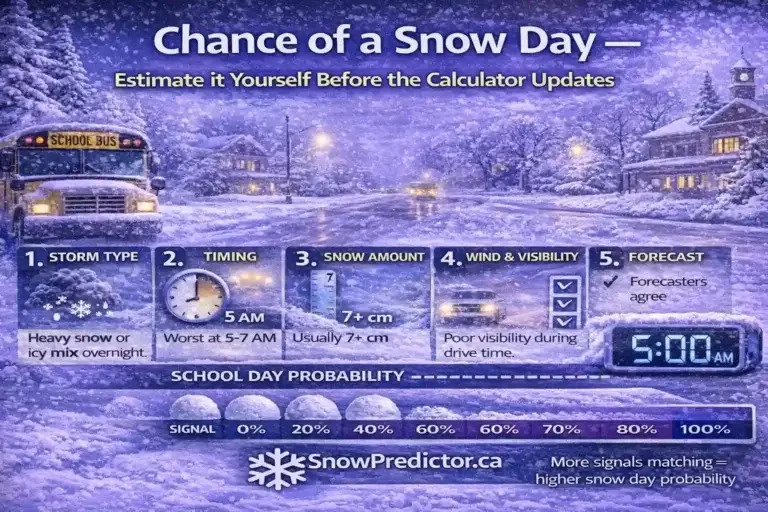
A 70% result means closure appears more likely than at 30%. It does not guarantee closure, prove 70% accuracy or mean 70% of schools will close. The snow day percentage guide explains the distinction.
Which Factors Usually Affect the Result Most?
There is no universal formula for every board, but the following factors commonly influence school closure prediction.
| Factor | Why It Matters | Example of Higher Disruption Risk |
|---|---|---|
| Snow amount and rate | Roads can worsen faster than crews can clear them | Heavy snow near bus departure |
| Ice | Reduces traction on roads and walkways | Freezing rain before dawn |
| Timing | Determines clearing and assessment time | Storm peaks during morning travel |
| Wind and visibility | Affects route safety even after plowing | Drifting on open rural roads |
| Temperature change | Can freeze wet surfaces quickly | Rain followed by a sharp freeze |
| Existing conditions | New weather can compound earlier hazards | Fresh snow over packed ice |
| Local operations | Capacity and routes differ by authority | Long, exposed transportation network |
The school closure probability should reflect overall travel impact. A low-total ice event can disrupt more than deep, dry snow in a prepared community.
Why Nearby Locations Can Receive Different Predictions
Canadian weather varies locally. A narrow lake-effect band may affect Barrie while Toronto receives limited snow. Elevation, coastal exposure and valley temperatures can also alter precipitation over short distances.
Administrative geography adds another layer. Nearby schools may belong to different boards or transportation consortia. One authority may cancel rural buses while another continues service on primarily urban routes. This is why snow day prediction Canada tools need local detail rather than a province-wide threshold.
If neighbouring percentages differ, compare their weather, forecast times and authorities before assuming one is wrong.
Why Snow Day Predictions Change Overnight
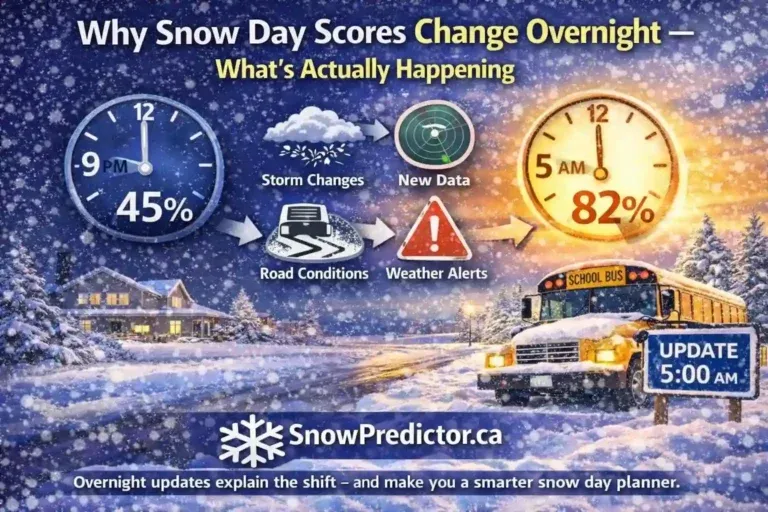
Forecasts are updated as new observations become available and models recalculate the storm. The predicted track may move, snowfall rates may strengthen or precipitation may switch between rain, snow and freezing rain. Even a small timing change can move the worst conditions into or out of the bus window.
A predictor should recalculate when its data refresh. Not every tool updates hourly or on the same schedule, so users should not assume a fixed interval.
Use the evening result to prepare, then check again in the morning. The article on why snow day scores change explains why a moving percentage is normal during an evolving storm.
How Accurate Can a Snow Day Predictor Be?
Snow day calculator accuracy depends on two separate challenges. First, the weather forecast must correctly predict the hazard’s location, timing and intensity. Second, the model must estimate a human operational decision that may include information unavailable to the public.
Accuracy requires a defined outcome: building closure, all-bus cancellation, partial cancellation or remote learning. Mixing outcomes makes statistics misleading. Evaluation also needs enough events and data not used to tune the model.
Be sceptical of a tool that claims exceptional accuracy without publishing:
- The period and locations tested
- The number of closure and non-closure days
- The exact outcome being predicted
- How probability estimates were scored
- Whether results were tested out of sample
- How missing or partial announcements were handled
SnowPredictor should be used as planning guidance, not a guarantee. Compare the estimate with current forecasts and official notices rather than choosing the tool with the loudest accuracy claim.
What a Predictor Cannot Know
When people ask how does a snow day predictor work, they often assume the model sees everything a school authority sees. It usually does not. Decision-makers may receive direct road inspections, bus-contractor feedback, municipal updates, staffing information and building-specific reports.
A public predictor may not know about:
- An untreated bridge or isolated rural route
- A vehicle or staffing issue unrelated to weather
- A last-minute policy or leadership decision
- Damage, power loss or heating failure at one school
- A partial transportation-zone cancellation
- A decision delayed while officials inspect roads
These blind spots rule out responsible claims of 100% certainty. An apparent miss may also reflect a different target, such as closure versus bus cancellation.
Bus Cancellations and School Closures Are Different
Many winter school closures begin as a transportation question. A board can keep buildings open while a transportation authority cancels some or all routes. Families may still be responsible for safe travel and afternoon pickup.
Therefore, school bus cancellations must not automatically be counted as full school closures. Read the official wording and determine whether it applies to buses, selected zones, individual buildings or the complete system. Ontario readers can use the guide to bus cancellation versus school closure for practical examples.
How Parents Should Use the Prediction
To predict a snow day responsibly, use the estimate as one part of a short verification routine:
- Select the correct location and forecast date.
- Read the local forecast and any official weather alert.
- Note ice, wind, visibility and timing, not just snow depth.
- Use the percentage to decide whether a backup plan is sensible.
- Check again when the forecast updates.
- Confirm the final result with the school board or transportation authority.
SnowPredictor.ca turns weather information into a planning signal. This is how does a snow day predictor work in practice: it helps families prepare earlier, while official sources remain responsible for Canadian school closures.
Frequently Asked Questions
How does a snow day predictor work?
It evaluates forecast weather, storm timing, travel hazards and local operating context, then converts those signals into an estimated chance of closure. Different tools use different rules or models, so the quality of the data and validation matters more than technical marketing language.
What Weather Factors Matter Most in a Snow Day Prediction?
Snowfall amount and rate, freezing rain, temperature changes, wind, visibility, storm timing and existing road conditions can all matter. The conditions expected during morning transportation hours are often more useful than a daily snowfall total alone.
Why Can Two Nearby Cities Receive Different Probabilities?
Nearby cities may experience different precipitation or belong to authorities with different routes, geography and operating practices. Lake-effect bands, elevation, rural exposure and separate transportation systems can produce different results over short distances.
Does a High Probability Guarantee a School Closure?
No. It is an estimate for planning. Only the responsible school board, school division or student transportation authority can confirm whether schools are closed, buses are cancelled or operations continue normally.
When Should Parents Check a Snow Day Predictor?
Check in the evening when the forecast becomes useful for planning, then check again in the early morning. Storm tracks, precipitation type, intensity and observed road conditions can change overnight, so the latest result is generally more relevant than an earlier estimate.