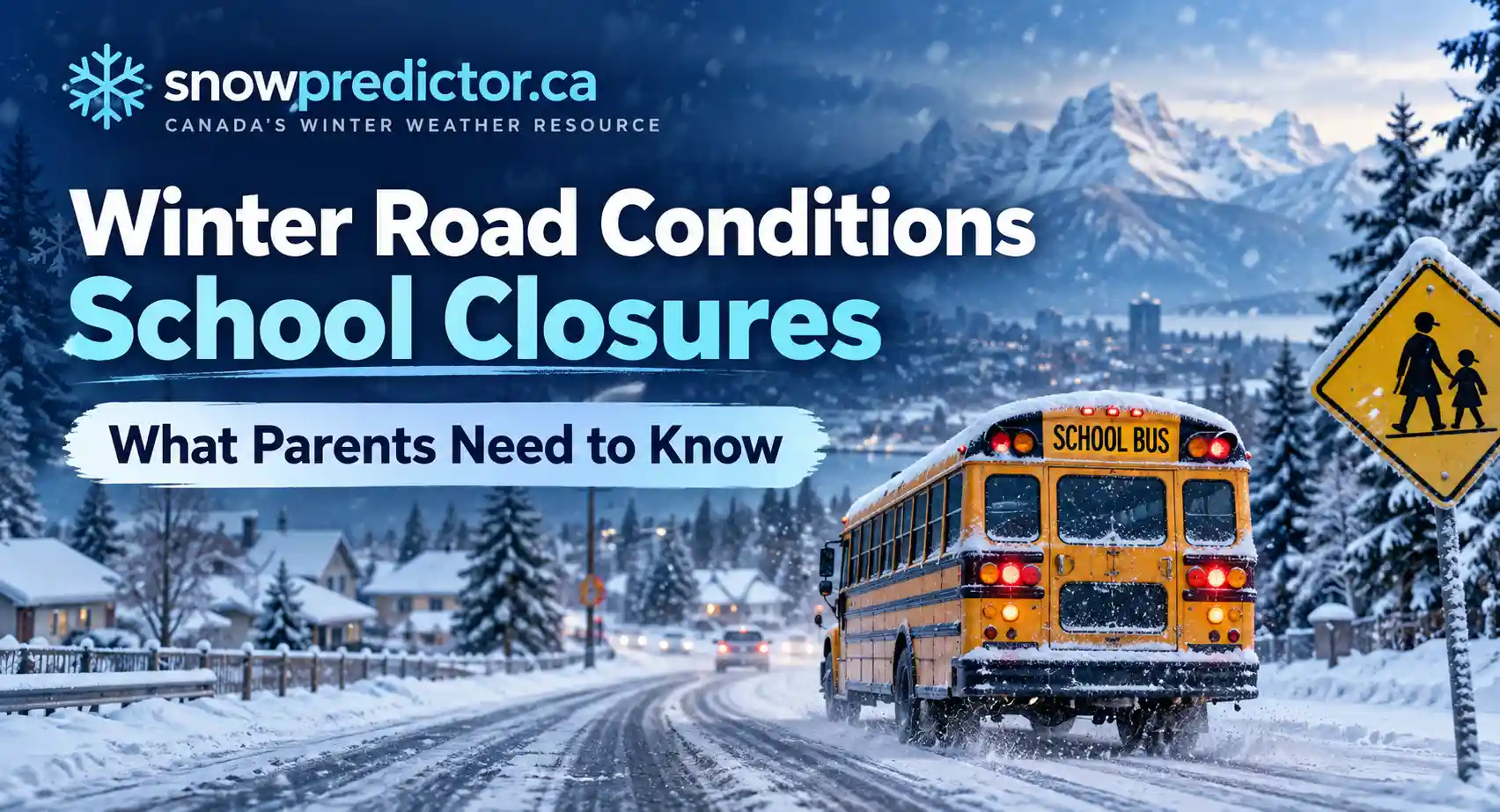
Winter Road Conditions Canada School Closures: What Parents Need to Know
Winter road conditions Canada school closures decisions are closely connected, but snowfall alone does not determine whether buses are cancelled or schools close. Transportation officials assess whether complete routes can be travelled safely when buses leave, during the school day and at dismissal.
A main road may look clear while rural roads, bridges, hills, bus stops and residential streets remain covered, icy or difficult to navigate. This is why families should check road reports, transportation notices and school-board announcements separately instead of relying on a snowfall total or weather-app icon.
The Canada Snow Day Predictor can provide an early planning estimate. It does not replace the official decision issued by a school board, school division or student transportation authority.
Why Do Winter Road Conditions Affect School Closures?
Road conditions affect school operations because buses must complete entire routes safely, often before sunrise and before every road has been fully cleared. Officials consider present conditions as well as the possibility that weather will worsen during morning or afternoon transportation.
The main concerns include:
- Snow-covered or unplowed roads
- Ice beneath fresh snow
- Freezing rain
- Blowing and drifting snow
- Poor visibility
- Rapidly falling snow
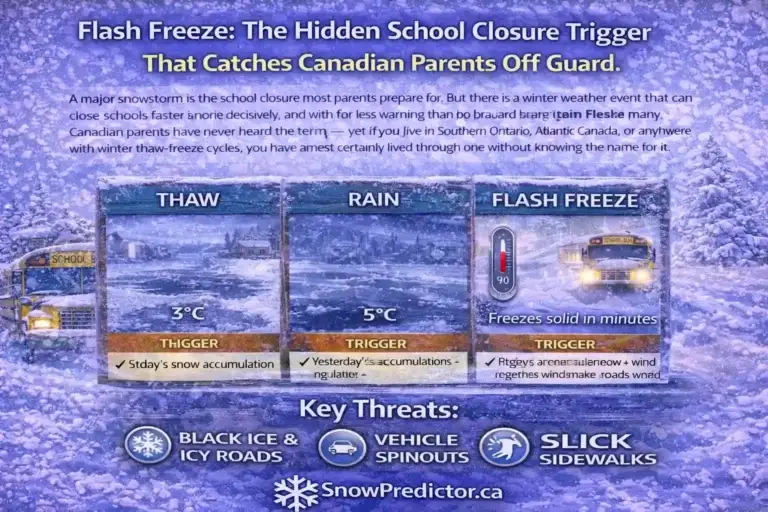
- Flash freezing
- Difficult hills, bridges and turns
- Unsafe school entrances or bus-loading areas
- Conditions expected at afternoon dismissal
A fixed snowfall amount cannot predict the outcome. Five centimetres accompanied by freezing rain or strong wind can create more dangerous travel than a larger snowfall that ended several hours earlier.
How Winter Road Conditions Canada School Closures Decisions Are Made
Winter road conditions Canada school closures decisions are made locally because weather, road maintenance, transportation networks and school policies differ across the country. There is no national rule requiring every Canadian school to close after a particular amount of snow.
Transportation teams may review weather forecasts, road reports, direct observations and information from drivers or road-maintenance authorities. School boards then determine whether buildings, classes, childcare programs or other operations must change.
| Condition | Possible Transportation Concern | Possible Operational Response |
|---|---|---|
| Snow ended several hours earlier | Plows may have time to clear routes | Normal operations may continue |
| Heavy snow during the morning commute | Roads may become covered again quickly | Route, zone or systemwide bus cancellation |
| Freezing rain | Braking and turning may become unsafe | Transportation cancellation or delayed opening |
| Blowing snow | Visibility may change across exposed roads | Rural or weather-zone cancellation |
| Flash freeze | Previously wet roads can ice rapidly | Late decision or broader cancellation |
| Storm expected after school begins | Afternoon travel may become difficult | Activities or return transportation may change |
These are possible outcomes, not automatic rules. The responsible local authority makes the final decision.
Why Clear Main Roads Do Not Guarantee Safe Bus Routes
A clear highway or city street does not prove that an entire school-bus route is safe. A route can include rural roads, subdivisions, bridges, steep grades, narrow turns and school-loading areas that receive different levels of winter maintenance.
Road clearing normally follows local priorities. Major routes may be treated before secondary streets, while rural roads can remain exposed to drifting after a plow has passed. Fresh snow may also cover ice that is difficult to see.
This explains why school bus cancellations Canada families receive can appear unnecessary from one neighbourhood. Transportation decisions must account for the most difficult sections of the route, not only the road visible outside a family’s home.
Which Winter Driving Conditions Cause the Most Concern?
The most dangerous winter driving conditions are not always linked to the greatest snowfall total. Ice, poor visibility and rapid changes often create more immediate transportation problems.
Freezing Rain and Black Ice
Freezing rain can produce a thin layer of ice on roads, bridges, sidewalks and loading areas. Black ice may be difficult to identify, particularly before daylight. A road that appears wet can have very limited traction.
Heavy Snowfall Rates
Snow falling faster than crews can remove it may repeatedly cover treated roads. Rapid accumulation can also hide lane markings, road edges and existing ice.
Blowing and Drifting Snow
Open rural roads are particularly vulnerable to drifting. Strong wind can move cleared snow back onto a route and reduce visibility within minutes.
Flash Freezing
A flash freeze can occur when the temperature drops rapidly after rain, melting snow or wet conditions. The resulting ice may form after an earlier road inspection, forcing transportation teams to reassess the route.
Mixed Precipitation
A storm involving rain, ice and snow is often harder to evaluate than a snow-only event. Fresh accumulation can hide an icy base, while changing temperatures can affect road treatment.
Why Rural and Urban Schools Can Receive Different Decisions
Rural and urban transportation systems face different hazards, so nearby schools do not always receive the same operational decision. A regional cancellation does not mean conditions are identical everywhere.
Rural routes may involve:
- Longer travel distances
- Open roads exposed to wind and drifting
- Lower-priority roads
- Reduced lighting
- Steep or untreated sections
- Longer emergency-response times
Urban routes may involve:
- Congested intersections
- Parked vehicles restricting plows
- Narrow residential streets
- Busy pedestrian areas
- Snowbanks affecting visibility
- Delayed traffic and transit
Weather-zone policies allow transportation providers to cancel service in affected areas without cancelling every route in the system. Families should check their exact school, route or transportation zone rather than relying on a citywide social-media post.
Do Poor Roads Always Cause a Full School Closure?
No. Poor roads can cause bus cancellations while school buildings remain open. Transportation service and school-building operations are separate decisions.
Possible announcements include:
- One route is cancelled.
- Transportation is cancelled in selected weather zones.
- All buses are cancelled, but schools remain open.
- School opening is delayed.
- One or more buildings are closed.
- An entire board or division is closed.
- Morning operations continue, but afternoon transportation changes.
If parents drive a child to an open school after buses are cancelled, they may also be responsible for arranging pickup. Read the guide explaining the difference between a cancelled bus and a closed school before making attendance or transportation plans.
What Should Parents Check Before School?
Parents should check several sources because no single website answers every question. A weather service describes the hazard, a road service reports travel conditions, a transportation authority reports bus operations and a school board confirms building status.
Use this order:
- Check the hourly forecast. Review snowfall timing, temperature, wind, visibility and expected precipitation changes.
- Read active weather alerts. Confirm the affected area, hazard, timing and expected impact.
- Check the provincial or territorial road service. Look for road conditions, closures and available cameras.
- Check the transportation authority. Search for the child’s route, school or weather zone.
- Check the school board or division. Confirm whether the building, classes, childcare and activities are operating.
- Review the afternoon forecast. A safe morning does not guarantee normal dismissal conditions.
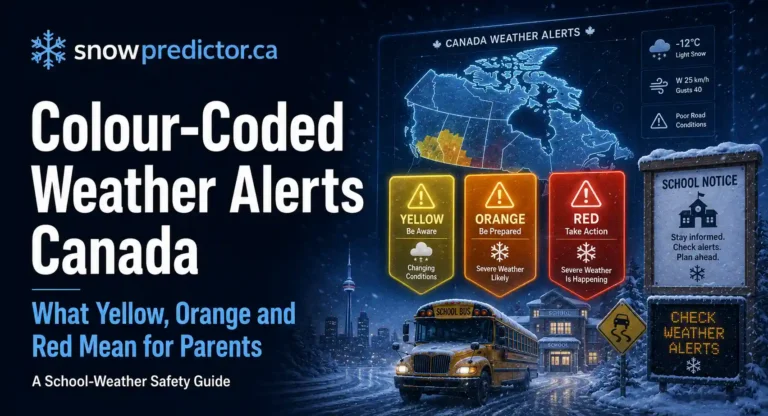
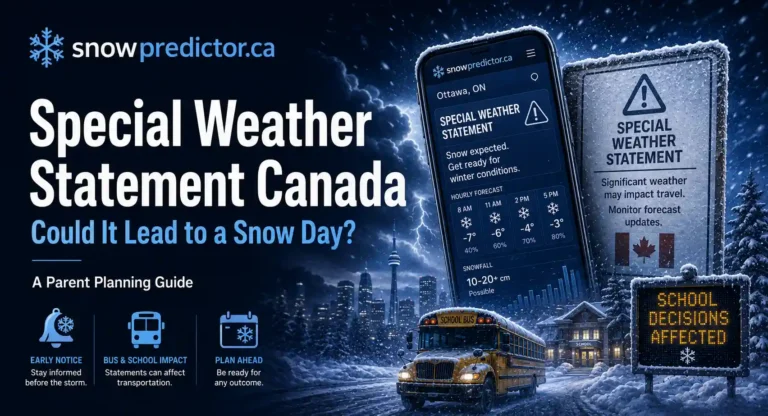
The Canadian weather alerts guide explains how to interpret winter weather messages without treating every alert as an automatic snow day.
How Does Overnight Snowfall Change Road Safety?
Overnight snowfall is most disruptive when it continues into the route-inspection period or morning commute. The final accumulation matters less when crews have enough time to clear and treat roads before buses leave.
For example, snow ending near midnight may provide several hours for plowing. The same amount falling rapidly from 4 a.m. to 7 a.m. can cover roads during inspections and after an earlier plow pass.
The guide to overnight snowfall and snow day chances explains how start time, snowfall rate and the clearing window influence morning decisions.
How Should Families Read Canadian Road Reports?
A road report describes known conditions at a particular time. It does not guarantee that every street, bus stop or rural section is safe.
When reviewing winter road conditions Canada reports, check:
- The time of the most recent update
- Whether the report covers the complete route
- Road closures or travel restrictions
- Snow-covered, partly covered or icy classifications
- Visibility warnings
- Available highway cameras
- Whether precipitation is continuing
- Conditions expected when the child returns home
Do not rely on an old screenshot shared on social media. Conditions can improve or deteriorate after it was captured.
A Practical Morning Decision Checklist
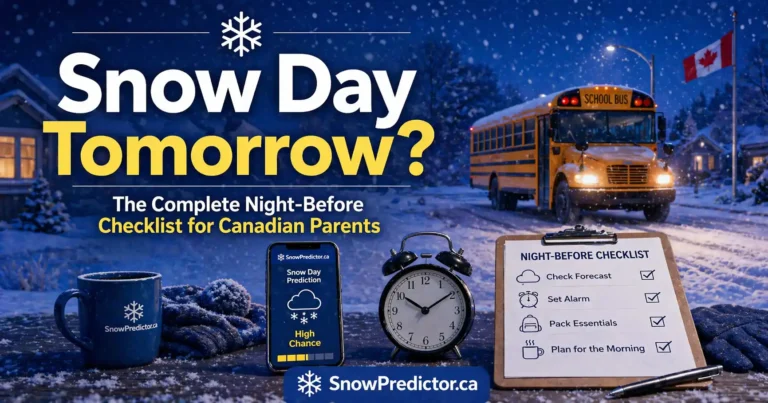
Use this checklist before children leave home:
- Is snow or freezing rain still falling?
- Are roads becoming covered again after plowing?
- Is visibility poor because of wind or heavy snow?
- Does the road report cover the relevant route?
- Has the transportation provider cancelled a route or zone?
- Is the school building open?
- Will buses remain cancelled for the afternoon?
- Who will collect the child if conditions worsen?
- Are childcare or school activities affected?
A family vehicle is not automatically safer because a school bus has been cancelled. If the reason for cancellation also affects the family’s route, delaying unnecessary travel may be the safer choice.
How bad do roads have to be for schools to close in Canada?
There is no Canada-wide road condition or snowfall threshold that automatically closes schools. Local officials assess ice, visibility, snowfall rate, road clearing, route exposure and the forecast for morning and afternoon travel. A transportation authority may cancel buses even when the school board keeps buildings open.
Can school buses be cancelled while schools remain open?
Yes, school buses can be cancelled while schools remain open. Transportation providers assess whether complete bus routes can be travelled safely, while school boards separately decide whether buildings can operate. Parents who drive children to an open school may need to arrange pickup because cancelled transportation often remains cancelled for the entire day.
Where can I check winter road conditions in Canada?
Check the official 511 or road-information service operated by the relevant province or territory. These services may provide road classifications, closures, travel warnings and highway cameras. Then check the local student transportation authority and school board because a public road report does not confirm whether a specific bus route or school is operating
Does a snowfall warning mean schools will be closed?
No, a snowfall warning does not automatically mean schools will close. The warning describes an expected weather hazard, while school and transportation authorities make operational decisions using local roads, visibility, timing and route conditions. Some schools operate normally during a warning, while buses may be cancelled during a smaller but icier event.
Why are buses cancelled when the main roads look clear?
Buses may be cancelled because their complete routes include rural roads, hills, bridges, subdivisions or loading areas that remain unsafe. Main roads are often cleared first and may not represent conditions elsewhere. Drifting snow, hidden ice and poor visibility can also affect sections of a route that families cannot see from home.