School Closure Policies in Canada by Province: How All 10 Provinces Compare
A snowstorm does not trigger the same school response everywhere in Canada. School closure policies in Canada by province differ because education systems, road networks, climates and transportation arrangements are managed locally. A modest snowfall can disrupt coastal British Columbia while creating few problems in Winnipeg, and buses may stop running even when school buildings remain open.
Canada has no federal snow-day threshold. Provincial and territorial governments oversee education, but local education and transportation authorities normally make weather decisions. This guide compares all 10 provinces and explains the difference between bus cancellation and school closure.
Table of Contents
- Who controls school closures?
- How do provincial policies compare?
- What happens in each province?
- Why do similar storms produce different decisions?
- How should families read announcements?
- How can families prepare?
Who Controls School Closures in Canada?
There is no single national authority that closes every Canadian school during severe weather. Provincial governments oversee education, while operational decisions are usually delegated to regional or local education and transportation bodies.
Depending on the province, the responsible organization may be a:
- District school board
- School district or school division
- French-language school service centre
- Regional centre for education
- Provincial school authority
- Student transportation consortium
- Senior administrator acting under an inclement-weather procedure
The organization responsible for buses may differ from the one responsible for buildings, explaining why families can receive two notices during one storm.
Weather services forecast the hazard, but education and transportation authorities decide the operational response. A warning for heavy snow or freezing rain does not automatically create a snow day.
School Closure Policies in Canada by Province: Quick Comparison
This table summarizes common structures and hazards. It does not replace a family’s current local procedure.
| Province | Typical Decision-Maker | Important Winter Hazards | Possible Response |
|---|---|---|---|
| Ontario | Board and transportation consortium | Snow, freezing rain, roads, visibility | Bus cancellation, program cancellation or closure |
| Quebec | Service centre or English school board | Snow, ice, roads, local forecasts | Transportation cancellation, delay or closure |
| British Columbia | School district | Wet snow, ice, mountain routes, flooding | Local closure or delayed opening |
| Alberta | School authority or division | Extreme cold, ice, rural roads | Route cancellation or local closure |
| Saskatchewan | School division | Wind chill, blowing snow, exposed roads | Transportation cancellation while schools may open |
| Manitoba | School division | Extreme cold, wind chill, snow, roads | Indoor measures, bus cancellation or closure |
| New Brunswick | Anglophone or francophone district | Snow, ice, visibility, rural roads | Regional or district-wide decision |
| Nova Scotia | Regional centre or CSAP | Snow, freezing rain, wind, road conditions | Delay, regional closure or early dismissal |
| Prince Edward Island | Public Schools Branch or applicable authority | Wind, drifting snow, ice | System-wide or regional announcement |
| Newfoundland and Labrador | Provincial school system | Heavy snow, wind, ice, regional variation | Delay, early dismissal or regional closure |
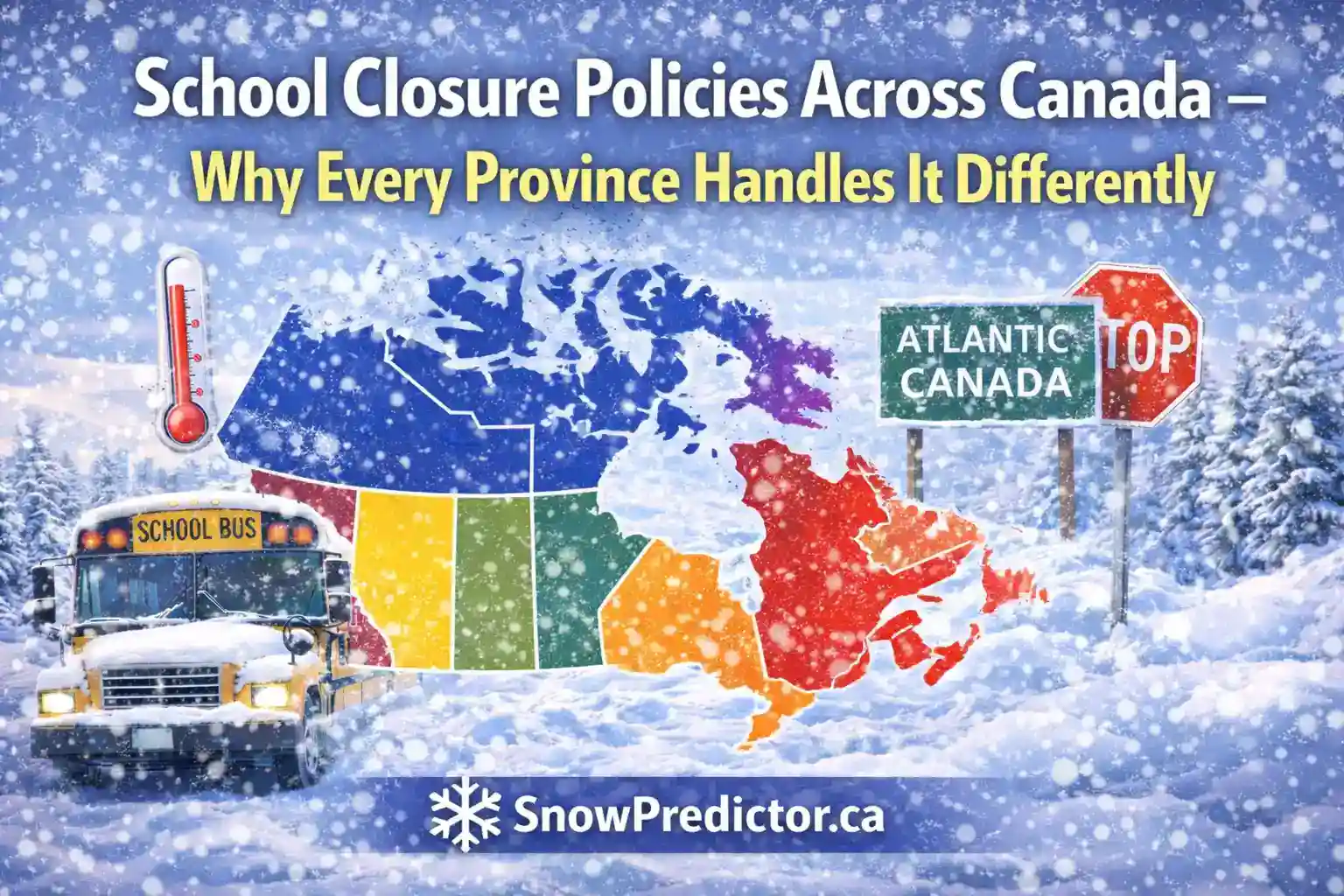
The real lesson from school closure policies in Canada by province is that the province supplies the education framework, while the practical decision often happens closer to the affected routes and communities.
How Do School Closure Policies Vary Across the Provinces?
Every province considers safety, but hazards and administrative structures differ. A fair comparison must examine transportation, buildings and geography together.
Ontario: Transportation and Buildings Are Separate Decisions
Ontario’s boards often work with student transportation consortia that assess bus routes independently from building operations. A consortium can cancel all transportation, selected zones or individual routes while a board keeps schools open.
TDSB states that transportation, classes, programs and buildings can be affected separately. Its current procedure says schools remain open after transportation cancellation unless a separate closure decision is made.
This distinction matters even more in rural and snowbelt regions where buses travel exposed roads. Read the guide to bus cancellations versus school closures in Ontario before treating “buses cancelled” as “no school.”
Quebec: Service Centres and Boards Decide Locally
Quebec’s French-language centres de services scolaires and English-language school boards make decisions for their territories. Montreal, Quebec City, the Eastern Townships and northern communities do not operate under one automatic snowfall cutoff.
Freezing rain can be more disruptive than a larger amount of dry snow because it affects braking, walking surfaces and power infrastructure. Nearby French and English systems may announce different outcomes if their routes, facilities or local conditions differ.
British Columbia: Terrain and Winter Readiness Matter
British Columbia shows why school closure policies in Canada by province cannot be interpreted through snowfall totals alone. Coastal districts, mountain communities, the Interior and northern regions face different hazards.
In the Lower Mainland, wet snow, steep streets, freezing conditions and limited snow-clearing capacity can disrupt travel with relatively modest accumulation. Interior and northern districts handle regular snow more often but must manage mountain routes, prolonged cold and large service areas. Flooding, landslides, wildfires and power failures can also interrupt school outside winter.
Alberta: Extreme Cold Does Not Create One Provincial Cutoff
Alberta authorities consider temperature, wind chill, visibility, road conditions and bus reliability. Calgary, Edmonton, central rural communities and northern regions have different levels of exposure.
Some divisions publish local cold-weather guidance, but it should not be converted into an Alberta-wide rule. A bus system may stop operating while buildings remain open, particularly when students can reach urban schools through other means.
Saskatchewan: Blowing Snow Can Outweigh Accumulation
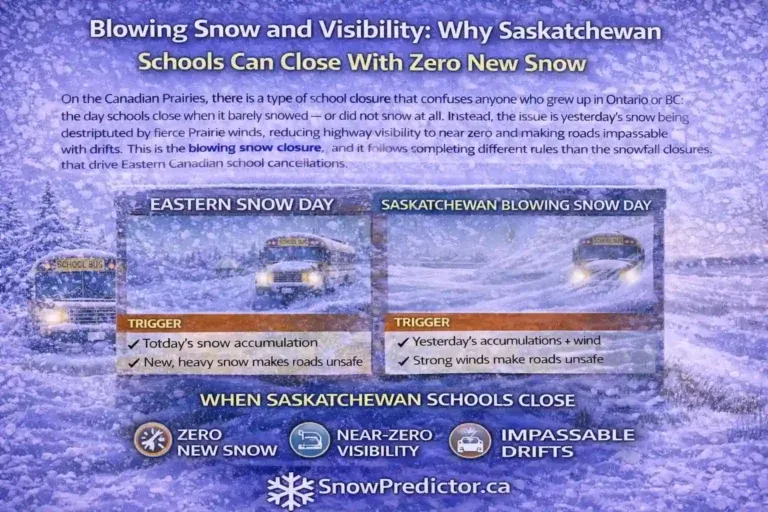
Saskatchewan’s open terrain makes visibility and drifting critical. A route can become unsafe when little new snow is falling because wind moves existing snow back across roads.
Divisions may consider highway and grid-road conditions, wind chill, route length, visibility, bus reliability and the afternoon forecast. Rural transportation can be cancelled without closing every school building.
Manitoba: Cold Policies Differ Among Divisions
Manitoba schools operate in severe winter conditions, so a low temperature does not automatically mean buildings close. Divisions may publish separate guidance for outdoor recess, transportation and school operations.
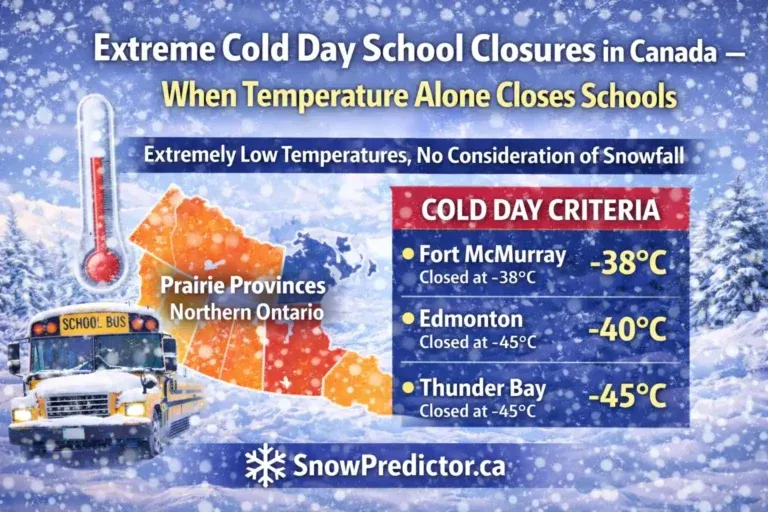
Winnipeg School Division, for example, publishes cold-weather guidance that moves students indoors for recess when the wind chill reaches -28°C. That is an indoor-recess rule, not a national school-closure threshold. Families must check the current division notice instead of applying an old temperature graphic or another district’s policy.
Atlantic Canada: Storm Systems Drive the Decision
Atlantic winter events can combine snow, freezing rain, strong wind, coastal impacts and power outages. This is why families often use the broader term “storm day.”
In Nova Scotia, regional centres can choose delayed opening, bus cancellation, selected school closure, system-wide closure or early dismissal. Halifax Regional Centre for Education aims to announce morning decisions near 6 a.m. and can issue an early-dismissal decision around 11 a.m. when conditions worsen.
New Brunswick’s anglophone and francophone districts assess their areas separately. Prince Edward Island’s exposed roads can refill with drifting snow after plowing. Newfoundland and Labrador may issue different decisions for Labrador, the island and individual regions because one Atlantic system does not affect every community equally.
Why Does the Same Weather Produce Different School Decisions?
The same snowfall can produce different outcomes because impact depends on timing, roads, visibility, routes and local capacity. School closure policies in Canada by province rely on conditions, not one universal number.
| Factor | Why It Matters |
|---|---|
| Storm timing | Overnight accumulation may leave little time for clearing before buses depart |
| Snowfall rate | Rapid snowfall can cover treated roads faster than crews can clear them |
| Freezing rain | A thin ice layer can make braking and walking dangerous |
| Wind | Drifting snow can close cleared roads and reduce visibility |
| Rural routes | Secondary roads may be exposed or cleared later than main streets |
| Temperature | Extreme cold affects waiting students, vehicles and building systems |
| Afternoon forecast | Authorities must be confident students can return home safely |
| Local capacity | Equipment, road design and winter experience affect disruption |
Microclimates complicate the picture further. Lake-effect snow, elevation, coastal exposure, valley cold pools and rain-snow boundaries can divide neighbouring districts. The guide to Canadian microclimates and snow days explains why one city forecast may not represent every route in the surrounding authority.
Is a Bus Cancellation the Same as a School Closure?
No. A bus cancellation stops some or all school transportation, while a school closure shuts the building to students and usually affects on-site classes and programs. The two outcomes must be read separately.
An official notice may announce:
- All buses cancelled for the full day
- Selected routes or transportation zones cancelled
- Schools open for students who can arrive safely
- Classes or programs cancelled while sites remain accessible
- A delayed opening
- An early dismissal
- Full closure of schools and administrative sites
This is central to provincial school closure rules. Rural road risk can stop buses even when facilities remain heated, staffed and accessible.
Parents who drive a child to an open school after bus cancellation should confirm whether they must also arrange pickup. Transportation that is cancelled in the morning often remains cancelled for the entire day.
Who Makes the Final Weather Decision?
Senior education administrators and transportation officials usually decide using local assessments. Forecasts inform the process without replacing operational judgment.
Information may come from:
- Road assessors and municipal services
- Bus operators and transportation staff
- Current and forecast weather conditions
- Police or highway reports
- Facility and power information
- Conditions in individual geographic zones
The guide to how Canadian schools decide snow days explains how early route checks, forecasts and return-trip risks influence the morning decision.
An individual principal may manage a building-specific emergency, such as loss of heat, water or power, under local procedures. That does not normally give one principal authority to close an entire board or district.
How Should Families Read a Closure Announcement?
Read the complete official notice and identify exactly which operation, region and time period it covers. Weather-related school closures Canada searches often surface old news reports or partial social-media screenshots that omit critical details.
Confirm these seven points:
- Are school buildings open or closed?
- Are all buses cancelled or only selected routes?
- Is the decision regional, district-wide or province-wide?
- Does the transportation cancellation last all day?
- Are childcare and after-school programs operating?
- Are classes cancelled, delayed or moved online?
- When was the notice published or updated?
Use the board, district, division, service centre or transportation provider as the final source. News outlets and community groups can help distribute information, but they do not make the decision.
How Can SnowPredictor.ca Support Family Planning?
SnowPredictor.ca can provide an early probability before the official announcement, helping families prepare childcare, transportation and work arrangements. It cannot confirm that a school or bus route is closed.
Enter your location into the Canada Snow Day Predictor and review the local estimate alongside current weather alerts. The snow day percentage guide explains how to interpret a probability without treating it as certainty.
Use this routine:
- Check the predicted weather hazards and timing.
- Review the SnowPredictor.ca estimate for planning context.
- Identify the correct education and transportation authorities.
- Prepare for bus cancellation and building closure as separate outcomes.
- Recheck official channels at their stated announcement time.
This approach reflects school closure policies in Canada by province and the limits of Canadian snow day policies. Forecasts estimate conditions; authorized organizations decide operations.
What Are the Limits of Comparing Provinces?
No reliable national dataset ranks every province by annual snow days, bus cancellations and full closures using one definition. School closure policies in Canada by province can be compared structurally, but not reduced to a credible “strictest province” ranking without standardized records.
Policies can also change between school years. A written procedure may allow administrators to respond differently during unusual storms, infrastructure failures or emergencies. Northern, rural, coastal and urban systems within the same province can produce different decisions.
The accurate conclusion is that school closure policies in Canada by province share a safety purpose but apply it through different local authorities, hazards and transportation networks. Families should use provincial comparisons for context and their own authority’s current notice for action.
Frequently Asked Questions
Is there one national school closure policy in Canada?
No. Canada has no single federal school-closure policy or national snowfall threshold. Provinces and territories are responsible for education, while boards, districts, divisions, service centres and transportation authorities usually make local weather decisions. Families must check the organization responsible for their school and, when separate, the authority responsible for student transportation.
Why are buses cancelled while schools remain open?
Buses may be cancelled while schools remain open because transportation officials assess route safety separately from building operations. Rural, exposed or secondary roads can be unsafe even when the school facility and major urban roads remain accessible. Parents should confirm whether they must provide both morning transportation and afternoon pickup before sending a child to an open school.
Do Canadian schools close at a specific temperature?
No national temperature automatically closes Canadian schools. Some school divisions publish local wind-chill, transportation or indoor-recess guidance, but the thresholds and operational effects differ. Authorities can also consider road conditions, bus reliability, student waiting time and building systems. Always use the current rule from the applicable board or division instead of applying another region’s number.
Which province has the strictest snow-day policy?
No province can be credibly identified as having the strictest snow-day policy from a standardized national dataset. Provinces delegate many operational decisions locally, and a bus cancellation is not the same as a building closure. Atlantic storm days, Prairie cold rules and Ontario transportation cancellations measure different hazards and outcomes, so a simple ranking would be misleading.
Who officially announces a school closure in Canada?
The applicable school board, district, division, regional education centre, service centre or provincial school authority officially announces a closure. A transportation consortium may separately announce bus cancellations. Weather apps, predictors and news outlets can provide useful information, but they cannot replace the organization authorized to decide whether buildings, transportation, classes or programs will operate.