Snowfall Warning Canada: How Much Snow Can Lead to School Closures?
For Canadian parents, students, school staff and bus drivers, a heavy-snow forecast creates one urgent question: will schools stay open? A snowfall warning Canada alert confirms that hazardous accumulation is expected, but it does not provide a universal school-closing number. A smaller amount falling during the morning commute can cause more disruption than a larger total cleared overnight. The Canada Snow Day Predictor helps families assess local disruption risk using snowfall, timing, wind and temperature, while school boards still make the final closure and transportation decisions.
What Does a Snowfall Warning Mean in Canada?
An Environment Canada snowfall warning is issued when expected snow is heavy enough to cause hazardous conditions or significant disruption. A snowfall warning Canada notice tells people to prepare for difficult travel, reduced traction, delayed services and substantial accumulation. A Canada snowfall warning is an official weather alert, but families still need local road and school-board updates.
Canada no longer relies only on one simple national snowfall figure to communicate risk. The public alert system now uses impact guidance that considers how snow may affect travel, collisions, route closures, injuries and property. The same amount under a snowfall warning Canada notice can produce different consequences depending on timing, location and local conditions.
A warning should therefore be read as an impact signal, not as a guaranteed school closure.
How to Read the Alert Colour and Map
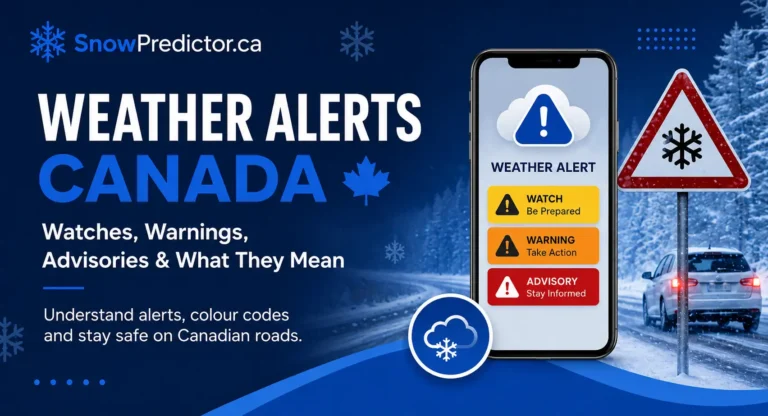
Canada winter weather warnings now use yellow, orange and red impact colours. A yellow snowfall notice usually signals moderate or local disruption. Orange indicates major or widespread effects, while red is reserved for extreme and potentially life-threatening impacts. The colour shows expected consequences; it does not replace the alert name.
A snowfall warning map Canada result should also be checked carefully. Confirm that your home, school and full travel route are inside the affected region. Then read the written details for accumulation, timing and visibility. A weather warning Canada headline can be misleading because one storm may bring heavy snow to northern Ontario while Toronto receives rain or lighter accumulation. This also applies to snowfall warning Ontario, Toronto snowfall warning, snow warning Ontario and snow warning Toronto. Related searches include snow storm warning Ontario and southern Ontario weather warnings.
Searches such as snowfall warning Canada today, snowfall warning today and Ontario weather warnings today may return expired or neighbouring alerts. Always check the issue time and exact forecast region before changing school or travel plans.
How Much Snow Can Lead to a School Closure?
There is no Canada-wide snowfall total that automatically closes schools. A snowfall warning Canada alert increases concern, but it does not create an automatic closure rule.
A school board may remain open after a substantial overnight snowfall if major roads, school entrances and bus routes are cleared before morning. Another board may cancel buses after a lower total if snow is falling rapidly, visibility is deteriorating or rural roads are drifting over.
The practical answer is that school disruption depends on the interaction of several conditions:
- How quickly the snow is falling
- Whether it arrives before or during bus pickup
- Wind and visibility
- Road and sidewalk treatment
- Rural versus urban routes
- The forecast for afternoon dismissal
- Availability of drivers and staff
- Local board procedures
This is why asking only, “How many centimetres are expected?” gives an incomplete answer. The more useful question is, “What will this snow do to transportation during the hours students are travelling?”
Snowfall Rate Can Matter More Than the Final Total
Snow that accumulates slowly gives plows and salt trucks time to keep priority roads open. Intense snowfall can cover treated roads again within minutes.
During a heavy burst, traffic may compact fresh snow before plows arrive, producing a polished and slippery surface at intersections, hills and bus stops. A moderate final total can still create severe morning disruption if most of it falls within two or three hours.
Timing Changes the School-Day Risk
A storm ending at midnight creates a different problem from one beginning at 5:30 a.m.
Overnight snow allows crews more time to clear roads and school property. Snow that intensifies around the morning commute can affect buses while they are already collecting students. Boards must also consider the return journey. If the worst conditions are expected during afternoon dismissal, opening schools may create a later transportation problem.
Local Geography Changes the Impact
Canadian school districts vary. One board may include urban streets, open farmland, forested roads and lakeside communities.
Wind can push snow back across exposed roads after they have been plowed. Lake-effect bands can create heavy accumulation in one community while a nearby area receives much less. A board covering a large region may therefore cancel transportation by zone instead of applying one decision everywhere.
How Do School Boards Decide Whether to Close?
A snowfall warning Canada alert is only one part of the decision. School boards may combine forecasts with reports from transportation providers, road crews, maintenance teams, and local staff.
Depending on conditions, a board may keep schools open, cancel selected routes, suspend all buses, delay opening, close particular zones, or dismiss students early. Different boards can make different decisions during the same storm because urban routes, rural roads, elevation, and plowing progress are not identical. These factors are also part of different decisions during the same storm because urban routes, rural roads, elevation, and plowing progress are not identical. These factors are also part of how Canadian schools decide on snow days, especially when conditions vary across a school board’s service area.
Bus Cancellation Does Not Always Mean School Closure
Families need to check transportation notices and school-operation notices separately.
Some boards keep buildings open even when buses are cancelled. Students who walk or are driven may still attend, while transported students remain home. Other boards may close schools when system-wide transportation is suspended.
This distinction matters because parents sometimes see “buses cancelled” and assume classes are cancelled too. Read the exact wording of the official notice.
A board-wide decision also cannot reflect every street. Even when a school remains open, families may need to judge whether their own driveway, sidewalk, bus stop or route is safe. Simcoe County, for example, states that it remains a family decision whether a child should leave for school during severe weather.
How Does Heavy Snow Affect Roads and Buses?
Roads Can Deteriorate Faster Than They Are Cleared
During persistent snowfall, plows may focus on major highways and arterial roads first. Residential streets, rural routes and school turnarounds can remain snow-covered longer.
A school bus may travel through dozens of local roads before reaching a main route. One unsafe hill, narrow road or blocked turnaround can make the entire route impractical.
Visibility Can Fall Even Without a Blizzard
Falling snow reduces contrast and makes road edges, lane markings and pedestrians harder to see. Wind can worsen the problem by lifting loose snow from fields and shoulders.
This is particularly serious for buses, which stop frequently and need enough visibility and traction to pull away safely. Drivers following a bus also require extra stopping distance on snow-covered roads.
Conditions May Remain Poor After Snow Stops
The expiry of a warning does not mean every road is clear.
Plowing, salting and snow removal continue after the storm. Parked vehicles, collisions, snowbanks and drifting may delay recovery. Families should review current provincial or territorial 511 information rather than relying only on the warning’s end time.
Snowfall Warning vs Other Winter Alerts
A snowfall warning focuses on significant snow accumulation. Related alerts describe different hazards.
| Alert | Main Concern |
|---|---|
| Snowfall warning | Heavy accumulation causing hazardous conditions |
| Snow squall warning | Sudden intense snow and sharply reduced visibility |
| Winter storm warning | Several severe winter hazards occurring together |
| Blizzard warning | Snow and strong wind producing prolonged, severely reduced visibility |
| Freezing rain warning | Ice forming as rain freezes on contact |
Do not treat these labels as different levels of the same warning. They describe different threats. A snow squall with a lower total may create a more immediate driving danger than steady snowfall lasting all day.
A yellow warning snow squall or yellow watch snow squall can still create rapid visibility loss. An orange watch snow squall signals more serious disruption. An orange watch winter storm or Environment Canada winter storm notice may involve snow, wind and ice, while an Environment Canada winter advisory may cover lower-level hazards. A freezing rain warning focuses on ice, and a blizzard warning Canada notice focuses on wind-driven snow and prolonged poor visibility.
For the broader distinctions between watches, warnings, advisories and impact colours, read the Canadian weather alerts guide. For multi-hazard events involving snow, wind and ice together, use the winter storm warning Canada guide.
What Should Parents Check Before School?
1. Read the Current Official Alert
Check the affected area, expected accumulation, timing, visibility and impact statement. Confirm that the warning applies to both your home and the school area.
Use the latest issue time. An alert shared the previous evening may have changed overnight.
2. Check School and Transportation Channels
Review the official school-board website, transportation provider and notification system. Look for wording that distinguishes:
- Bus cancellation
- School closure
- Delayed opening
- Zone-specific cancellation
- Early dismissal
Avoid depending on unofficial social posts because they may omit a region, route or later update.
3. Check Live Road Conditions
Use the provincial or territorial 511 service for current reports, closures and cameras.
Look beyond the main highway. The route to a bus stop, rural concession road or school entrance may be in worse condition than the nearest arterial road.
4. Review the Local Closure Estimate
The school closure probability tool helps families judge whether changing conditions may affect local school operations.
Use the estimate to prepare backup childcare, remote-work arrangements or a different morning schedule. It does not replace the official school-board decision.
5. Make a Route-Specific Decision
Think about the actual journey rather than the regional forecast alone.
Consider hills, untreated roads, snowbanks, visibility, walking conditions and whether the storm will worsen before the child returns home. A school can remain open while one family’s route is still unsafe.
How the Snow Day Predictor Supports Earlier Planning
A snowfall warning Canada alert explains the expected weather hazard. A local school board decides whether transportation and classes will operate. Families often remain between those two sources while waiting for the morning announcement.
The Canadian snow-day forecasting tool adds planning context by assessing local winter conditions associated with school disruption. It can help parents decide when to prepare for a possible closure without presenting the estimate as an official decision.
Readers who want to understand the model can review how the Snow Day Predictor works and how Canadian schools decide on snow days.
Frequently Asked Questions
What Part of Canada Is Snowing Right Now?
Snowfall changes hour by hour and may be limited to northern regions, mountain areas, lake-effect bands or an active storm corridor. A snowfall warning Canada notice may cover only part of a province, so check the latest local forecast and radar rather than relying on an older national result.
Is There Snow Coming in Ontario?
The answer depends on the date and location. Snow may affect northern Ontario or a lake-effect corridor while Toronto and other southern communities remain dry. Check the latest local alert and forecast for your exact region.
When Can We Expect Snow in Canada?
Snow can arrive in northern Canada and mountain regions as early as September. Most southern Canadian cities usually see their first measurable snowfall between October and November, although the exact timing varies by region and year.
What Is the Coldest Place in Canada Right Now?
The coldest location changes throughout the day and may be a remote Arctic weather station rather than a city. Current national observations provide a more reliable live comparison than a fixed answer.
What Is the Snowiest City in Ontario?
Owen Sound is commonly identified as one of Ontario’s snowiest cities. Its location near Georgian Bay exposes it to frequent lake-effect snowfall and high seasonal totals.