Weather App vs School Board Notice: Which Should Parents Trust?
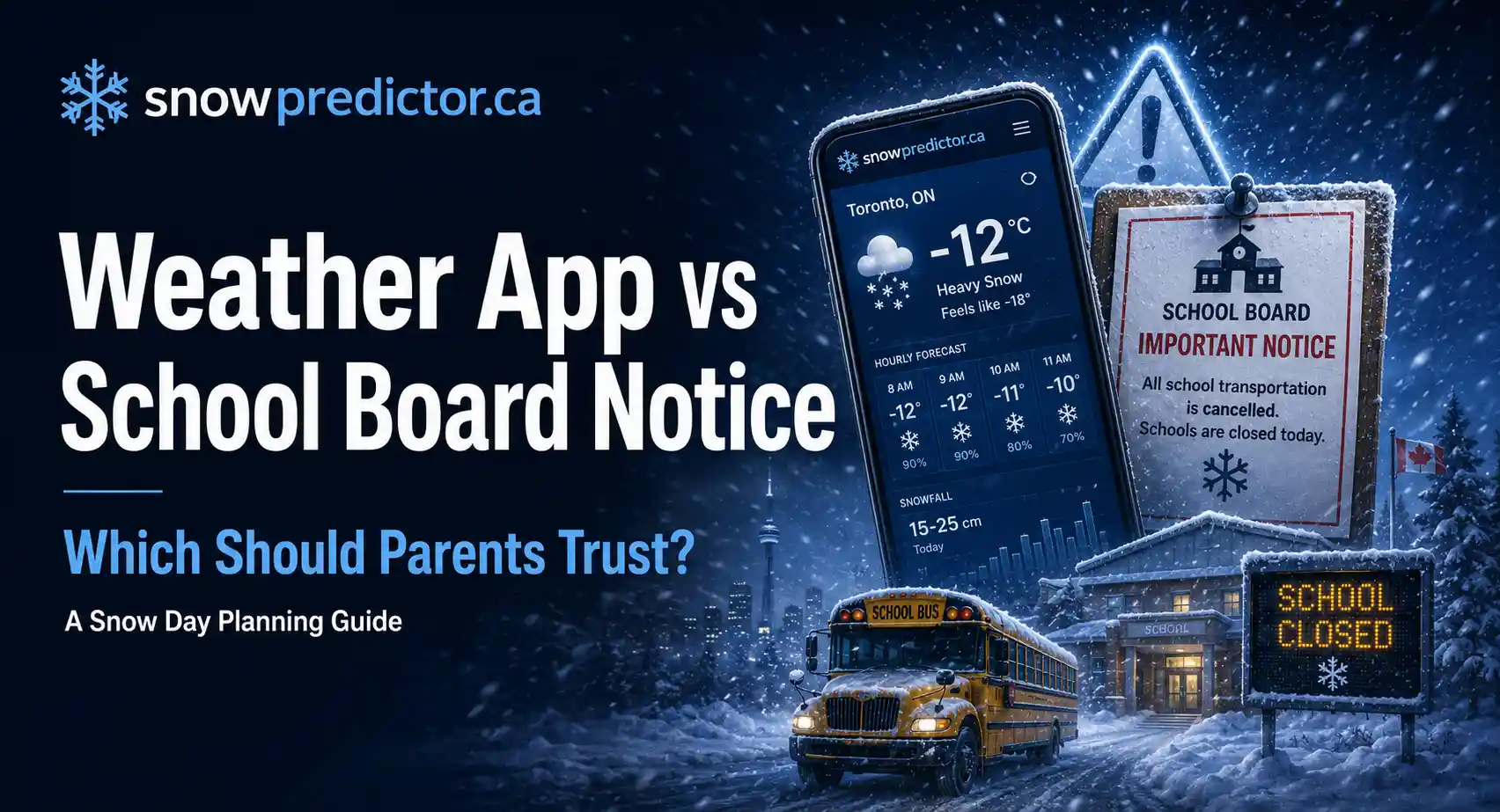
For Canadian parents trying to organise the next school morning, mixed signals create a real problem. A weather app may show heavy snow, freezing rain or a sharp temperature drop, while the local board has not announced a closure. Another app may show improving conditions even though buses have already been cancelled. In a weather app vs school board notice decision, the board or official transportation authority confirms what will actually happen, while the Canada Snow Day Predictor helps families estimate the likelihood of disruption before that final announcement appears.
Which Source Should Parents Trust?
The simplest way to understand a weather app vs school board notice is to separate forecasting from decision-making.
| Source | What It Tells You | Can It Officially Close a School? |
|---|---|---|
| Weather app | Forecasts, snowfall, temperature, wind, alerts and timing | No |
| School board notice | Whether schools are open, closed, delayed or dismissed early | Yes |
| Transportation notice | Whether buses are running, delayed or cancelled | Yes, for transportation |
| Snow day predictor | Estimated school closure probability | No |
These sources are not competing versions of the same answer. They serve different purposes.
A weather app answers, “What conditions are expected?”
A school board answers, “How will schools operate?”
A transportation service answers, “Will buses run?”
A prediction tool answers, “How likely is disruption before the official decision?”
Parents run into trouble when they expect one source to perform all four jobs.
The most useful way to handle a weather app vs school board notice comparison is to ask what decision you are making. If you need to know whether snow may arrive before sunrise, check the forecast. If you need to know whether buses will collect students, check transportation updates. If you need to know whether the building is open, read the board’s message. Matching the source to the question prevents most last-minute confusion.
What a Weather App Can and Cannot -Tell You
A reliable weather Canada app can help parents understand what may happen before, during and after the school commute. Useful details include:
- Expected snowfall
- Snowfall timing
- Freezing rain risk
- Temperature and wind chill
- Wind speed and gusts
- Visibility
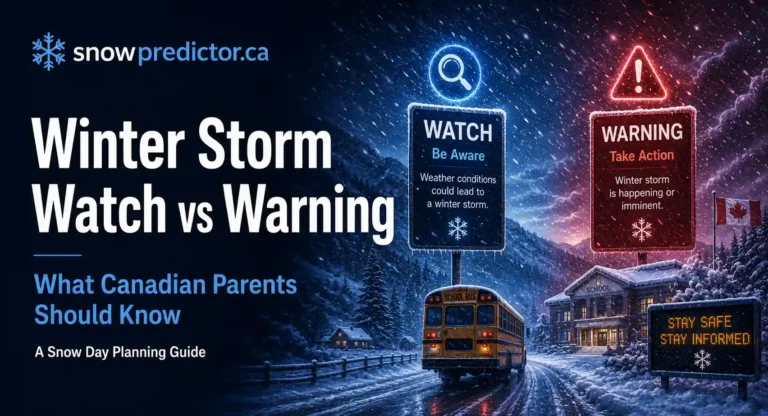
- Weather warnings and watches
- Hourly changes
- Radar movement
The Environment Canada weather app, WeatherCAN, provides current conditions, forecasts and notifications for official Canadian alerts. It is useful for understanding the hazard, but it does not know whether a rural bus route has been plowed, whether a district has enough drivers or whether a school board has decided to keep buildings open.
That limitation does not make the forecast inaccurate. It simply means the app is answering a different question.
Forecasts Do Not Decide School Operations
A weather model estimates atmospheric conditions. A closure decision depends on how those conditions affect local transportation, staffing and safety.
For example, an app may correctly forecast 15 centimetres of snow. The board still has to consider:
- When the heaviest snow will fall
- Whether roads will be cleared before buses leave
- Whether drifting will affect exposed routes
- Whether sidewalks and school entrances are safe
- Whether freezing rain may arrive later
- Whether conditions will worsen before dismissal
- Whether school buses can operate safely
A forecast can be accurate even when the school remains open. The weather app has not failed simply because the snowfall did not lead to a closure.
Why Different Apps Show Different Forecasts
Parents often search for the best free weather app Canada offers because two apps may show different snowfall totals or start times. The difference may come from:
- Different forecast models
- Different observation points
- Different update schedules
- Different map grids
- Different methods for presenting uncertainty
One app may highlight the highest possible snowfall total, while another displays the most likely amount. A third may update later and show a shifted storm track.
Switching between several apps until one matches the forecast you prefer usually creates more confusion. Choose one dependable weather source, then use official school channels for the operational decision.
What an Official School Board Notice Confirms
A school board closure notice confirms how the education system will operate. Depending on the district, the message may cover:
- Full school closure
- Schools open as normal
- Delayed opening
- Early dismissal
- Selected school closures
- Child-care programme changes
- Cancellation of activities
- Remote-learning instructions
The board may use weather forecasts, but it also receives information that a public app cannot provide. This may include reports from bus operators, road assessors, maintenance teams, local officials and school administrators.
That is why the school board notice carries more authority when parents are asking, “Is school open today?” A forecast may suggest that closure is likely, but only the board can confirm the school’s status.
Why the App and Board May Appear to Disagree
Most weather app vs school board notice conflicts have a practical explanation.
The Board May Have Better Local Information
Weather apps show conditions across forecast regions or map grids. School boards may receive direct updates from drivers and route assessors.
A parent may see clear pavement outside one home while rural roads elsewhere in the district remain snow-covered. In a large board, one section may face lake-effect snow, open-field drifting or freezing rain while another section has lighter conditions.
A broad city forecast cannot fully represent every bus route.
They May Update at Different Times
Forecasts change as new data arrives. Boards must make decisions early enough to notify families, staff and transportation providers.
A bus cancellation may be announced at 5:45 a.m. A forecast update at 6:15 a.m. may then show that snowfall has weakened. That later change does not automatically reverse the earlier operational decision. Restarting an entire transportation system may not be practical once buses and drivers have been stood down.
The Board Must Think About the Whole Day
Parents often focus on the weather at departure time. Boards must consider morning travel, school operations and afternoon dismissal.
Roads may be manageable at 7:00 a.m. but expected to freeze by 2:00 p.m. A closure or delayed opening can therefore look overly cautious when only the current conditions are considered.
Bus Cancellation and School Closure Are Not the Same
This distinction causes more confusion than the weather forecast itself.
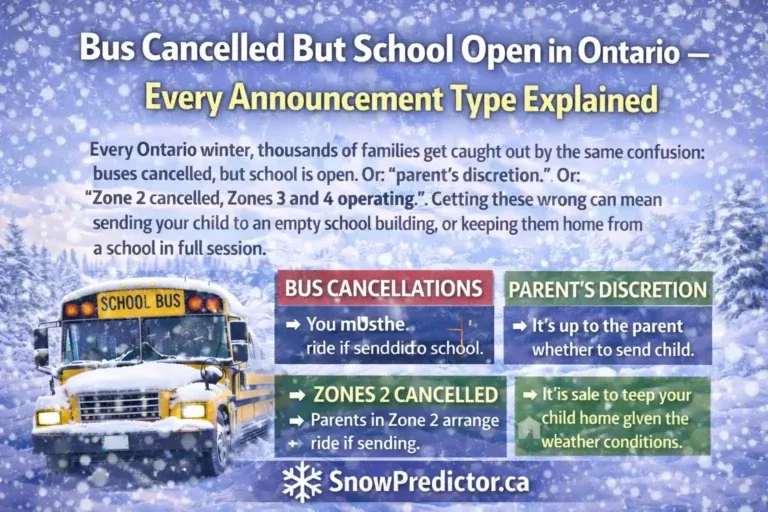
A school bus cancellation notice means transportation will not operate. It does not always mean the school building is closed. Some boards keep schools open for students who can walk or be driven safely.
Parents should look for two separate answers:
- Are buses operating?
- Are schools open?
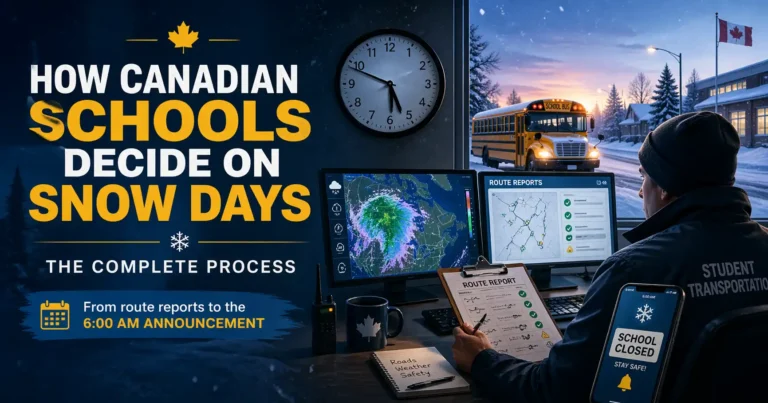
A message saying “all transportation cancelled” is not the same as “all schools closed.” Read the full notice rather than relying on a notification preview or a shared social-media headline. The guide to how Canadian schools decide on snow days explains why boards may cancel transportation without closing every building.
In practical weather app vs school board notice situations, parents should save both the board page and the transportation page. Some districts publish both updates together, while others use separate systems. Checking only one page may leave a family with half the answer.
A Better Snow-Day Checking Routine
The most useful weather app vs school board notice routine changes depending on the time of day.
The Evening Before
Use one trusted weather app to understand:
- Whether a storm is expected
- Approximate start and end times
- The main hazard
- Whether an official warning is active
- Whether conditions may worsen before morning
Then check the local snow day predictor to estimate the chance of a snow day and decide whether backup planning is sensible.
At this stage, the goal is preparation, not confirmation.
Early in the Morning
Check the school board and transportation provider directly. Look for:
- Publication time
- Affected district or weather zone
- Bus status
- School status
- Delayed-opening instructions
- Early dismissal information
- Whether another update is expected
Do not assume that no social-media post means there is no decision. Check the official website, notification service or transportation portal.
Before Leaving Home
Review current road and weather conditions. A board-wide decision covers a large area, but your own road, driveway, walking route or bus stop may still be unsafe.
Families can also review what to watch the night before a possible snow day for a practical planning checklist.
What Parents Should Do While Waiting
Waiting for the official announcement before making any plan creates unnecessary stress. When the snow day forecast shows meaningful risk, prepare for both outcomes.
Useful steps include:
- Arrange possible childcare
- Discuss remote-work options
- Charge phones and laptops
- Check school notification settings
- Save the transportation-provider page
- Prepare winter clothing
- Review the route to school
- Confirm who can collect the child
- Keep breakfast and morning routines flexible
A snow day prediction does not confirm closure, but it can provide enough warning to avoid a rushed decision at 6:00 a.m.
Parents who want to understand the calculation can review how the Snow Day Predictor works. The tool estimates school closure probability from weather conditions and local patterns; it does not replace the final school board announcement.
Choosing a Weather App Without Creating More Confusion
The best free weather app Canada parents choose should provide clear hourly information, warnings and location-based updates. WeatherCAN is a strong starting point for official Canadian alerts, while other apps may offer useful radar views or longer-range comparisons.
In a weather app vs school board notice decision, convenience should not be confused with authority. A polished app may be easier to read, but it still cannot confirm a district’s operating plan.
The best setup is not five competing forecasts. It is one dependable weather source combined with:
- The official school board website
- The official transportation service
- A local snow day calculator or predictor
- Current road-condition information
Each source should have one clear purpose.
A weather app helps you understand the storm.
A board notice confirms school operations.
A bus notice confirms transportation.
A snow day predictor tomorrow estimate helps you prepare before the final decision.
Where the Snow Day Predictor Fits
The Canadian school closure predictor sits between the forecast and the board announcement.
It does not tell a school board what to do. It estimates the chance of school disruption using factors such as snowfall, storm timing, wind, temperature and regional closure patterns.
That makes it useful when parents are asking:
- Is tomorrow a snow day?
- What is the chance of a snow day?
- Are school closures today likely?
- Should I arrange backup childcare?
- Could buses be cancelled even if school stays open?
In a weather app vs school board notice comparison, the predictor is the planning layer. It helps families prepare early, while the final answer still comes from the school board or transportation authority.
Frequently Asked Questions
Which Is More Accurate, a Weather App or the Met Office?
The Met Office is the official forecasting authority for the United Kingdom. A weather app may use Met Office data or another provider, so accuracy depends on the source and update frequency. For Canadian families, Environment and Climate Change Canada is the relevant official forecasting authority.
What Is the Most Accurate Weather Site for Canada?
No service is perfectly accurate for every location and every type of weather. For official Canadian forecasts and alerts, Environment and Climate Change Canada and WeatherCAN are the most authoritative starting points. Parents should still use school-board and transportation notices for closure decisions.
Why Do All the Weather Apps Say Something Different?
Apps may use different forecast models, observation points, update times and methods for calculating local conditions. Small differences in temperature, wind or storm track can produce noticeably different snowfall forecasts, especially several days in advance.
Is AccuWeather 100% Accurate?
No weather service is 100% accurate. AccuWeather may provide useful local forecasts, but uncertainty increases with time because weather models cannot measure or predict every atmospheric change. For Canadian warnings, use official Canadian alerts, and for school operations, rely on the board’s final notice.
Is the Weather App Trustworthy?
A weather app can be trustworthy when it uses reliable forecast data and updates conditions regularly. However, no app can predict every local weather change perfectly. Canadian parents should use a trusted weather app to understand snowfall, freezing rain and storm timing, but rely on the official school board or transportation notice to confirm school closures and bus cancellations.