Freezing Rain vs Snow: Which One Cancels More School Buses in Canada?
A winter forecast calling for 15 centimetres of snow sounds more disruptive than a few millimetres of freezing rain. For school transportation, that assumption can be dangerously incomplete. Snow reduces traction, covers roads and can overwhelm clearing crews. Freezing rain can coat hills, bridges, intersections and bus steps with hard-to-see ice before meaningful accumulation appears.
The freezing rain vs snow comparison therefore has no universal winner. Ice can create severe route risk with a small measured amount, while heavy or rapidly falling snow can make roads impassable and visibility poor. Timing, temperature, road treatment, wind and local geography determine which hazard is more disruptive. This guide compares both precipitation types, explains how officials assess freezing rain vs snow bus cancellations and shows families where to verify the final school-day decision.
Freezing Rain vs Snow Closure Risk at a Glance
| Factor | Freezing Rain | Snow |
|---|---|---|
| Main road hazard | Glaze ice and loss of traction | Accumulation, ruts, drifting and reduced traction |
| Visibility | Often reasonable unless mixed with fog or snow | Can decline during heavy snow or blowing snow |
| Mechanical removal | Plows cannot simply remove bonded glaze | Plows can move snow, though rates may exceed capacity |
| Treatment | Salt, brine and sand may help under suitable conditions | Plowing, salt and sand are commonly combined |
| Hardest locations | Bridges, hills, intersections and untreated roads | Open roads, hills, rural routes and unplowed streets |
| Forecast challenge | Small temperature changes alter precipitation type | Storm track and snow ratios change accumulation |
| Infrastructure risk | Ice can affect trees and power lines | Heavy snow can affect trees, roofs and power lines |
| School outcome | Bus cancellation, zone cancellation or closure | Bus cancellation, zone cancellation or closure |
Neither column provides an automatic threshold. The practical question is how the weather affects the complete route during morning and afternoon service.
What Is the Difference Between Freezing Rain and Snow?
Snow forms when ice crystals remain frozen as they fall to the ground. It can be light and powdery, wet and heavy or compacted by traffic. Its travel impact depends on snowfall rate, total accumulation, temperature, wind and how quickly roads are cleared.
Freezing rain begins as snow higher in the atmosphere. It melts while passing through a layer of warmer air and remains liquid while moving through shallow subfreezing air near the ground. The supercooled drops freeze when they contact roads, trees, wires or other cold surfaces.
Environment and Climate Change Canada describes freezing rain and freezing drizzle as liquid precipitation that freezes on contact with sub-zero surfaces. This process forms glaze rather than a layer that can simply be pushed aside by a plow.
The atmospheric profile makes forecasting freezing rain vs snow sensitive to small temperature differences at the ground and above it. A shift in the warm layer can change a forecast from snow to ice pellets, freezing rain or ordinary rain.
Why Freezing Rain Can Cancel Buses With Little Accumulation
The strongest argument for freezing rain is not that it always causes more closures. It is that a thin ice layer can sharply reduce traction before the event looks severe.
Braking and Turning Become More Difficult
School buses are large vehicles that require controlled stopping distances. Glaze on a hill, intersection or railway approach can make braking and turning unsafe. Bridges and overpasses may ice sooner because cold air reaches the structure from above and below.
Ice Is Difficult to See
Freezing rain may leave pavement looking wet rather than white. Drivers can encounter a slippery section without the visual warning provided by deeper snow. Ice accumulation on roads may also vary between treated highways, side roads, parking areas and bus turnarounds.
The Hazard Extends Beyond Driving
Freezing rain school closures may involve access problems as well as road conditions. Ice can cover sidewalks, stairs, school entrances and bus steps. Larger events can damage trees or power lines, adding blocked roads, outages and building-access concerns.
This explains why freezing rain bus cancellations can occur without snowfall. It does not prove that every small amount of ice closes buses or schools.
Why Snow Can Still Be the More Disruptive Hazard
Snow becomes more serious when accumulation, intensity, wind and timing combine.
Snowfall Rate Can Exceed Clearing Capacity
A road may be plowed and covered again before buses arrive. Heavy overnight snow can leave residential and rural roads uncleared even when major highways are improving. Wet snow may also be harder to move than light powder.
Wind Creates Drifts and Poor Visibility
Open routes can drift shut after clearing. Falling and blowing snow may hide lane markings, other vehicles and road edges. A modest accumulation with strong wind can create more dangerous travel than a larger total under calm conditions.
Route Coverage Matters
Snow school closures are more likely when a storm affects an entire school division rather than one isolated corridor. A wide service area may include urban streets, hills, unpaved roads and remote bus stops with different maintenance priorities.
Snow bus cancellations therefore depend on much more than a centimetre total. A snowfall warning Canada alert is an important signal, but officials still assess timing, road response and local impact.
Freezing Rain vs Snow: Which Is More Likely to Cancel Buses?
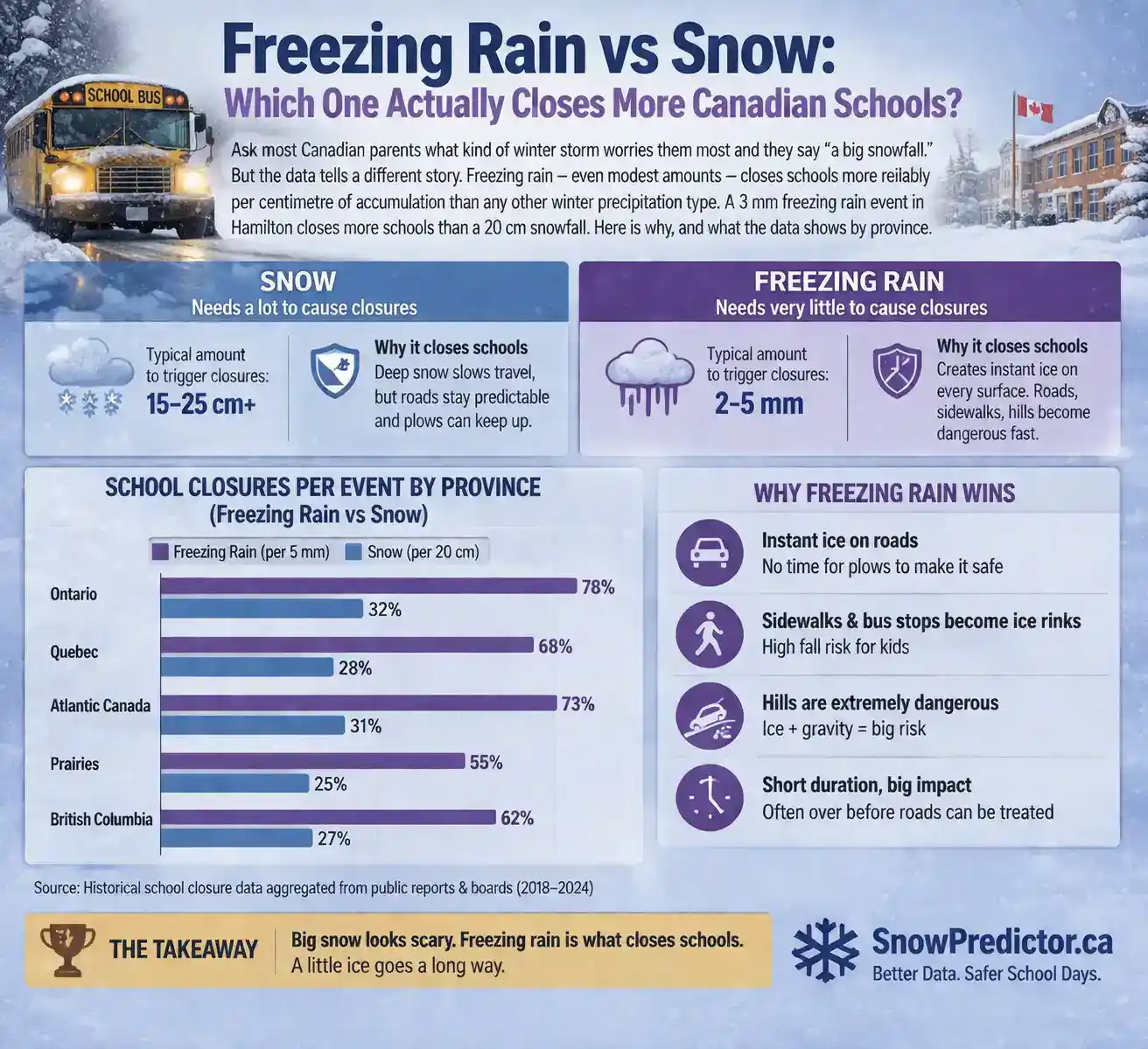
There is no credible Canada-wide percentage proving one precipitation type closes more schools. Public closure records are fragmented, boards use different terms and a single storm may contain snow, ice pellets, freezing rain, wind and a flash freeze. Assigning the outcome to only one factor can misrepresent what happened.
The comparison is better understood by scenario:
- Light snow versus active freezing rain: Freezing rain may create the greater traction risk.
- Brief freezing drizzle versus heavy overnight snow: Snow may cause broader disruption.
- Treated urban roads versus untreated rural roads: The same storm can produce different outcomes.
- Ice ending before treatment versus snow during bus time: Timing may decide the result.
- Snow with strong wind versus light glaze: Visibility and drifting may make snow more dangerous.
- Freezing rain with power outages: Ice may affect both transportation and building operations.
This is the defensible answer to ice day vs snow day searches: impact matters more than precipitation labels.
Regional Differences Across Canada
Ontario
Ontario school bus cancellations vary by consortium, weather zone and road network. Student Transportation Services of Waterloo Region publicly lists current or forecast freezing rain during service times as a consideration. For snow, it considers overnight accumulation, expected rate, wind, drifting and confirmation that plows have operated.
That process shows why one province cannot have a universal ice or snow threshold. Conditions in Toronto, Hamilton, Waterloo Region, Ottawa, Simcoe County and rural eastern Ontario differ in route exposure, topography and maintenance.
British Columbia
The Lower Mainland’s hills, bridges and elevation changes can make ice and wet snow highly disruptive. Interior districts experience more persistent winter conditions but also have remote or mountainous routes. It is inaccurate to claim that all British Columbia districts respond to a few millimetres of ice in the same way.
Atlantic Canada
Atlantic storms frequently involve transitions among snow, ice pellets, freezing rain and rain. Mixed precipitation school closures may result from the combined event rather than one phase. Coastal and inland routes can also change at different times.
Quebec and the Prairies
Quebec experiences both major snowstorms and ice events. Prairie districts may face heavy snow, blowing snow, extreme cold and occasional freezing rain. Local exposure, route length and wind can outweigh the precipitation category.
How Canadian Weather Alerts Help Parents
A freezing rain warning Canada notice means hazardous icing is occurring or expected. Environment Canada’s ice impact guidance includes slippery routes, collisions, travel delays, infrastructure icing, broken branches and possible utility outages. Higher-impact events can bring widespread dangerous travel and extensive disruption.
Canada’s colour-coded alert system adds impact information:
- Yellow: Moderate, localized or shorter-term impacts are expected.
- Orange: Major or widespread impacts are likely.
- Red: Extreme, extensive and potentially life-threatening impacts are expected.
Weather alerts do not cancel buses. Read the geographic area, start and end times, confidence, impact colour and expected transition between precipitation types. A warning issued for a broad region may include freezing rain in one area and snow in another.
What Transportation Officials Consider
School closures due to freezing rain and school closures due to snow are local operational decisions. Officials may examine:
- Current and forecast precipitation type
- Ice, snow and slush on actual bus routes
- Accumulation rate and storm timing
- Hills, bridges, rural roads and turnarounds
- Wind, drifting and visibility
- Road-treatment and plowing progress
- Collisions, closures and police travel advice
- Expected conditions for afternoon transportation
- Power outages, fallen trees and school access
No public warning or forecast amount replaces route inspection. Winter school bus safety depends on the most hazardous part of the network, not conditions outside one home.
Bus Cancelled Does Not Always Mean School Closed
Transportation providers can cancel buses while school boards keep buildings open. Some cancellations affect one route or weather zone; others cover all transportation. If buses are cancelled in the morning, many systems also cancel the afternoon trip.
Read the complete message and determine:
- Whether it applies to your route or zone
- Whether morning and afternoon buses are cancelled
- Whether schools and board offices remain open
- Whether childcare and activities are affected
- How the school wants absences reported
The guide to bus cancelled versus school closed in Ontario explains these announcement types. Families should still follow their local authority’s wording.
How to Estimate the Risk Before the Official Decision
Use multiple signals instead of treating freezing rain vs snow as a simple contest:
- Check the latest hourly precipitation type and temperature.
- Identify when hazardous weather overlaps with bus service.
- Read the full Environment Canada alert and impact colour.
- Review provincial 511 and municipal road information.
- Look for ice, drifting, visibility and power concerns.
- Confirm the result with the transportation provider and board.
SnowPredictor Canada can turn forecast signals into an early planning estimate. A responsible snow day prediction Canada result should account for precipitation type, timing, road exposure and local decision practices without inventing guaranteed closure thresholds.
Families comparing mixed winter hazards can also read the flash freeze school closure guide. The guide to when Canadian schools announce closures explains typical notification windows.
Frequently Asked Questions
Does Freezing Rain Cancel School Buses More Easily Than Snow?
It can create dangerous traction with less visible accumulation, but it does not always cause more cancellations. Heavy snow, poor visibility and drifting can be equally or more disruptive. Local road impacts and timing determine the decision.
How Much Freezing Rain Closes Schools in Canada?
Canada has no universal ice threshold for Canadian school closures. A small amount may be serious on untreated hills and bridges, while treated routes may remain usable. Officials assess local roads, forecasts and operational conditions.
Does a Freezing Rain Warning Automatically Cancel School?
No. A warning identifies an expected weather hazard. The school board and transportation provider make separate decisions after considering route conditions, timing, treatment and other impacts.
Can Schools Close for Snow Without a Snowfall Warning?
Yes. Local snowfall, drifting, poor visibility or untreated roads may make transportation unsafe even when the event does not carry that specific alert. A weather warning is not required for a local cancellation.
Why Are Buses Cancelled While the School Remains Open?
The complete bus network may include exposed or untreated roads that are unsafe while the building remains accessible. Families who drive a child to an open school may be responsible for arranging the return trip when buses are cancelled.