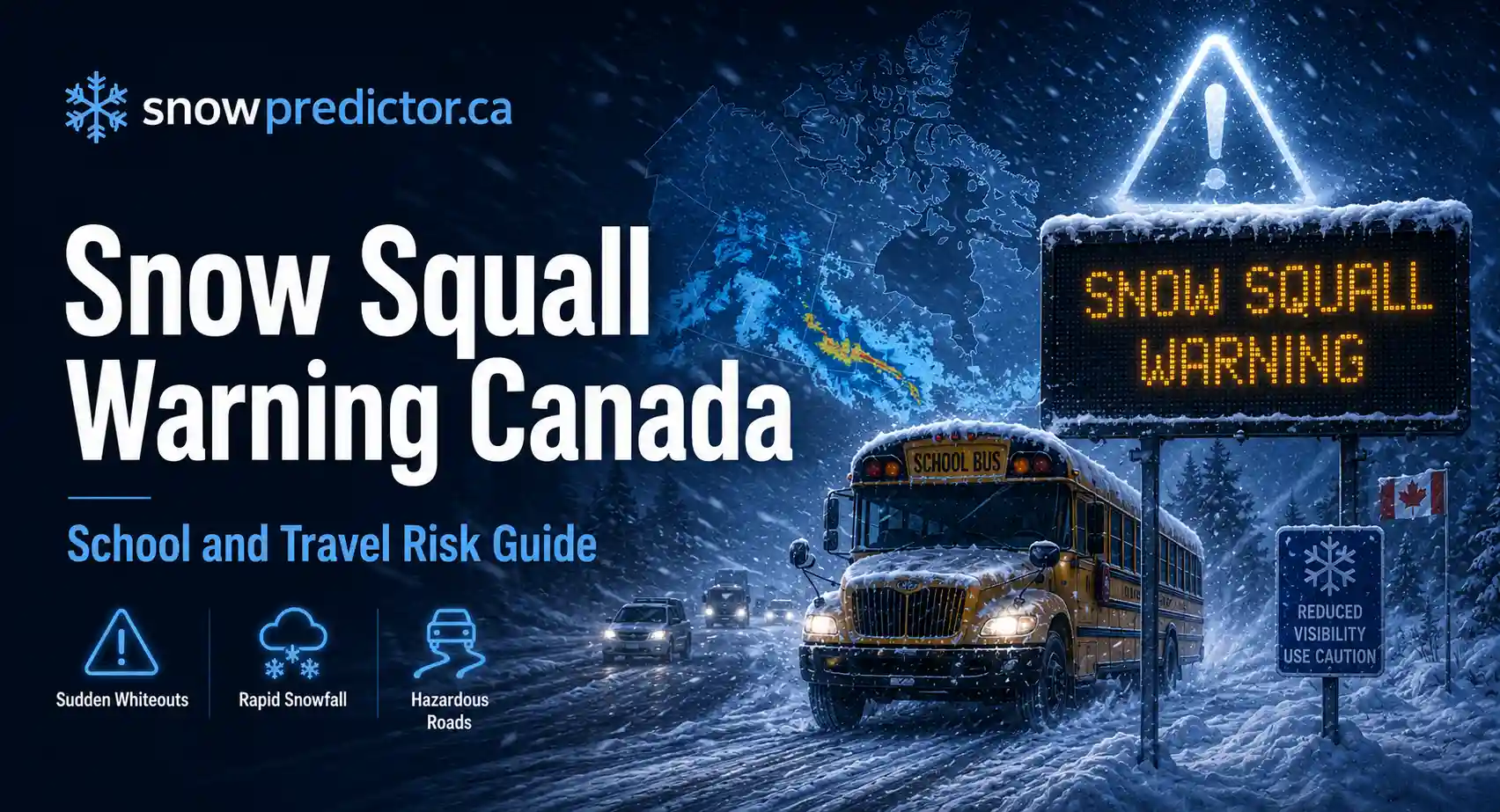
Snow Squall Warning Canada: Why School and Travel Risk Can Change Quickly
Canadian parents, students, school staff and drivers may see a calm forecast, only for a narrow band of intense snow to make local roads dangerous minutes later. A snow squall warning matters because snow squall meaning includes sudden visibility loss. The Canada Snow Day Predictor can help families assess disruption before an official decision, while severe weather authorities, school boards and transportation providers remain responsible for alerts, school status and bus operations.
What This Alert Means for Families
A snow squall warning is issued for a localized, short-duration burst of intense snowfall that can sharply reduce visibility. Strong, gusty winds may accompany the snow, and some events can also produce lightning. These bands may form when cold air passes over open water or when a cold front moves through, allowing local snowfall totals to rise quickly.
snow squall warning differ from steady snow covering a broad region for hours. One town, highway or school route may face near-whiteout conditions while a nearby community receives only light snow. This narrow and shifting pattern explains why a district may cancel transportation in selected weather zones instead of closing every school.
The alert should be read in full. Families should check the affected region, issue time, expected duration, travel impacts, possible accumulation and advice for people already on the road. The headline identifies the hazard, but the details show where and when the danger is expected.
Why School Closure Risk Can Rise So Fast
A daily forecast may show snow without revealing how quickly a concentrated band can affect school travel. The main concern is not only the total number of centimetres. Visibility, road grip, wind and timing can deteriorate during the exact hours when buses, students and staff are travelling.
Visibility Can Collapse Within Minutes
Intense snowfall and blowing snow visibility can hide lane markings, road edges, stopped vehicles and pedestrians. A route that looked manageable when a bus left the depot may become unsafe after it enters the band.
Transportation decisions are usually made before routes begin, but a squall can strengthen, weaken or shift afterward. Boards therefore consider observed road conditions as well as the forecast path.
One District Can Have Several Different Conditions
Many Canadian school districts include cities, small towns, rural roads and open farmland. A narrow band may affect only one part of that area.
Families should check the exact route, weather zone or municipality named in the notice. A broad message about snow in the region may not show whether a child’s transportation area is affected. This is especially important in districts where lake-effect snow creates sharp differences over short distances.
Rapid Accumulation Can Cover Treated Roads
A concentrated burst can cover treated pavement quickly. Main roads may remain passable while secondary roads, school loops, rural turnarounds and steep hills become snow-covered.
For a school bus, one unsafe hill, narrow road or turnaround can affect the viability of the complete route. That is why school bus cancellations may be announced even when a parent sees traffic moving on a nearby highway.
The Afternoon Journey Also Matters
Boards must consider the trip home, not only the morning commute. snow squall warning expected near dismissal can create more operational concern than one forecast to end before sunrise.
Possible responses include delayed opening, selected route cancellation, a change in dismissal time or closure of specific schools. Families should keep notifications active throughout the day when conditions may shift.
A Weather Alert Does Not Automatically Close Schools
A weather notice confirms a serious hazard, not an automatic closure. The operational response depends on road checks, route exposure, visibility, timing and expected conditions later in the day.
A district may choose any of the following:
- Schools open and buses operating
- Selected routes cancelled
- Transportation cancelled by weather zone
- Schools open but all buses cancelled
- Delayed opening
- Selected schools closed
- System-wide closure
- Early dismissal if travel conditions worsen
A school may remain open even when transportation stops. Parents should read the complete notice rather than assuming that “no buses” means “no school.” They should also confirm whether families who drive children must arrange pickup at the usual time.
The guide to how Canadian schools decide on snow days explains why road reports, bus routes, forecast timing and local observations can lead to different decisions across neighbouring districts.
Watch, Warning, Snowfall Alert and Blizzard Compared
The snow squall watch vs warning distinction is important. A watch means conditions may support localized and intense bands, while a warning means the hazard is occurring or expected soon enough to require action.
| Alert or Condition | Main Concern |
|---|---|
| Snow squall watch | Conditions may support localized, intense bands of snow |
| Squall warning | A concentrated burst is occurring or expected, with sharply reduced visibility |
| Snowfall warning | Significant accumulation is expected over a broader area or longer period |
| Winter storm alert | Several serious winter hazards may occur together |
| Blizzard warning | Strong wind and snow create prolonged, severely reduced visibility |
| Snow advisory | Snow may create hazardous travel, though the expected impact may differ from a warning |
The snow squall vs blizzard comparison mainly concerns duration, coverage and wind. A squall is generally narrow and short-lived, but visibility can collapse suddenly. Winter blizzards normally involve strong wind and prolonged poor visibility across a broader area.
For a broader explanation of warnings, watches and advisories, read the Canadian weather alerts guide.
What Yellow and Orange Alert Colours Indicate
Canada’s impact-based alert colours communicate increasing potential disruption. Families should read the impact statement rather than judging the event only by the colour.
A yellow snow squall warning generally points to localized or short-term hazardous impacts that still require care. Travel may become difficult, visibility may fall and some roads may be affected.
An orange snow squall warning indicates a greater likelihood of significant disruption. Dangerous travel, collisions, road closures, stranded motorists and delayed emergency response may become more likely.
Red is reserved for rare, extreme and potentially life-threatening impacts. Whatever colour appears, the location, timing and impact details remain essential because conditions can vary sharply within the broader alert region.
Searches written as “yellow warning snow squall” or “orange warning snow squall” refer to the same colour-based impact system. The correct wording should be used naturally rather than repeating misspelled or awkward variations.
Where Snow Squalls Are Most Common
Snow squalls often develop downwind of large open bodies of water when cold air moves across relatively warmer water. The Great Lakes, Georgian Bay, Lake Huron and the Gulf of St. Lawrence can support these events. Frontal squalls can also form when a cold front moves through.
This helps explain frequent interest in Ontario communities such as Barrie, Collingwood, London, Owen Sound and other areas near the Great Lakes snowbelts. Snow squalls in Ontario may affect one corridor severely while Toronto, Ottawa or another nearby region sees little disruption.
Correctly spelled searches such as snow squall, snow squalls and snowstorm should be treated as related but not identical weather terms.
How to Check the Correct Local Alert
A search for snow squall warning Ontario may return notices for several forecast regions. Families should confirm that the named area covers their home, school and travel route.
A snow squall warning today result may remain visible after an update, so check the latest issue time and expiry details. Do not rely on an old screenshot, social post or notification preview.
A snow squall warning map is useful for seeing the affected zone, but the map should be read with the full alert text. A narrow band can shift, and a regional boundary cannot describe every road, hill or bus route.
A Reliable School-Morning Checking Routine
Using the same sequence on every difficult morning reduces confusion.
Read the Latest Weather Details
Check the affected region, issue time, expected duration, accumulation, visibility impacts and travel advice. Make sure the notice applies to both the home and school area.
Check the Transportation Provider
Look for route-specific, weather-zone or district-wide cancellations. Transportation notices may be more precise than a general board message when only one section of a large district is affected.
Check the School Board Separately
Confirm whether buildings are open, delayed, closed or changing dismissal time. A weather app does not provide the final operating decision.
The weather app versus school-board notice guide explains which source answers each part of the school-day decision.
Review the Actual Route
Check road information, local cameras and conditions on the roads or sidewalks the student will use. A regional decision cannot describe every rural road, hill, crossing or walking route.
Prepare for a Later Change
Keep notifications enabled and make sure the child knows what to do if transportation or dismissal changes. Families should have backup childcare, pickup and work arrangements ready before the weather arrives.
This routine helps parents separate general school closure risk from the conditions on their own route.
What Drivers Should Do When Conditions Deteriorate
Avoid unnecessary travel when the affected band crosses the route. If already driving and visibility drops, reduce speed smoothly, increase following distance and avoid sudden steering or braking.
Use low-beam headlights so the vehicle is easier to see. Do not stop in an active traffic lane unless the vehicle cannot move.
Check closures and never drive around a barrier. Before winter travel, keep the vehicle fuelled or charged and carry warm clothing, food, water, a flashlight, first-aid supplies, a shovel, traction material and a phone charger.
The winter emergency kit Canada guide covers household and vehicle supplies for a snow emergency.
What Students and Walkers Should Do
Walking conditions can become hazardous when snow hides icy surfaces and reduces visibility. Students should use cleared routes, controlled crossings and reflective outerwear where possible.
Phones and headphones should stay away near traffic. Children should avoid roadside snowbanks and wait well back from the road at bus stops.
A school can remain open while a specific family route remains unsafe.
How SnowPredictor.ca Supports Early Planning
An official alert explains the weather hazard. The transportation provider decides whether buses will operate, and the board confirms whether school buildings will open.
The Canadian school closure probability tool supports the period before those announcements by estimating how local conditions may affect school operations. Families can use the estimate to prepare childcare, work and travel alternatives, but it is not an official closure notice.
Frequently Asked Questions
What Is a Snow Squall?
A snow squall is a sudden, intense and highly localized burst of snow, often accompanied by strong, gusty winds. It can begin quickly, reduce visibility sharply and produce rapid accumulation over a narrow area. These events commonly form when cold air passes over open water, although they may also develop along a cold front.
What Is the Difference Between Snow and a Snow Squall?
Snow is the general form of frozen precipitation falling from clouds. It may be light, steady or widespread. A squall is a specific short-lived event involving localized moderate-to-heavy snow, gusty wind and suddenly poor visibility. Nearby communities may receive little or no snow.
Should You Drive in a Snow Squall?
Avoid driving through one where possible. Delay travel and check weather and road information before leaving. When caught in rapidly worsening snow, reduce speed gradually, use low-beam headlights, increase following distance and avoid unnecessary lane changes or passing.
What Is a Snow Squall Warning in Ontario?
It is issued when localized, intense and limited-duration snowfall is expected to reduce visibility significantly in a specified Ontario forecast region. Gusty winds and rapid accumulation may accompany the event. Read the complete notice for timing, affected roads and the yellow, orange or red impact level.
Is a Snow Squall Rare?
These events are not rare in Ontario’s Great Lakes snowbelt regions, where lake-effect snow commonly develops during autumn and winter. Their narrow bands mean one community can experience severe conditions while another nearby remains clear.